

مقدمة
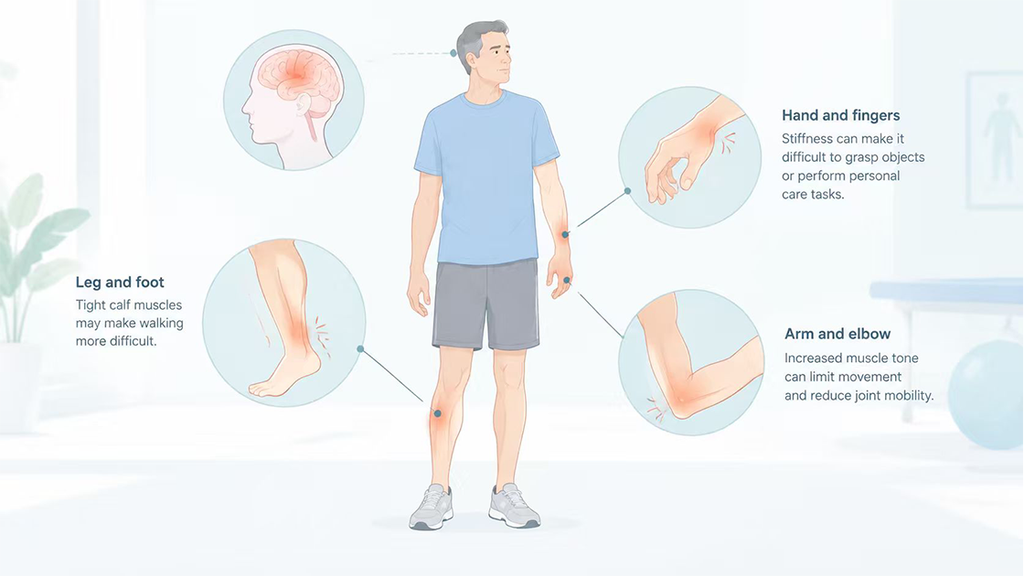
Stroke can affect the brain’s ability to control movement, sometimes leading to post-stroke spasticity. This condition causes certain muscles to become unusually stiff, making everyday activities more difficult. It may affect the arms, hands, legs, or feet and interfere with walking, dressing, and reaching.
Extracorporeal shockwave therapy (ESWT) has attracted research interest as a non-invasive approach to managing post-stroke spasticity. Studies have explored its potential to reduce muscle tone and improve joint mobility. However, the evidence remains limited, and ESWT should be considered a possible addition to individualized rehabilitation rather than a replacement for established care.
1. Understanding Post-Stroke Spasticity
1.1 What Causes Post-Stroke Spasticity?
Post-stroke spasticity is a motor disorder associated with damage to the central nervous system. It involves increased resistance to muscle stretching, particularly when a joint is moved quickly.
This condition develops when a stroke disrupts the neural pathways responsible for regulating muscle activity. As a result, some muscles may become overactive and remain stiff during movement.
1.2 How Does Spasticity Affect Daily Activities?
Spasticity can affect different parts of the body. Tight calf muscles may make walking more difficult, while stiffness in the wrist and fingers can interfere with grasping objects or performing personal care tasks.
Persistent muscle stiffness may also contribute to pain, reduced joint mobility, and contractures. Early assessment helps rehabilitation professionals identify these limitations and develop an appropriate management plan.
2. What Is Extracorporeal Shockwave Therapy?
2.1 How Does ESWT Work?
Extracorporeal shockwave therapy delivers acoustic pressure waves to selected tissues through an applicator placed on the skin. It is a non-invasive treatment that has been studied in musculoskeletal care and neurological rehabilitation.
Researchers are investigating whether shockwaves may influence muscle tone and tissue properties in people with neurological conditions. However, the exact mechanisms behind potential changes in post-stroke spasticity are not fully understood.
2.2 Focused and Radial Shockwave Therapy
Focused shockwave therapy concentrates energy at a selected depth, while radial pressure waves spread outward from the applicator. These approaches differ in energy distribution and treatment characteristics.
Both have been explored in clinical applications, but their parameters and results should not be treated as interchangeable. The choice of treatment approach requires professional assessment and consideration of the available evidence.
3. Research on Shockwave Therapy for Post-Stroke Spasticity
3.1 Findings From Clinical Studies
Clinical studies have reported promising findings for ESWT in post-stroke spasticity management. Some systematic reviews have found reductions in muscle tone and improvements in joint range of motion following treatment.
Other research has explored changes in pain and motor function. However, the results vary across studies, partly because of differences in treatment protocols, participant characteristics, and assessment methods.
3.2 Limitations of Current Evidence
Positive findings do not establish ESWT as a standard treatment for every stroke survivor. Some studies include relatively small participant groups, and treatment methods differ considerably.
Further high-quality research is needed to determine which patients may benefit most, which protocols are appropriate, and whether improvements in muscle tone lead to lasting gains in daily function.
4. Potential Effects on Muscle Tone and Mobility
4.1 Changes in Muscle Tone
One major research focus is whether ESWT can reduce resistance to muscle stretching. Researchers often use the Modified Ashworth Scale to assess resistance during passive movement.
A lower score may indicate reduced muscle tone, but it does not necessarily mean that voluntary movement or overall motor control has improved. Muscle tone is only one part of post-stroke recovery.
4.2 Joint Range of Motion
Spasticity can restrict movement around the ankle, wrist, elbow, and other joints. If muscle resistance decreases, passive movement may become easier and allow rehabilitation professionals to perform stretching or positioning exercises more effectively.
However, improvements in passive range of motion should be distinguished from gains in muscle strength, coordination, and active movement.
4.3 Functional Mobility and Daily Activities
Walking, maintaining balance, transferring between surfaces, and using the affected hand require more than reduced muscle stiffness. These activities also depend on strength, sensation, coordination, and motor control.
For this reason, rehabilitation outcomes should focus on practical goals. Changes in muscle tone are useful measurements, but they should be considered alongside improvements in movement and daily independence.
5. Integrating ESWT Into Stroke Rehabilitation
5.1 An Individualized Treatment Plan
Post-stroke spasticity management may involve physical therapy, occupational therapy, stretching, positioning, orthoses, medication, or botulinum toxin injections. The appropriate approach depends on the individual’s symptoms and functional goals.
If ESWT is considered, a rehabilitation professional should assess the affected muscles, joint mobility, skin condition, sensation, and relevant medical history. Treatment settings and target areas should be selected carefully.
5.2 Combining Treatment With Rehabilitation Exercises
ESWT should not be viewed as a standalone method for restoring movement. When appropriate, it may be incorporated into a broader rehabilitation program that includes active movement practice, gait training, stretching, and task-specific exercises.
Progress should be evaluated against the person’s functional goals. A reduction in stiffness is most useful when it supports meaningful activities, such as walking more safely or using the affected arm more effectively.
6. Safety and Important Considerations
6.1 Potential Side Effects and Precautions
ESWT is non-invasive, but treatment may cause temporary discomfort, localized redness, or small skin marks. Suitability depends on the patient’s condition, treatment area, and selected parameters.
Some stroke survivors have reduced sensation or difficulty communicating discomfort. These factors require careful assessment before treatment. Clinicians should also consider skin health, medical history, and device-specific precautions.
6.2 Understanding the Limits of Treatment
Current evidence does not establish ESWT as a universal treatment for post-stroke spasticity. Its potential benefits should be weighed against the uncertainty surrounding treatment protocols and long-term functional outcomes.
Patients should discuss this option with their rehabilitation team and should not replace prescribed treatments with shockwave therapy without professional guidance.
الخاتمة
Extracorporeal shockwave therapy is an area of growing interest in post-stroke spasticity research. Studies suggest that it may help reduce abnormal muscle tone and improve joint range of motion, although evidence for long-term functional benefits remains uncertain. Individualized rehabilitation remains essential for stroke survivors. When clinically appropriate, ESWT may be considered as an adjunct to established care, with progress assessed according to meaningful goals such as safer walking, improved hand use, and greater independence.
المراجع
- Effects of Extracorporeal Shock Wave Therapy on Spasticity in Post-Stroke Patients: A Systematic Review and Meta-Analysis of Randomized Controlled Trials
https://pubmed.ncbi.nlm.nih.gov/30264850
- Long-Term Effects of Extracorporeal Shock Wave Therapy on Poststroke Spasticity: A Meta-Analysis of Randomized Controlled Trials
https://pubmed.ncbi.nlm.nih.gov/31899073
- Long-Term Efficacy of Extracorporeal Shock Wave Therapy on Lower Limb Post-Stroke Spasticity: A Systematic Review and Meta-Analysis of Randomized Controlled Trials
https://pmc.ncbi.nlm.nih.gov/articles/PMC7795167
- Extracorporeal Shock Wave Therapy for Post-Stroke Spasticity: An Umbrella Review of Systematic Reviews and Meta-Analyses
https://pmc.ncbi.nlm.nih.gov/articles/PMC13135996
- VA/DoD Clinical Practice Guideline for the Management of Stroke Rehabilitation