

Introducción
Groin pain is a common musculoskeletal concern among soccer players, particularly those who frequently sprint, kick, accelerate, and change direction. One structure often involved in these movements is the adductor longus tendon, which connects the inner thigh muscle to the pubic region and helps control hip movement. Repetitive loading can place considerable stress on this tendon, potentially contributing to persistent pain and reduced athletic performance. For players dealing with ongoing adductor-related groin pain, shockwave therapy (Extracorporeal Shockwave Therapy, ESWT) has attracted attention as a non-invasive option that may support symptom management. By delivering acoustic pressure waves to targeted tissues, this technology is being investigated for its potential effects on pain-related mechanisms and tissue responses. Although research specifically involving adductor longus tendon injuries is still developing, emerging clinical findings have created interest in its possible role in sports medicine. Understanding how shockwave therapy works, what current research suggests, and where its limitations remain can help athletes and healthcare professionals make informed decisions.
1. Understanding Adductor Longus Tendon Injuries in Soccer Players
1.1 The Role of the Adductor Longus
The adductor longus is one of the major muscles on the inner thigh. It originates from the pubic bone and attaches to the femur, helping bring the leg toward the body’s midline. It also contributes to hip flexion and pelvic control during dynamic movements. Its tendon transfers force between the muscle and its bony attachment, making it important for activities that involve rapid leg movement and stabilization. In soccer, the adductor longus works repeatedly during kicking, sprinting, lateral movement, and changes of direction. High or repetitive loading may contribute to muscle strains or persistent tendon-related symptoms around the groin.
1.2 Why Soccer Players Are Vulnerable to Adductor Injuries
Soccer places substantial demands on the hip adductor muscle group. Powerful kicks require coordinated movement between the pelvis, hip, and thigh, while sudden changes of direction place additional demands on the muscles that stabilize the lower body. Sprinting, tackling, and rapid deceleration can also increase the forces experienced by the adductor longus. When training intensity rises quickly or recovery is insufficient, the tendon and surrounding tissues may struggle to tolerate repeated loading. These factors can contribute to acute muscle injuries or longer-lasting adductor-related groin pain.
1.3 Tendon-Related Pain and Muscle Strains
Adductor longus injuries can involve different parts of the muscle-tendon unit. An acute strain may affect muscle fibers or the muscle-tendon junction, often following a sudden forceful movement. Tendinopathy, by contrast, generally describes a persistent tendon-related condition associated with pain and changes in tendon structure or function. Some athletes may have overlapping muscle and tendon involvement. Distinguishing between these conditions matters because research on shockwave therapy for chronic tendinopathy cannot automatically be applied to every acute groin strain.
2. What Is Shockwave Therapy?
2.1 Understanding Extracorporeal Shockwave Therapy
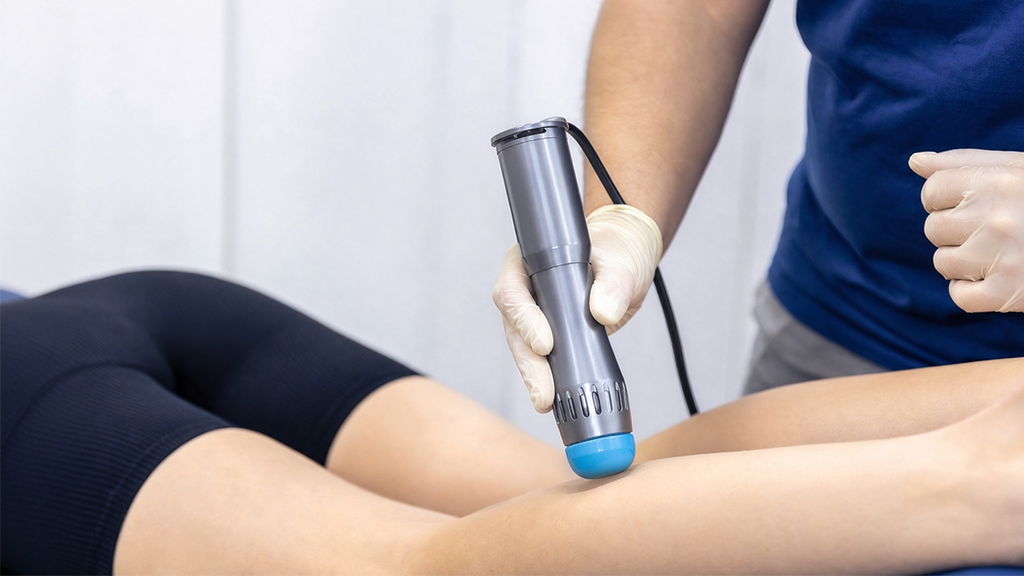
Extracorporeal Shockwave Therapy (ESWT) is a non-invasive technology that delivers acoustic pressure waves through a treatment applicator to a selected area of the body. These waves interact with biological tissues and may influence local cellular signaling, pain-related pathways, and tissue responses. Researchers have investigated ESWT in several musculoskeletal conditions, particularly chronic tendinopathies and persistent soft-tissue pain. However, its effects can vary according to the condition being treated, the type of shockwave technology, and individual patient characteristics. Shockwave therapy is not a universal solution for every tendon injury, and its clinical role should be considered in relation to a specific diagnosis.
2.2 How Shockwaves May Influence Tendon-Related Pain
The biological effects of shockwave therapy are still being studied. Proposed mechanisms include changes in local cellular activity, signaling processes involved in tissue remodeling, and the sensitivity of pain-related nerve pathways. Some research also suggests that mechanical stimulation may influence the biological environment around chronically irritated tendons. These possible effects help explain why ESWT has attracted interest in the management of persistent tendon-related pain. Nevertheless, proposed biological mechanisms should not be interpreted as proof that shockwave therapy repairs every damaged tendon or restores normal tissue structure. Pain relief, functional improvement, and measurable tissue changes are separate outcomes that require appropriate clinical evaluation.
2.3 Focused Shockwave and Radial Pressure Wave: Key Differences
Focused shockwave therapy and radial pressure wave therapy are related but distinct technologies. Focused systems concentrate acoustic energy at a selected depth within the body, whereas radial systems distribute pressure differently, with the highest pressure generally occurring near the applicator. These differences affect how energy is delivered to the targeted region. The distinction is important when reviewing clinical research because findings from focused shockwave studies cannot automatically be applied to radial pressure wave devices. For adductor longus tendon problems, the location of the affected tissue and the characteristics of the technology are relevant considerations for qualified healthcare professionals.
3. The Potential Role of Shockwave Therapy in Adductor Longus Tendon Injuries
3.1 A Non-Invasive Option for Persistent Groin Pain
Persistent adductor-related groin pain can interfere with training consistency, kicking ability, sprinting, and overall athletic performance. Shockwave therapy is being explored as a non-invasive option that may help manage symptoms in selected musculoskeletal conditions. For soccer players with ongoing tendon-related groin pain, it may be considered as one component of a broader clinical management approach following an appropriate assessment. Its potential value lies primarily in symptom management and its possible effects on pain-related and tissue-response mechanisms. It should not be presented as a guaranteed way to heal a tendon injury, eliminate the underlying condition, or ensure a rapid return to competition.
3.2 Potential Benefits for Athletic Function
Pain around the adductor longus can affect movements that are central to soccer performance. Players may experience discomfort when kicking, accelerating, sprinting, or moving laterally. If shockwave therapy helps reduce symptoms in an appropriate clinical context, it may indirectly support greater comfort during daily activities and sports-related movement. However, reduced pain does not necessarily mean that the tendon has fully recovered or can immediately tolerate high-intensity loading. Athletic function depends on several factors, including tissue capacity, muscle strength, movement coordination, and the athlete’s overall physical condition. Therefore, symptom improvement should be interpreted alongside functional assessment rather than treated as the sole indicator of recovery.
3.3 Shockwave Therapy as Part of a Broader Management Strategy
Adductor-related groin pain often involves more than one contributing factor. Training load, muscle capacity, movement mechanics, previous injuries, and other pelvic or hip conditions may all influence symptoms. For this reason, shockwave therapy should not be viewed as a stand-alone solution. When considered appropriate, it may form part of a broader management strategy guided by a qualified healthcare professional. Active rehabilitation and appropriate load management remain important considerations in the management of many adductor-related conditions. The role of shockwave therapy is better understood as a possible adjunct rather than a replacement for clinical assessment or other evidence-based care.
3.4 Which Adductor-Related Conditions Require Careful Assessment?
Not every case of groin pain is caused by adductor longus tendinopathy. Pain may arise from an acute muscle strain, tendon-related changes near the pubic attachment, pubic-related groin pain, hip joint conditions, or other structures around the pelvis. Some athletes may have more than one contributing condition. Because shockwave therapy is not appropriate for every source of groin pain, identifying the affected structure is an important first step. A professional assessment can help determine whether the symptoms are consistent with an adductor-related condition and whether ESWT is a reasonable option to consider.
4. Clinical Evidence on Shockwave Therapy for Groin Pain
4.1 Emerging Research in Soccer Players
A prospective study published in 2026 investigated focused shockwave therapy combined with a structured rehabilitation program in soccer players with groin pain syndrome. The study included 31 adult players and reported changes in pain and functional outcomes during the observation period. This research is relevant because it directly examines focused shockwave therapy in a soccer population rather than relying entirely on findings from unrelated tendon conditions. It provides an early indication that ESWT may deserve further investigation as part of a broader approach to managing groin pain in athletes.
4.2 What the Study Does and Does Not Prove
Despite its relevance, the 2026 study has important limitations. It was a prospective study without a separate control group receiving rehabilitation alone. As a result, researchers cannot attribute the observed improvements to focused shockwave therapy by itself. Rehabilitation, natural recovery, differences in individual responses, or other factors may also have influenced changes. The relatively small sample size further limits how broadly the findings can be applied. The study should therefore be considered preliminary evidence rather than definitive proof of effectiveness for adductor longus tendon injuries.
4.3 What Broader Tendon Research Tells Us
Shockwave therapy has been investigated in several chronic tendon conditions, including certain problems involving the heel, elbow, and shoulder. These studies provide useful background about the possible role of acoustic pressure waves in musculoskeletal care. However, evidence from one anatomical region does not automatically establish effectiveness in another. The adductor longus has specific biomechanical demands, and groin pain can involve several overlapping structures. Researchers need more research to determine which athletes may benefit, which types of adductor-related conditions are most suitable for investigation, and whether different shockwave technologies produce comparable outcomes.
4.4 Why More High-Quality Research Is Needed
Future studies should include larger groups of athletes, clearly defined diagnoses, and appropriate comparison groups. Researchers also need to distinguish between acute adductor strains, persistent adductor-related groin pain, and confirmed tendon disorders. This distinction would make it easier to understand which conditions may respond to shockwave therapy. Studies should also report meaningful outcomes such as pain, functional capacity, training participation, and return-to-sport measures. Comparisons between focused shockwave and radial pressure wave technologies would provide additional clarity, since clinicians should not assume the two approaches have identical effects.
5. Important Considerations When Evaluating Shockwave Therapy
5.1 Accurate Diagnosis Before Considering ESWT
A correct diagnosis is essential when evaluating shockwave therapy for groin pain. A healthcare professional may review the athlete’s injury history, assess tenderness around the adductor attachment, and examine hip movement and resisted muscle function. Imaging, such as musculoskeletal ultrasound or magnetic resonance imaging (MRI), may be considered when symptoms are persistent or the diagnosis remains unclear. These assessments can help distinguish adductor-related pain from other conditions involving the hip, pelvis, pubic region, or surrounding soft tissues. Without an accurate understanding of the pain source, it is difficult to determine whether shockwave therapy is relevant.
5.2 Individual Differences in Treatment Response
Athletes do not all respond to musculoskeletal interventions in the same way. The duration of symptoms, the type and severity of the injury, the location of the affected tissue, and other health factors may influence outcomes. The distinction between an acute muscle injury and a persistent tendon condition is particularly important. Research findings from one group of patients should not be treated as a guarantee for another. A qualified professional can consider the available evidence alongside the athlete’s clinical presentation when evaluating whether ESWT is appropriate.
5.3 Understanding the Limits of Shockwave Therapy
Shockwave therapy should not be described as a guaranteed tendon repair method or a substitute for comprehensive injury management. Although research has explored its potential effects on pain and tissue responses, the clinical evidence for adductor longus tendon injuries remains limited. A reduction in pain does not necessarily confirm that the underlying tissue has fully recovered. Athletes should also avoid using symptom improvement alone as a reason to return immediately to unrestricted training or competition. Decisions about sports participation should consider functional capacity and professional assessment.
5.4 The Importance of Evidence-Based Expectations
The growing interest in shockwave therapy reflects ongoing research into non-invasive approaches for musculoskeletal conditions. However, promising findings from early studies should be interpreted carefully. The 2026 prospective study in soccer players provides useful preliminary information, but it does not establish that focused shockwave therapy independently improves every type of groin pain. More controlled research is necessary before firm conclusions can be drawn. For now, clinicians should best view ESWT as a potential adjunct for selected cases rather than a proven stand-alone treatment for all adductor longus tendon injuries.
FAQ
1. Can shockwave therapy help with adductor longus tendon injuries?
Shockwave therapy is being investigated as a possible adjunct for persistent adductor-related groin pain. Early research in soccer players is encouraging enough to support further study, but evidence specific to adductor longus tendon injuries remains limited.
2. How does shockwave therapy work?
ESWT delivers acoustic pressure waves to a selected tissue area. Researchers are studying how this mechanical stimulation may influence local biological responses and pain-related mechanisms.
3. Is focused shockwave therapy the same as radial pressure wave therapy?
No. Focused shockwave systems concentrate energy at a selected depth, while radial pressure wave systems distribute pressure differently. Their research findings and clinical applications should not be treated as interchangeable.
4. Is shockwave therapy suitable for every type of groin pain?
No. Groin pain can originate from muscles, tendons, the pubic region, the hip joint, or other structures. An accurate diagnosis is important before considering ESWT.
5. Does shockwave therapy guarantee tendon healing?
No. It may help manage symptoms in selected musculoskeletal conditions, but current evidence does not establish that it guarantees structural tendon repair or complete recovery.
6. What does recent research say about shockwave therapy for soccer-related groin pain?
A 2026 prospective study involving 31 soccer players reported improvements during a program combining focused shockwave therapy with structured rehabilitation. However, the lack of a separate control group means the independent effect of shockwave therapy remains uncertain.
7. Can soccer players return to competition as soon as pain improves?
Not necessarily. Pain reduction does not automatically mean that the tendon and surrounding muscles can tolerate full sporting demands. Return-to-sport decisions should also consider functional ability and professional assessment.
Conclusión
Shockwave therapy is an emerging area of interest in the management of persistent musculoskeletal pain, including adductor-related groin problems in soccer players. By delivering acoustic pressure waves to targeted tissues, ESWT may influence pain-related mechanisms and local tissue responses, making it a potential adjunct for selected cases. Early research involving soccer players has reported improvements when focused shockwave therapy is combined with structured rehabilitation, but the available evidence remains preliminary. Researchers have not yet established the independent contribution of shockwave therapy, and findings from other tendon conditions should not be directly applied to every groin injury. Accurate diagnosis, an understanding of the difference between focused and radial technologies, and realistic expectations are essential when evaluating this approach. As further clinical research becomes available, the role of shockwave therapy in adductor longus tendon injuries may become clearer.
Referencias
- Integrating Focused Shockwave Therapy into Rehabilitation for Groin Pain Syndrome: A Prospective Study in Soccer Players. Life. 2026.
https://pmc.ncbi.nlm.nih.gov/articles/PMC13027506
- Current Clinical Concepts: Exercise and Load Management of Adductor Strains, Adductor Ruptures, and Long-Standing Adductor-Related Groin Pain. Journal of Athletic Training. 2023.
https://pmc.ncbi.nlm.nih.gov/articles/PMC10569248
- Athletes With Adductor-Related Groin Pain: A Narrative Review. Cureus. 2024.
https://pmc.ncbi.nlm.nih.gov/articles/PMC11451080
- Doha Agreement Meeting on Terminology and Definitions in Groin Pain in Athletes. British Journal of Sports Medicine. 2015.
https://bjsm.bmj.com/content/49/12/768
- Study Quality on Groin Injury Management Remains Low: A Systematic Review on Treatment of Groin Pain in Athletes. British Journal of Sports Medicine. 2015.