

Introducción
New mothers spend countless hours holding, feeding, and soothing their babies. Over time, repetitive thumb and wrist movements can lead to a painful condition called De Quervain’s tenosynovitis, often known as “mommy wrist.” Many mothers find that simple actions like lifting the baby, opening a jar, or turning a doorknob cause sharp pain along the thumb side of the wrist. For those seeking a non‑invasive, drug‑free option, modern Shockwave Therapy devices offer an effective solution worth understanding.
1. Understanding De Quervain’s Tenosynovitis
Parents need a clear picture of what De Quervain’s tenosynovitis means and why new mothers are particularly vulnerable. This section explains the condition, its causes, and why early recognition matters.
1.1 What Is De Quervain’s Tenosynovitis?
De Quervain’s tenosynovitis involves inflammation and thickening of the tendon sheath that surrounds two tendons on the thumb side of the wrist: the abductor pollicis longus and the extensor pollicis brevis. These tendons pass through a narrow tunnel called the first dorsal compartment. Repetitive friction causes the sheath to swell, narrowing the tunnel and making tendon movement painful. The condition usually develops gradually from repetitive thumb and wrist actions such as lifting a baby, scrolling on a smartphone, or knitting. The hallmark symptom is pain when turning the wrist, gripping objects, or making a fist.
1.2 Who Is Most at Risk?
New mothers represent the most common group affected by De Quervain’s tenosynovitis due to the repetitive lifting and holding of an infant. However, the condition also frequently appears in individuals who perform prolonged or repetitive wrist and thumb activities, including smartphone users, knitters, gardeners, and assembly line workers. Women experience this condition more often than men, likely due to hormonal changes during pregnancy and postpartum that affect connective tissue. The condition typically appears between the ages of thirty and fifty, though it can occur at any age. Recognizing these risk factors helps individuals take preventive steps early.
1.3 Why This Condition Deserves Attention
De Quervain’s tenosynovitis can significantly interfere with daily activities and childcare. Mothers with this condition may struggle to hold their baby, change diapers, or prepare bottles without experiencing sharp pain. Without proper management, the condition can become chronic, leading to persistent discomfort and even reduced hand function. Fortunately, most cases respond well to conservative approaches when addressed early. Understanding available treatment options empowers parents to seek timely care and avoid unnecessary suffering during an already demanding period of their lives.
2. Recognizing Symptoms and Getting a Diagnosis
Parents need to know what symptoms to look for and how healthcare providers confirm De Quervain’s tenosynovitis. This section describes the typical signs and the simple diagnostic test used in clinical settings.
2.1 Common Symptoms of De Quervain’s Tenosynovitis
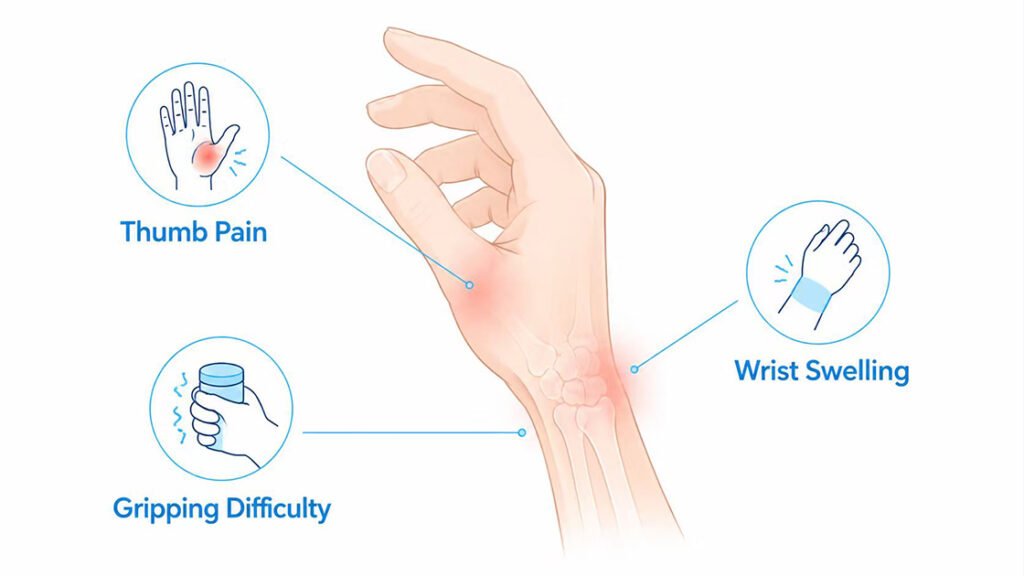
The most common symptom is pain along the thumb side of the wrist, which may appear gradually or suddenly. The pain often worsens with thumb and wrist movements such as grasping, pinching, twisting, or making a fist. Swelling may be visible near the base of the thumb, and some individuals report a feeling of “catching” or “snapping” when moving the thumb. The pain can radiate up the forearm or down to the thumb tip. Activities that typically aggravate symptoms include lifting objects, turning keys, opening jars, and, most importantly for new parents, picking up and holding a baby.
2.2 The Finkelstein Test for Diagnosis
Healthcare providers commonly use a simple physical exam maneuver called the Finkelstein test to diagnose De Quervain’s tenosynovitis. During this test, the patient makes a fist with the thumb tucked inside the fingers, then the provider gently bends the wrist downward toward the little finger side. Reproduction of pain along the thumb side of the wrist suggests a positive test. Providers may also ask about symptom history and examine for swelling or tenderness over the first dorsal compartment. Imaging studies are rarely necessary but can help rule out other conditions such as thumb artritis or wrist ganglion cysts.
3. Why New Mothers Are Particularly Vulnerable
New mothers face unique anatomical and physical demands that increase their risk for De Quervain’s tenosynovitis. Understanding these factors helps mothers recognize why they develop the condition and how to modify activities.
3.1 Hormonal Changes During Pregnancy and Postpartum
During pregnancy and the postpartum period, hormonal fluctuations cause ligaments and connective tissues throughout the body to become more lax. This natural adaptation prepares the pelvis for childbirth but also affects wrist and hand structures. The tendon sheaths in the wrist may become more susceptible to irritation and inflammation under repetitive stress. These hormonal effects can persist for several months after delivery, leaving new mothers vulnerable during the very period when they perform the most demanding repetitive wrist and thumb movements. This combination of biological and mechanical factors explains why De Quervain’s tenosynovitis disproportionately affects new mothers.
3.2 Repetitive Lifting and Holding of the Baby
Caring for an infant involves countless repetitive wrist and thumb movements. Lifting the baby from a crib, supporting the baby’s head during feeding, adjusting clothing, and holding the baby for extended periods all place stress on the thumb tendons and their sheaths. Many mothers instinctively use a wide, abducted thumb position to spread their hand for better support, which further irritates the affected tendons. Additionally, the baby’s weight steadily increases over the first few months, progressively loading the same structures without allowing adequate recovery time. This combination of repetition, awkward positioning, and increasing load creates the perfect environment for De Quervain’s tenosynovitis to develop.
4. How Shockwave Therapy Treats De Quervain’s Tenosynovitis
Shockwave Therapy delivers high‑energy acoustic waves to targeted soft tissues. This section explains the technology behind modern shockwave devices, how they work on tendon sheath conditions, and what new mothers can expect during treatment.
4.1 What Is Shockwave Therapy and How Does It Work?
Shockwave Therapy, also known as Extracorporeal Shockwave Therapy (ESWT), uses a handheld applicator to transmit acoustic pulses through the skin to the affected area. These pulses create mechanical forces that stimulate cellular repair processes. Modern shockwave machines offer two main types: radial (or ballistic) shockwaves that spread outwards over a wider area, and focused shockwaves that converge at a specific depth. For De Quervain’s tenosynovitis, which involves a superficial tendon sheath, radial shockwave devices are particularly suitable. The treatment requires no incisions, no needles, and no medication, making it a truly non‑invasive option.
4.2 The Biological Effects of Shockwaves on Tendon Sheaths
When acoustic waves penetrate the thickened tendon sheath, they create controlled microtrauma at the cellular level. This microtrauma triggers a natural healing cascade: the body releases growth factors, recruits repair cells, and increases blood flow to the area. Over several weeks, these biological processes remodel the sheath tissue, reducing its thickness and restoring its flexibility. As the sheath becomes less swollen, the underlying tendons glide more smoothly, and pain gradually diminishes. Additionally, shockwave pulses can influence pain signaling pathways, providing relief even before structural changes fully occur. This dual action on both tissue and pain makes shockwave therapy particularly effective for chronic tendon sheath conditions.
4.3 What Modern Shockwave Devices Offer for De Quervain’s Tenosynovitis
Contemporary shockwave machines, such as those available from specialized medical equipment suppliers, come with adjustable energy levels and interchangeable applicators. For De Quervain’s tenosynovitis, clinicians typically use a radial shockwave device with a small‑diameter applicator to precisely target the first dorsal compartment. Treatment parameters—including frequency, pressure, and number of pulses—can be tailored to the patient’s comfort and the condition’s severity. Many devices also feature intuitive interfaces that allow the practitioner to store protocols for common conditions. The portability of modern shockwave units means they can be used in various clinical settings, from physical therapy offices to chiropractic clinics, making access convenient for new mothers.
4.4 What New Mothers Should Expect During Treatment
A typical shockwave session for De Quervain’s tenosynovitis lasts about five to ten minutes. The patient sits comfortably while the clinician applies a coupling gel to the skin over the painful area, then moves the applicator in circular motions. Most mothers feel a tapping or tingling sensation, sometimes described as a repetitive pressure wave. Some discomfort may occur over the most tender spot, but this sensation stops immediately when the applicator moves away. No anesthesia is required, and there is no downtime after the session. The usual treatment protocol involves three to five sessions spaced one week apart. Many mothers notice improvement after the second or third session, although individual responses vary.
5. Why Choose Shockwave Therapy Over Other Conservative Options
Shockwave Therapy stands apart from rest, splinting, and steroid injections for several reasons. This section compares it with other common approaches and highlights its unique advantages for active new mothers.
5.1 How Shockwave Compares to Rest and Activity Modification
Resting the wrist and modifying activities represent the first line of conservative management for De Quervain’s tenosynovitis. While reducing repetitive thumb movements can help decrease inflammation, complete rest is rarely practical for a new mother who must care for her baby. Splints or braces may limit motion but cannot resolve the underlying tendon sheath thickening. Shockwave Therapy offers an active treatment that works while the mother continues her daily routine. The acoustic waves reach the affected sheath directly, promoting healing without requiring her to stop holding or lifting her baby.
5.2 How Shockwave Compares to Corticosteroid Injections
Corticosteroid injections are commonly used for De Quervain’s tenosynovitis and can provide rapid pain relief. However, injections carry risks of tendon rupture, skin atrophy, and recurrence of symptoms after the steroid effect wears off. Some mothers prefer to avoid needles or have concerns about steroid use during breastfeeding. Shockwave Therapy uses no needles and introduces no medication into the body. The treatment works by stimulating the body’s own repair mechanisms rather than masking pain with anti‑inflammatory drugs. For mothers who want a needle‑free, drug‑free option, shockwave provides an appealing alternative.
5.3 Long‑Term Benefits of Shockwave for Tendon Health
Unlike treatments that only address symptoms temporarily, Shockwave Therapy aims to restore normal tendon sheath structure. The remodeling effect induced by acoustic waves can lead to lasting improvement, reducing the likelihood of symptom recurrence. Many mothers who complete a full course of shockwave treatment remain pain‑free for months or years afterward. Additionally, the treatment can be repeated if symptoms return, with no cumulative risks or side effects. For a condition that often affects both wrists sequentially or simultaneously, shockwave offers a safe, repeatable solution that respects the body’s natural healing capacity.
FAQ
Q1: Can I continue breastfeeding while receiving Shockwave Therapy?
Yes. Shockwave Therapy uses only acoustic energy and does not introduce any medication into your body. It is completely safe for nursing mothers.
Q2: How many shockwave sessions will I need for mommy wrist?
Most patients require three to five sessions, each about one week apart. Your provider will adjust the number based on your response.
Q3: Does shockwave treatment hurt?
You may feel some discomfort during the few minutes of treatment, especially over the tender area. The sensation stops immediately after the session ends.
Q4: When will I see results?
Some mothers notice pain reduction after the first or second session. Others may need all scheduled sessions before feeling significant relief.
Q5: Is Shockwave Therapy safe for new mothers who had a C‑section?
Yes. The treatment applies only to the wrist area and does not affect abdominal or pelvic regions. It poses no special risks following any type of delivery.
Conclusión
De Quervain’s tenosynovitis affects countless new mothers, turning everyday childcare tasks into painful challenges. While rest and activity modification remain important first steps, persistent symptoms often require additional support. Modern Shockwave Therapy devices deliver targeted acoustic energy to the thickened tendon sheath, stimulating the body’s own healing mechanisms without drugs or downtime. This non‑invasive, convenient treatment fits easily into a busy mother’s schedule. Understanding the condition, recognizing its symptoms, and knowing how shockwave technology works empowers mothers to seek timely care and return to enjoying time with their baby without wrist pain.
Referencias
Journal of Hand Surgery — De Quervain’s Tenosynovitis: Pathophysiology and Management
Mayo Clinic — De Quervain Tenosynovitis Overview
https://www.mayoclinic.org/diseases-conditions/de-quervains-tenosynovitis
Cleveland Clinic — Shockwave Therapy for Musculoskeletal Conditions
https://my.clevelandclinic.org/health/treatments/shockwave-therapy
American Academy of Orthopaedic Surgeons — De Quervain’s Tenosynovitis
https://orthoinfo.aaos.org/en/diseases–conditions/de-quervains-tenosynovitis
Harvard Health Publishing — Treating Wrist Pain in New Mothers