

Introducción
Pain around the kneecap can make everyday activities such as climbing stairs, squatting, running, and standing up from a chair unexpectedly difficult. One common cause is patellofemoral pain syndrome (PFPS), a condition involving pain around or behind the patella, where it meets the thigh bone. Although exercise-based rehabilitation remains the foundation of care, some patients and clinicians explore additional approaches to support symptom management. Shockwave Therapy is one technology receiving attention in musculoskeletal rehabilitation. Understanding how patellofemoral pain develops, how acoustic wave technology works, and where this treatment may fit into a broader rehabilitation plan can help patients make more informed decisions.
1. Understanding Patellofemoral Pain Syndrome
Patellofemoral pain syndrome describes pain around or behind the kneecap that often becomes more noticeable when the knee bends under load. It commonly affects active adults, recreational athletes, and people whose daily routines involve repeated stair climbing, squatting, or prolonged sitting. Symptoms can develop gradually and may persist when activity levels increase faster than the knee can tolerate.
1.1 What Is the Patellofemoral Joint?
The patellofemoral joint is formed by the patella, or kneecap, and the groove at the lower end of the femur. The patella moves along this groove as the knee bends and straightens. It also improves the mechanical efficiency of the quadriceps by increasing the leverage available during knee extension.
Healthy movement depends on coordinated activity from the quadriceps, hip muscles, and surrounding soft tissues. When the knee repeatedly handles loads that exceed its current capacity, the structures around the patellofemoral joint may become sensitive. This sensitivity can contribute to pain during everyday movements.
1.2 Common Symptoms and Triggers
People with patellofemoral pain often report discomfort around the front of the knee or behind the kneecap. Symptoms may increase during deep squats, lunges, stair climbing, running, jumping, or rising from a low chair.
Another common complaint is pain after sitting with the knees bent for an extended period. Some people describe this as a dull ache or pressure around the kneecap. However, swelling, locking, or a clear traumatic injury may suggest another condition and should receive appropriate clinical assessment.
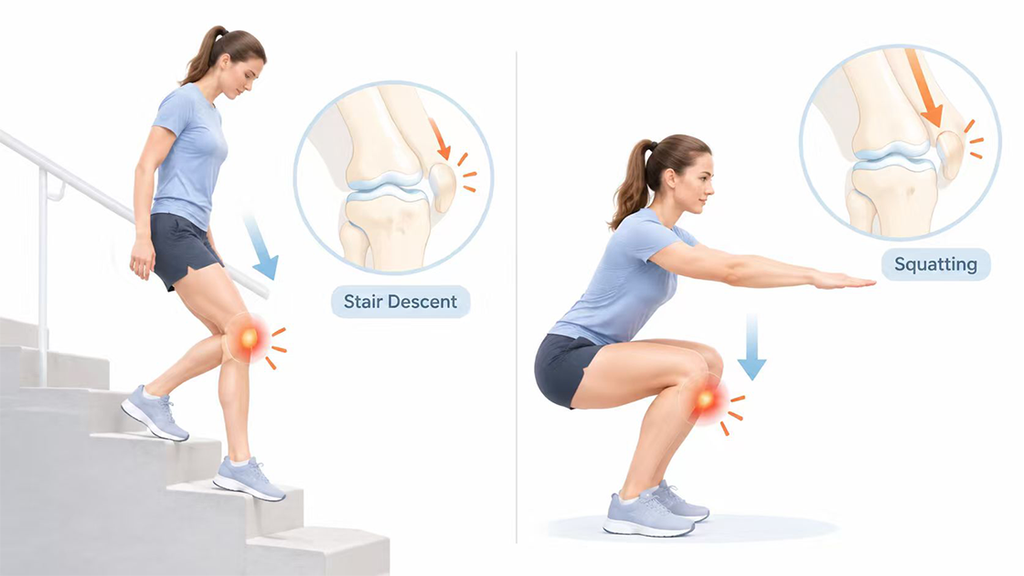
1.3 Why Stair Climbing and Squatting Can Hurt
Both stair climbing and squatting require the knee to bend while supporting body weight. As knee flexion increases, the patellofemoral joint experiences greater compressive loading. This does not automatically indicate damage, but an irritated or poorly conditioned knee may have difficulty tolerating repeated loading.
Stair descent can be particularly uncomfortable because the quadriceps must control the body’s downward movement. Squats also require coordinated hip and knee movement. If training volume increases too quickly or lower-limb strength is insufficient, symptoms may become more noticeable.
2. Factors That Contribute to Kneecap Pain
Patellofemoral pain rarely has one universal cause. Instead, several factors can interact, including training habits, muscle capacity, movement coordination, and individual anatomy. Identifying these factors helps clinicians develop a rehabilitation plan that addresses the patient’s actual limitations.
2.1 Sudden Changes in Physical Activity
A rapid increase in running distance, gym sessions, stair workouts, or sports participation can place more demand on the patellofemoral joint than the body is prepared to handle. Repeated loading without sufficient recovery may increase pain sensitivity.
For example, someone returning to exercise after several inactive months may begin performing deep squats or high-volume step exercises too soon. Gradually increasing training intensity and allowing adequate recovery can help improve load tolerance.
2.2 Hip and Quadriceps Muscle Function
The quadriceps control knee extension and help manage forces around the patella. Hip muscles, particularly the hip abductors and external rotators, contribute to lower-limb movement coordination during walking, running, and squatting.
Reduced strength or poor coordination in these muscle groups may affect how a person controls the knee during weight-bearing activities. Rehabilitation therefore often includes both hip-targeted and knee-targeted exercises rather than focusing exclusively on the kneecap.
2.3 Movement Mechanics and Foot Position
Some people demonstrate increased hip adduction, dynamic knee valgus, or changes in foot movement during squatting and landing. These movement patterns may influence how forces are distributed through the lower limb.
However, no single alignment pattern explains every case of patellofemoral pain. A clinician should evaluate the person’s symptoms, strength, mobility, and movement performance instead of assuming that one visible movement feature is the primary cause.
3. How Shockwave Therapy Works
Shockwave Therapy, also called extracorporeal shockwave therapy (ESWT), delivers acoustic energy through an applicator placed against the skin. The mechanical stimulus interacts with tissues and may influence cellular signaling and local biological responses. Its effects depend on the type of device, energy delivery, treatment location, and clinical condition.
3.1 Acoustic Waves and Tissue Stimulation
Shockwave devices generate acoustic pulses that travel through tissue. These mechanical pulses can produce controlled physical stimulation, which researchers have investigated for potential effects on cellular activity, tissue remodeling, and pain-related processes.
The response is not the same for every condition. Evidence supporting shockwave therapy for certain chronic tendon disorders cannot automatically be applied to patellofemoral pain syndrome. More condition-specific research is needed before its clinical benefits for PFPS can be established.
3.2 Radial and Focused Shockwave Technology
Radial and focused shockwave systems deliver acoustic energy differently. Radial pressure waves spread outward from the applicator and generally produce broader stimulation near the contact area. Focused systems concentrate acoustic energy toward a selected depth within the tissue.
The choice depends on the treatment objective, anatomical location, device design, and clinician assessment. These technologies should not be considered interchangeable, and their energy measurements are not directly comparable. A suitable approach requires an understanding of the target tissue and the characteristics of the selected device.
3.3 Adjustable Energy and Treatment Controls
Modern shockwave equipment may provide adjustable energy output, pulse frequency, and treatment controls. Some systems also use touchscreen interfaces to help clinicians select and monitor settings during a session.
For example, equipment with an adjustable output range can offer flexibility when treating different anatomical regions or when adapting stimulation to an individual’s tolerance. However, a higher energy setting does not automatically produce a better outcome. Device output values also should not be confused with energy flux density at the target tissue.
3.4 Applicator Design and Treatment Area
Different applicator shapes and contact surfaces can help clinicians adapt the treatment approach to the size and location of a target area. A broader contact surface may be useful when addressing a larger soft-tissue region, while a smaller contact area can support more localized application.
Ergonomic handpiece designs and accessible controls can also help clinicians maintain consistent contact and positioning. Nevertheless, the number or shape of applicator attachments does not establish clinical effectiveness for a particular diagnosis. Treatment selection must remain based on anatomy, clinical reasoning, and available evidence.
4. Exploring Shockwave Therapy in Patellofemoral Rehabilitation
The potential role of Shockwave Therapy in patellofemoral pain requires careful interpretation. Current clinical recommendations emphasize exercise therapy and patient education. Shockwave treatment should not replace these established rehabilitation components, and its direct benefit for PFPS has not been sufficiently established.
4.1 Understanding the Potential Role of Acoustic Stimulation
Some researchers investigate whether mechanical stimulation may influence pain-related responses and tissue activity in musculoskeletal conditions. These mechanisms have generated interest in acoustic wave applications beyond traditional tendon rehabilitation.
However, patellofemoral pain is a complex condition involving joint loading, movement coordination, and individual pain sensitivity. It is not simply a localized soft-tissue injury. Therefore, proposed effects of shockwave stimulation should be regarded as theoretical or under investigation rather than proven benefits for kneecap pain.
4.2 Individual Assessment Before Treatment
Before considering any additional modality, a healthcare professional should assess the location and behavior of the patient’s pain. The examination may include squatting, step-down testing, knee range of motion, patellar mobility, hip strength, and lower-limb movement coordination.
The clinician should also consider other possible causes of anterior knee pain, including patellar tendinopathy, cartilage-related conditions, and joint injuries. A clear clinical diagnosis helps prevent inappropriate treatment selection.
4.3 Choosing Device Settings and Treatment Areas
If a qualified clinician considers shockwave treatment within an individualized care plan, device selection and settings should reflect the treatment objective and the patient’s presentation. Energy output, pulse frequency, applicator design, treatment area, and patient tolerance all require consideration.
There is currently no universally established shockwave protocol for patellofemoral pain syndrome. Clinicians should avoid applying protocols developed for unrelated tendon conditions without supporting evidence. Treatment response should also be monitored rather than assuming that a particular number of pulses or energy setting will produce a predictable result.
5. Combining Rehabilitation With Long-Term Knee Care
Active rehabilitation remains the most important part of managing patellofemoral pain. A well-designed program gradually improves strength, movement control, and tolerance for daily activities. Additional treatments should support these goals rather than distract from them.
5.1 Knee- and Hip-Targeted Exercise
Quadriceps strengthening helps improve the knee’s capacity to manage weight-bearing activities. Depending on the patient’s symptoms, exercises may begin with controlled knee extensions, supported squats, or other tolerable movements.
Hip strengthening can complement knee exercises by improving lower-limb control. Exercises may include hip abduction, external rotation, bridges, and controlled single-leg movements. A physical therapist can adjust resistance, range of motion, and repetitions as the patient’s tolerance improves.
5.2 Gradual Return to Stairs and Squatting
Returning to demanding movements should involve gradual increases in activity. Patients may initially use a smaller squat depth, lower step height, or reduced training volume. As symptoms and strength improve, the program can progress toward deeper squats, repeated stair climbing, and more demanding functional movements.
Pain response during and after exercise can help guide progression. Persistent worsening symptoms suggest that the current workload may need adjustment.
5.3 Activity Modification and Movement Awareness
Temporary changes to training volume can reduce excessive loading while maintaining appropriate physical activity. Patients may benefit from avoiding sudden increases in running distance, repeated deep squats, or high-volume jumping during periods of symptom aggravation.
Movement retraining can also help address individual movement limitations. The goal is not to force every person into one ideal knee position, but to improve comfortable and controlled movement during the activities that matter to them.
6. Diagnosis, Safety, and Treatment Expectations
Accurate diagnosis and realistic expectations are essential when considering any intervention for anterior knee pain. Patellofemoral pain can resemble other knee conditions, and treatment decisions should follow a comprehensive assessment.
6.1 When to Seek Professional Evaluation
Persistent pain around the kneecap, difficulty using stairs, or reduced exercise tolerance may justify an assessment by a qualified healthcare professional. A clinician can determine whether symptoms are consistent with PFPS or indicate another knee condition.
Sudden severe pain, significant swelling, inability to bear weight, knee locking, or symptoms following major trauma require prompt medical evaluation. Imaging may be appropriate when the clinical examination suggests an alternative diagnosis or structural injury.
6.2 Safety Considerations for Shockwave Therapy
Shockwave treatment requires appropriate screening and professional administration. Clinicians should review relevant medical history, treatment location, skin condition, and potential contraindications before proceeding.
Treatment should not be applied automatically over sensitive structures or areas where acoustic stimulation may be inappropriate. Temporary soreness, redness, or localized discomfort can occur. Patients should receive clear information about possible reactions and follow-up arrangements.
6.3 Setting Realistic Expectations
Patellofemoral pain often improves through consistent exercise, appropriate load management, and gradual restoration of activity. Progress may take time, particularly when symptoms have persisted for several months.
Shockwave Therapy should not be presented as a guaranteed solution for kneecap pain or as a way to correct patellar tracking. Its role in PFPS remains uncertain, and patients should prioritize treatments supported by current clinical recommendations.
FAQ
1. What is patellofemoral pain syndrome?
Patellofemoral pain syndrome causes pain around or behind the kneecap. Symptoms often increase during squatting, stair climbing, running, or prolonged sitting with bent knees.
2. Why does my kneecap hurt when I climb stairs?
Stair climbing increases the demand on the quadriceps and patellofemoral joint. If the knee is sensitive to repeated loading, this activity may trigger pain around the kneecap.
3. Can Shockwave Therapy treat patellofemoral pain syndrome?
Its direct effectiveness for PFPS has not been firmly established. Shockwave Therapy remains an area of investigation and should not replace exercise-based rehabilitation.
4. What is the difference between radial and focused shockwave therapy?
Radial waves spread outward from the applicator, while focused waves concentrate energy at a selected depth. Their suitability depends on the treatment target and clinical assessment.
5. What exercises may help with patellofemoral pain?
Quadriceps strengthening, hip strengthening, and controlled functional exercises are commonly included in rehabilitation. A clinician can adjust exercise intensity to match individual symptoms and ability.
6. Should I stop squatting if my knee hurts?
Not necessarily. Reducing squat depth, resistance, or repetitions may help manage symptoms while maintaining activity. Persistent or worsening pain should be assessed by a healthcare professional.
7. How long does patellofemoral pain take to improve?
Recovery varies according to symptom duration, activity demands, and rehabilitation consistency. Some people improve over several weeks, while persistent cases may require a longer and more individualized program.
8. Is Shockwave Therapy a replacement for physical therapy?
No. Exercise therapy and education remain central to patellofemoral pain management. Shockwave Therapy should not replace strengthening, movement training, or appropriate activity modification.
Conclusión
Patellofemoral pain syndrome can interfere with everyday movements, especially stair climbing, squatting, and other activities that load the knee in a bent position. Understanding the patellofemoral joint, managing training demands, and improving hip and quadriceps function are important parts of long-term rehabilitation. Shockwave Therapy offers an established acoustic stimulation technology in several musculoskeletal treatment settings, but its specific effectiveness for patellofemoral pain remains uncertain. When clinicians consider this technology, they should use careful assessment, appropriate device settings, and realistic treatment expectations while keeping exercise-based rehabilitation at the center of care.
Referencias
- Best Practice Guide for Patellofemoral Pain Based on Synthesis of a Systematic Review, the Patient Voice and Expert Clinical Reasoning – British Journal of Sports Medicine
https://pubmed.ncbi.nlm.nih.gov/39401870/ - Patellofemoral Pain: Clinical Practice Guidelines Linked to the International Classification of Functioning, Disability and Health – Journal of Orthopaedic & Sports Physical Therapy
https://pubmed.ncbi.nlm.nih.gov/31475628/ - Dutch Multidisciplinary Guideline on Anterior Knee Pain: Patellofemoral Pain and Patellar Tendinopathy
https://pmc.ncbi.nlm.nih.gov/articles/PMC11792096/ - What Is Shockwave Therapy? – Shockwave Therapy Technology and Applications
https://www.shockwavemachines.com/what-is-shockwave-therapy - Terapia con ondas de choque radiales frente a focalizadas: ¿Cuál es la diferencia?
https://www.shockwavemachines.com/radial-vs-focused-shockwave-therapy-whats-the-difference.html