

Introducción
Fracture recovery in animals is a complex biological process that requires not only bone stabilization but also efficient management of surrounding soft tissue inflammation, circulation, and functional mobility restoration. In modern veterinary rehabilitation, Shockwave Therapy has gained attention as a non-invasive modality that supports the physiological environment needed for bone healing. By delivering acoustic pressure waves into affected tissues, this technology is increasingly being incorporated into post-fracture care protocols to complement traditional orthopedic management and rehabilitation strategies.
1. Understanding Post-Fracture Recovery Challenges in Veterinary Patients
1.1 Biological Complexity of Bone Healing in Animals
Bone healing is not a single event but a multi-phase biological cascade involving inflammation, repair, and remodeling. In veterinary patients, especially dogs and horses, this process can be influenced by age, metabolic health, fracture severity, and immobilization duration. During the inflammatory phase, local edema and reduced microcirculation can slow cellular activity, while the repair phase depends heavily on osteoblast function and collagen matrix formation. Any disruption in these stages may lead to delayed union or incomplete functional recovery. Veterinary rehabilitation aims to support these phases by optimizing the tissue environment surrounding the fracture site rather than directly altering bone structure itself.
1.2 Limitations of Conventional Post-Fracture Management
Traditional fracture management in veterinary medicine primarily relies on immobilization through external fixation, internal fixation, or casting. While these approaches ensure structural stability, they may also lead to secondary complications such as muscle atrophy, joint stiffness, and reduced local circulation. Prolonged inactivity can negatively affect surrounding soft tissues, slowing overall functional recovery even after bone union occurs. In many cases, rehabilitation professionals focus on restoring mobility and improving soft tissue quality once the primary orthopedic stabilization phase is complete. This creates a clinical need for supportive modalities that can enhance recovery without interfering with mechanical bone healing.
2. Role of Terapia de ondas de choque in Post-Fracture Rehabilitation
2.1 Mechanism of Acoustic Wave Interaction with Healing Tissue
Shockwave Therapy works through the delivery of high-energy acoustic pulses that propagate through soft tissues, stimulating cellular activity and promoting microcirculation. In a post-fracture environment, these mechanical waves influence biological processes such as angiogenesis, fibroblast activation, and local metabolic exchange. This type of mechanotransduction encourages a more active healing environment in surrounding tissues, which indirectly supports bone regeneration by improving oxygen and nutrient delivery. Unlike invasive interventions, Shockwave Therapy does not disrupt fixation hardware or fracture stability, making it a suitable adjunct in controlled rehabilitation settings.
2.2 Supporting the Biological Environment of Bone Regeneration
While Shockwave Therapy does not directly “set” or mechanically heal bone, it plays a supportive role in optimizing the conditions necessary for regeneration. Enhanced vascular activity improves perfusion in peri-fracture tissues, which is critical during the remodeling phase of healing. Additionally, improved soft tissue elasticity and reduced adhesions can help restore normal biomechanical loading patterns once controlled movement is reintroduced. This creates a more favorable environment for progressive weight-bearing and functional recovery. Veterinary rehabilitation specialists often integrate shockwave sessions into structured recovery plans to complement physical therapy and controlled exercise protocols.
3. Clinical Applications in Veterinary Rehabilitation Settings
3.1 Integration into Post-Operative Orthopedic Care
In post-operative fracture cases, Shockwave Therapy is typically introduced after the initial stabilization phase when tissue integrity allows for adjunctive rehabilitation. It is commonly incorporated alongside controlled mobilization exercises, hydrotherapy, and manual therapy techniques. Within this context, shockwave sessions are used to address surrounding muscle tightness, fascial restrictions, and localized circulation deficits. The goal is not to replace surgical or orthopedic intervention but to enhance the overall rehabilitation environment. Veterinary teams often structure treatment plans in phases, gradually increasing functional loading while maintaining fracture protection.
3.2 Application in Delayed Healing and Functional Recovery Cases
In cases where fracture healing appears delayed or where patients exhibit prolonged functional impairment, Shockwave Therapy may be used as part of a broader rehabilitation strategy. These cases often involve secondary complications such as muscle stiffness, reduced range of motion, and compensatory gait patterns. By improving soft tissue flexibility and stimulating local biological activity, shockwave treatment supports the transition from immobilization to active rehabilitation. This is particularly relevant in larger animals or highly active breeds where early return to function is clinically important.
4. Species-Specific Considerations in Shockwave-Assisted Recovery
4.1 Canine Fracture Rehabilitation Dynamics
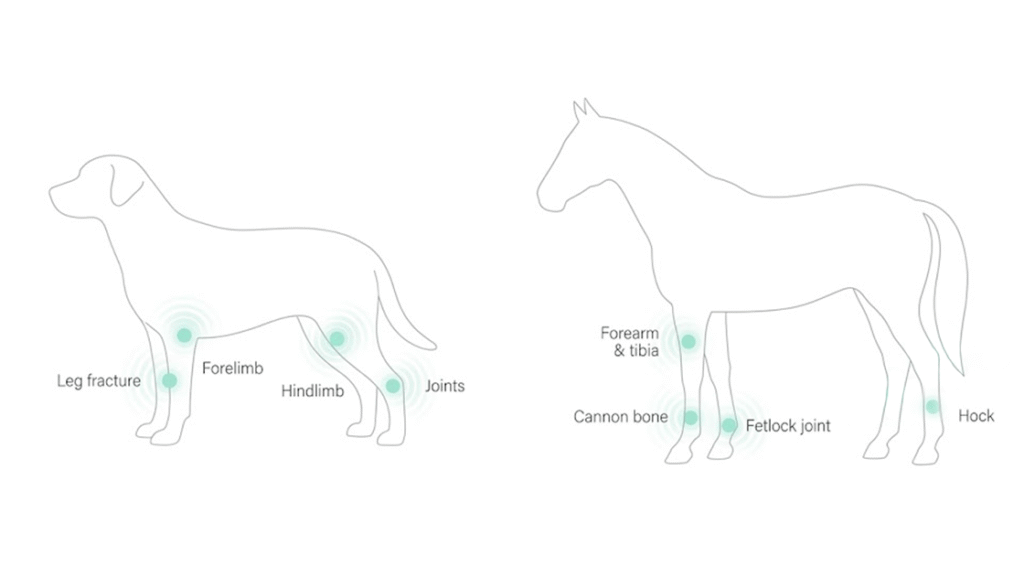
Dogs represent one of the most common patient groups in veterinary rehabilitation following fractures. Depending on breed size and activity level, recovery demands can vary significantly. Smaller breeds may experience faster bone union but still face soft tissue stiffness, while larger breeds may require extended support due to mechanical load demands. Shockwave Therapy is often integrated to address these secondary recovery challenges by improving soft tissue compliance and supporting gradual return to mobility. Its adaptability makes it suitable for a wide range of fracture locations, including long bones and joint-adjacent injuries.
4.2 Equine Applications in High-Load Skeletal Recovery
In equine patients, fracture rehabilitation presents a unique challenge due to high biomechanical stress and limited tolerance for prolonged immobilization. The large musculoskeletal structure requires careful management of both bone healing and surrounding tissue adaptation. Shockwave Therapy is often used as part of a controlled rehabilitation program to support soft tissue health during staged reloading phases. By enhancing circulation and tissue responsiveness, it contributes to maintaining functional integrity during recovery. This is particularly valuable in performance animals where return to activity is a critical outcome.
5. Expanding the Role of Shockwave Therapy in Veterinary Rehabilitation
5.1 Positioning Within Multimodal Rehabilitation Protocols
Modern veterinary rehabilitation rarely relies on a single modality. Instead, it incorporates a combination of manual therapy, controlled exercise, hydrotherapy, and energy-based devices. Shockwave Therapy fits into this multimodal framework as a biological stimulus that enhances tissue responsiveness. Its non-invasive nature allows it to be integrated without interfering with other treatment components. As rehabilitation protocols become more structured and outcome-driven, shockwave technology continues to gain relevance as a supportive tool in complex recovery cases.
5.2 Future Direction in Post-Fracture Recovery Support
As veterinary rehabilitation continues to evolve, there is growing emphasis on technologies that improve recovery efficiency while maintaining patient safety. Shockwave Therapy is increasingly viewed as part of this evolution, particularly in post-fracture management where soft tissue health plays a crucial role in overall functional outcomes. Continued integration into clinical protocols reflects a broader shift toward biologically supportive, non-invasive rehabilitation strategies that enhance recovery environments rather than replace traditional orthopedic care.
FAQ
What is Shockwave Therapy used for in fracture recovery?
It is used as a supportive modality to improve soft tissue environment and circulation around healing fractures.
Can Shockwave Therapy directly heal bones?
No, it does not directly heal bone but supports the biological conditions needed for bone regeneration.
When can Shockwave Therapy be used after a fracture?
It is typically introduced after initial stabilization when tissues are safe for adjunctive rehabilitation.
Is Shockwave Therapy suitable for all animal species?
It is commonly used in dogs and horses, but protocols vary depending on species and clinical condition.
Does it replace surgery or fixation methods?
No, it is an adjunct therapy used alongside orthopedic management, not a replacement.
Conclusión
Shockwave Therapy has become an increasingly valuable tool in veterinary rehabilitation for post-fracture recovery support. While it does not directly replace orthopedic stabilization methods, it plays a significant role in enhancing the biological and mechanical environment surrounding healing bone. By improving circulation, supporting soft tissue function, and integrating seamlessly into multimodal rehabilitation protocols, it contributes to more comprehensive recovery strategies in both small and large animal patients.
Referencias
American College of Veterinary Surgeons (ACVS) – Fracture Management in Small Animals
https://www.acvs.org/small-animal/fracture-repair
World Small Animal Veterinary Association (WSAVA) – Musculoskeletal Disorders Overview
https://wsava.org/global-guidelines/musculoskeletal-disease
American Veterinary Medical Association (AVMA) – Rehabilitation and Physical Therapy in Veterinary Medicine
https://www.avma.org/resources-tools/animal-health-and-welfare/rehabilitation-physical-therapy
International Society of Veterinary Rehabilitation (ISVR) – Veterinary Rehabilitation Principles
https://www.isvr.org
National Center for Biotechnology Information (NCBI) – Bone Healing and Mechanotransduction Research
https://www.ncbi.nlm.nih.gov/pmc/articles/PMC
Frontiers in Veterinary Science – Advances in Veterinary Orthopedic Rehabilitation
https://www.frontiersin.org/journals/veterinary-science