

Introduction
Ballroom dancing combines intricate footwork, rapid changes in direction, repeated pivots, and sustained balance, placing considerable demands on the ankle and foot. Over time, these movements may contribute to irritation of the peroneal tendons, which help stabilize the ankle and control foot movement. Chronic peroneal tendinopathy can cause persistent pain along the outer ankle, making turns, lateral steps, and weight transfers increasingly uncomfortable. Understanding the condition is important for dancers, coaches, and rehabilitation professionals who want to support comfortable movement while reducing unnecessary strain. Extracorporeal shockwave therapy and low-level laser therapy are among the modalities clinicians may consider as part of a broader, individualized care plan. Neither modality guarantees recovery, and their potential role depends on an accurate diagnosis, symptom severity, and the dancer’s overall functional needs.
1. Why Ballroom Dancers Are Vulnerable to Peroneal Tendinopathy
Ballroom dance requires the feet and ankles to respond continuously to changes in rhythm, direction, posture, and body weight. Although these demands help develop coordination and control, repeated loading can irritate the structures responsible for lateral ankle stability.
1.1 Understanding the Peroneal Tendons and Their Function
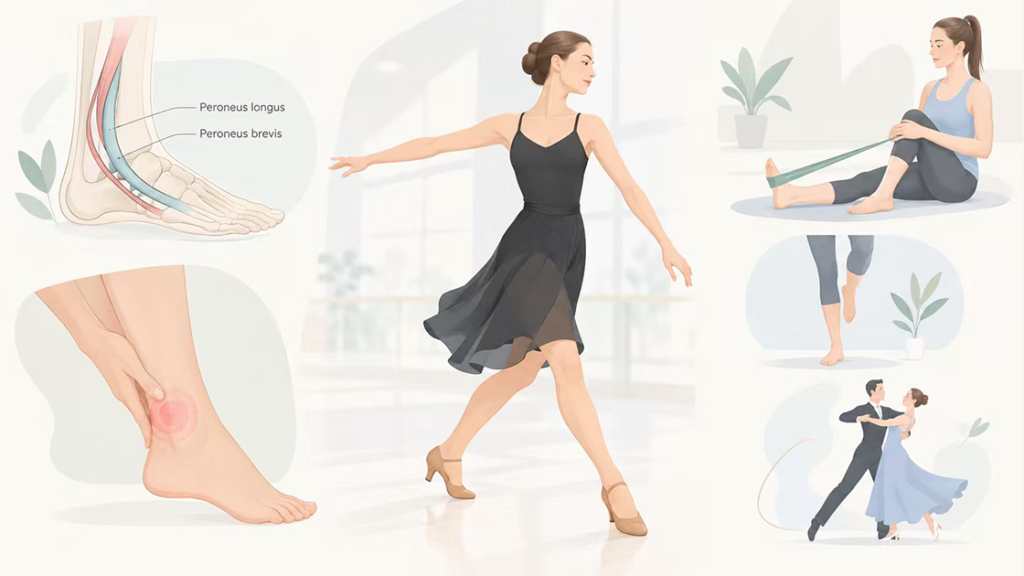
The peroneus longus and peroneus brevis, also known as the fibularis longus and fibularis brevis, run along the outer side of the lower leg and pass behind the lateral malleolus. They contribute to foot eversion, assist with plantar flexion, and help stabilize the ankle during dynamic movement. The peroneus brevis attaches near the base of the fifth metatarsal, while the peroneus longus continues beneath the foot toward the first metatarsal and medial cuneiform.
These tendons work with the surrounding muscles, ligaments, and sensory feedback systems to maintain control during standing, walking, and dancing. When repeated mechanical stress exceeds the tissues’ capacity to adapt, tendon pain and impaired function may develop.
1.2 How Dance Movements Increase Lateral Ankle Stress
Ballroom dancers repeatedly perform turns, side steps, directional transitions, and movements that require precise foot placement. These actions can increase the demand on the peroneal tendons, particularly when dancers practice for long periods without sufficient recovery.
Footwear, dance-floor friction, sudden changes in training intensity, and previous ankle sprains may also influence symptoms. A dancer who repeatedly loads one side of the body or struggles with ankle control may place additional stress on the lateral ankle structures. However, peroneal tendinopathy rarely has one universal cause; individual anatomy, training habits, and previous injuries all matter.
1.3 Recognizing Symptoms That Affect Dance Performance
Peroneal tendinopathy may cause tenderness behind or below the outer ankle bone, discomfort along the outer foot, or pain during resisted eversion. Some dancers notice stiffness after rest, increased discomfort following rehearsals, or difficulty maintaining balance during turns.
Symptoms can overlap with lateral ankle ligament injuries, tendon tears, tendon instability, and other foot or ankle conditions. Swelling, snapping sensations, or recurrent ankle giving-way deserve particular attention. A qualified healthcare professional can assess these findings and determine whether imaging, such as ultrasound or magnetic resonance imaging (MRI), is appropriate.
2. Understanding Chronic Peroneal Tendinopathy and Its Clinical Impact
Persistent tendon symptoms can affect more than comfort. They may change movement patterns, reduce confidence, and limit a dancer’s ability to perform technical sequences consistently. Understanding the underlying condition helps clarify why symptom management should account for both tissue health and movement function.
2.1 Tendinopathy Is More Than Simple Inflammation
Tendinopathy describes a clinical condition involving tendon pain and impaired function. In persistent cases, tendon structure may show changes in collagen organization, extracellular matrix composition, and the tissue’s response to mechanical loading. These changes do not occur identically in every person, and imaging findings do not always correspond directly to symptom severity.
Although inflammation can contribute to some tendon conditions, chronic tendinopathy should not automatically be described as a purely inflammatory disorder. This distinction matters because appropriate care depends on the clinical presentation rather than on a single assumed mechanism.
2.2 Why Persistent Symptoms Can Change Movement Patterns
When ankle pain develops, dancers may unconsciously shorten their steps, avoid certain turns, shift weight toward the opposite leg, or reduce movement speed. These compensations can temporarily make movement feel more manageable, but they may also alter coordination and distribute loading differently across the lower limbs.
Persistent symptoms can also affect proprioception—the body’s ability to sense joint position and movement. Because ballroom dancing depends on precise balance and timing, reduced ankle confidence may interfere with transitions and partner coordination. Assessing functional limitations alongside pain provides a more complete picture of a dancer’s needs.
2.3 Why Accurate Assessment Matters Before Selecting a Modality
Lateral ankle pain does not confirm peroneal tendinopathy by itself. A clinical assessment may include symptom history, palpation, ankle range of motion, resisted muscle testing, balance assessment, and evaluation of previous sprains or instability. A clinician may request diagnostic imaging when the examination suggests a tear, tendon subluxation, or another condition.
This assessment also helps determine whether an energy-based modality is suitable. Shockwave therapy and laser therapy do not address every cause of ankle pain, and neither should replace evaluation of a significant structural injury.
3. Shockwave Therapy and Laser Therapy in the Context of Tendon Care
Energy-based modalities may form one part of a clinician-directed plan for selected musculoskeletal conditions. Their mechanisms differ, and evidence from one tendon or anatomical region cannot automatically establish effectiveness for another. For peroneal tendinopathy, expectations should remain measured and should reflect the available condition-specific evidence.
3.1 How Extracorporeal Shockwave Therapy Works
Extracorporeal shockwave therapy (ESWT) delivers acoustic energy to a targeted area through an applicator placed against the skin. Depending on the technology, treatment may use focused shockwaves or radial pressure waves; these approaches differ in how they distribute energy through tissue.
Researchers have proposed several biological mechanisms, including changes in local mechanotransduction, pain signaling, and tissue responses. However, these proposed mechanisms do not mean that shockwave therapy will produce the same outcome in every patient. Evidence varies across tendon disorders, treatment protocols, and study populations. For chronic peroneal tendinopathy specifically, the evidence base remains limited, so clinicians should avoid presenting the modality as a guaranteed solution.
3.2 The Potential Role of Low-Level Laser Therapy
Low-level laser therapy (LLLT), also described as photobiomodulation therapy, uses non-thermal or minimally thermal light at selected wavelengths and doses. The light interacts with cellular photoreceptors and may influence signaling pathways associated with cellular activity, oxidative balance, and pain modulation.
Clinical outcomes depend on factors such as wavelength, irradiance, energy density, application site, and treatment schedule. Evidence for photobiomodulation varies by musculoskeletal condition, and findings from other tendinopathies cannot be assumed to apply directly to peroneal tendon problems. Clinicians may consider laser therapy as a supportive option when appropriate, but it should not be described as repairing every tendon injury or eliminating the underlying cause of symptoms.
3.3 Understanding the Differences Between the Two Modalities
Shockwave therapy uses acoustic energy, whereas laser therapy uses optical energy. Their delivery methods and biological interactions differ, so they are not interchangeable treatments. The choice of modality depends on the diagnosis, the available evidence, individual tolerance, clinical judgment, and the broader goals of care.
Combining modalities does not automatically improve outcomes. A clinician should consider whether each intervention has a clear rationale and whether the overall plan supports meaningful improvements in pain, strength, balance, and dance-related function. Treatment selection should also account for contraindications and the possibility that another clinical approach may be more appropriate.
4. Factors That Influence Recovery and Return to Dance
Managing chronic tendon symptoms requires attention to the demands placed on the ankle as well as the dancer’s functional capacity. Energy-based modalities may provide symptom relief for some individuals, but long-term dance participation also depends on appropriate loading, physical conditioning, and movement control.
4.1 Training Load and Recovery Time
Repeated rehearsals, extended practice sessions, and sudden increases in dance intensity can exceed the tendon’s current load tolerance. Recovery needs vary according to symptom severity, conditioning, sleep, overall activity, and coexisting injuries.
Monitoring symptom changes during and after dancing can help clinicians and dancers understand how the ankle responds to activity. Persistent worsening, increasing swelling, or declining weight-bearing ability warrants reassessment rather than simply continuing the same training schedule.
4.2 Strength, Balance, and Ankle Control
The peroneal muscles work with the calf muscles, intrinsic foot muscles, and other lower-limb structures to support ankle control. Depending on the assessment, a rehabilitation plan may address eversion strength, calf capacity, single-leg balance, proprioception, and control during directional changes.
These physical qualities are relevant because ballroom dancers need to transfer weight smoothly and maintain stability while rotating or moving laterally. The appropriate exercise intensity should reflect current function and symptom response. Pain-free performance of a single exercise does not necessarily mean that the ankle is ready for prolonged or technically demanding dance sessions.
4.3 Footwear, Technique, and Individual Movement Patterns
Dance shoes influence foot positioning, contact with the floor, and the way forces pass through the ankle. Shoe fit, heel height, outsole characteristics, and floor conditions may affect comfort and stability, although no single footwear design suits every dancer.
Technique also matters. Excessive or poorly controlled foot rotation, abrupt transitions, and asymmetrical loading may increase demands on particular structures. A dance instructor, physical therapist, or other qualified professional may help identify modifiable movement patterns without assuming that technique alone caused the problem.
4.4 Measuring Progress Beyond Pain Relief
Pain is an important outcome, but it is not the only indicator of functional improvement. Clinicians may also monitor ankle strength, range of motion, balance, walking tolerance, response to repeated loading, and the ability to complete dance-specific movements.
A gradual return to full practice should reflect these findings rather than a fixed timeline. If symptoms remain unchanged or worsen despite appropriate care, reassessment can help identify an overlooked diagnosis, a structural problem, or a need to adjust the overall plan.
5. Safety, Evidence, and Realistic Expectations
A responsible approach to chronic peroneal tendinopathy places diagnosis and clinical judgment ahead of device selection. Shockwave therapy and laser therapy may have a role in selected circumstances, but their benefits and limitations should be explained clearly.
5.1 Evidence Limitations for Peroneal Tendon Conditions
Clinical guidance recognizes peroneal tendon disorders as a distinct group of conditions that may involve tendinopathy, tearing, or instability. However, evidence specific to chronic peroneal tendinopathy is less extensive than evidence for some more commonly studied tendon conditions.
Research on shockwave therapy or photobiomodulation for other disorders may help inform clinical discussion, but it cannot establish the same effects for ballroom dancers with peroneal tendon symptoms. A qualified clinician should consider the quality and relevance of the available evidence before recommending a particular modality.
5.2 Safety Considerations and Professional Supervision
Shockwave therapy can cause temporary discomfort, redness, tenderness, or bruising. Laser therapy also requires appropriate device settings and eye protection suited to the equipment and wavelength. Contraindications and precautions differ between modalities and depend on the person’s health status, treatment site, and equipment.
Sudden severe pain, an inability to bear weight, marked swelling, or a new snapping sensation should prompt timely medical assessment. Dancers should not use energy-based treatment as a substitute for evaluating a possible tendon tear, significant ankle sprain, or tendon instability.
5.3 Setting Practical Expectations for Dancers
The main goal of conservative care is to help manage symptoms and support a gradual return to meaningful activity. Some people may experience reduced discomfort, while others may need a different approach or further assessment. Outcomes depend on the underlying condition, symptom duration, treatment selection, and adherence to an appropriate rehabilitation plan.
No single modality can guarantee pain relief or restore full dance performance. Clinicians and dancers can make better-informed decisions by setting measurable goals, reviewing progress, and adjusting the plan according to functional changes rather than relying on promises of a specific result.
FAQ
What is peroneal tendinopathy?
It is a tendon condition involving pain and impaired function in the tendons that run along the outer ankle and help control foot movement.
Can shockwave therapy help chronic peroneal tendon pain?
It may be considered in selected cases, but condition-specific evidence remains limited. A clinician should first confirm the diagnosis and assess suitability.
How does laser therapy differ from shockwave therapy?
Laser therapy uses light energy, while shockwave therapy uses acoustic energy. Their mechanisms, protocols, and evidence differ.
Can dancers continue practicing with ankle pain?
That depends on symptom severity and the underlying diagnosis. Worsening pain, swelling, instability, or difficulty bearing weight requires professional assessment.
Does pain relief mean the tendon has fully recovered?
No. Pain is only one measure of progress. Strength, balance, load tolerance, and dance-specific function also matter.
When should a dancer seek medical evaluation?
Seek assessment for persistent or recurring lateral ankle pain, snapping, repeated instability, or symptoms that interfere with normal activity. Severe or sudden symptoms warrant prompt evaluation.
Conclusion
Chronic peroneal tendinopathy can make ballroom dancing more difficult by affecting lateral ankle comfort, balance, and movement control. Understanding tendon anatomy, recognizing contributing training demands, and obtaining an accurate clinical assessment can help dancers make informed decisions about their care. Shockwave therapy and low-level laser therapy may offer supportive symptom relief in selected circumstances, but the evidence for their use in peroneal tendinopathy remains limited and neither guarantees recovery. A well-considered care plan should reflect individual needs, appropriate professional guidance, and measurable improvements in everyday and dance-specific function.
Références
van Dijk PA, Miller D, Calder J, et al. The ESSKA-AFAS International Consensus Statement on Peroneal Tendon Pathologies.
https://doi.org/10.1007/s00167-018-4971-x
International Society for Medical Shockwave Treatment (ISMST). ISMST Recommendations.
https://shockwavetherapy.org/ismst-recommendations/
International Society for Medical Shockwave Treatment (ISMST). Indications.
https://shockwavetherapy.org/indications/
Cotler HB, Chow RT, Hamblin MR, Carroll J. The Use of Low Level Laser Therapy (LLLT) For Musculoskeletal Pain.
https://doi.org/10.1007/s10103-014-1570-7
Tumilty S, Munn J, McDonough S, Hurley DA, Basford JR, Baxter GD. Low Level Laser Treatment of Tendinopathy: A Systematic Review with Meta-analysis.