

はじめに
Soccer officials repeatedly accelerate, change direction, and move laterally throughout a match, placing considerable stress on the hip adductor muscles and tendons. Over time, these demands may contribute to persistent groin pain that affects running and match performance. Shockwave therapy may be considered as part of a comprehensive rehabilitation plan for selected cases, but accurate diagnosis, progressive strengthening, and appropriate workload management remain essential for recovery.
1. Why Soccer Officials May Develop Chronic Adductor Tendon Pain
1.1 Repeated Direction Changes and Lateral Movement
Soccer officials must constantly adjust their position to maintain a clear view of play. Their movement patterns include short accelerations, lateral shuffling, diagonal running, and rapid changes of direction.
The hip adductor muscles help control thigh movement and stabilize the pelvis during these activities. When training volume increases too quickly or recovery is insufficient, the muscles and tendons may struggle to tolerate the repeated workload.
Persistent discomfort near the inner thigh or pubic region can develop when the adductor muscle-tendon unit is repeatedly overloaded. However, recurring groin pain does not automatically indicate tendinopathy and should be professionally assessed.
1.2 Chronic Tendon Pain vs. an Acute Groin Strain
An acute groin strain often begins suddenly during a forceful movement and may cause sharp pain, tenderness, or weakness. Chronic adductor-related pain tends to develop gradually and may persist during repeated physical activity.
A referee might notice discomfort during acceleration, lateral movement, or resisted hip adduction. Symptoms may also become more noticeable after a match or training session.
These conditions require different management strategies. A clinical assessment can help determine whether the problem involves a muscle strain, tendon-related pain, or another source of groin discomfort.
1.3 How Match Demands Can Delay Recovery
Referees may have limited opportunities to reduce their workload, especially during busy competition periods. Even if symptoms improve with rest, the demands of a full match can trigger discomfort again.
Returning to high-intensity running before the hip and adductor muscles have regained sufficient capacity may contribute to recurring symptoms. Rehabilitation should therefore address both pain and the physical demands of officiating.
2. Understanding Chronic Groin Pain and Its Possible Causes
2.1 Adductor-Related Groin Pain
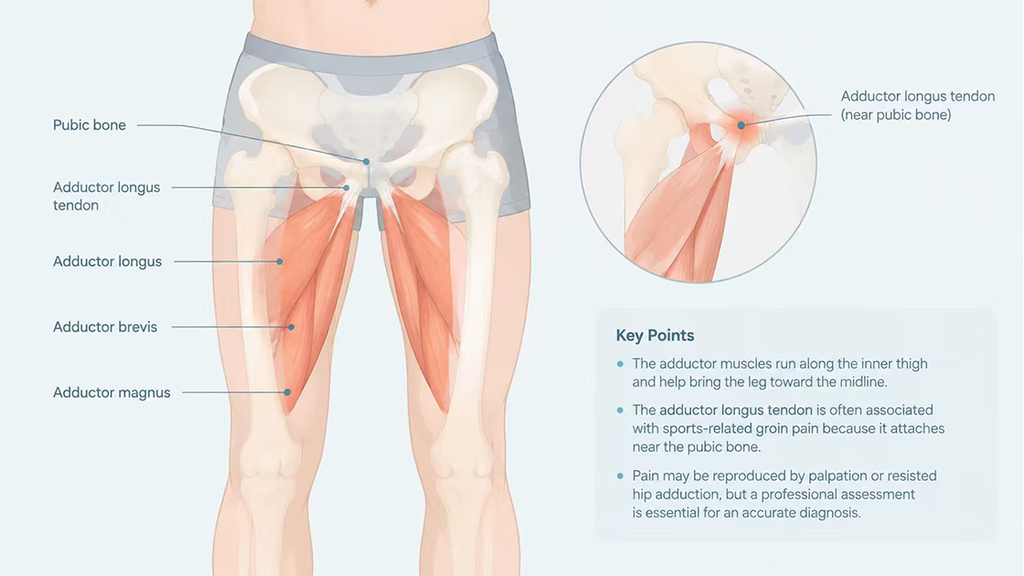
The adductor muscles run along the inner thigh and help bring the leg toward the body’s midline. The adductor longus tendon is frequently associated with sports-related groin pain because it attaches near the pubic bone.
Adductor-related pain may be reproduced by palpating the affected area or performing resisted hip adduction. These findings can help guide an examination, but no single symptom or test can establish the diagnosis independently.
A sports medicine professional may also assess muscle strength, hip mobility, running mechanics, and the response to functional movements.
2.2 Hip Joint Problems and Other Sources of Pain
Not all groin pain originates in the adductor tendons. Hip joint conditions, including femoroacetabular impingement and hip osteoarthritis, can cause groin discomfort, particularly during hip flexion or rotation.
Other possible causes include pubic-related pain, inguinal-related groin pain, abdominal muscle injuries, and referred pain from the lower back. Several conditions may also contribute to symptoms simultaneously.
The Doha agreement on terminology for groin pain in athletes emphasizes classifying symptoms according to clinical findings rather than relying on a general label such as “groin strain.” Accurate classification helps clinicians choose appropriate investigations and treatment strategies.
2.3 When Professional Assessment Is Important
Persistent groin pain should be assessed when it limits running, changes movement patterns, or fails to improve with reasonable workload adjustments.
Sudden severe pain, an inability to bear weight, significant swelling or bruising, fever, a painful groin lump, or testicular pain requires prompt medical evaluation. These symptoms should not be managed by proceeding directly to shockwave therapy.
A clear diagnosis also helps determine whether imaging is necessary and whether tendon-focused rehabilitation is appropriate.
3. How Shockwave Therapy May Support Adductor Tendon Rehabilitation
3.1 Understanding Extracorporeal Shockwave Therapy
Extracorporeal shockwave therapy (ESWT) delivers acoustic energy through an applicator placed against the skin. Depending on the technology, the energy may spread across a broader area or be concentrated at a selected depth.
Shockwave therapy is used in the management of several musculoskeletal conditions, including certain chronic tendinopathies. Researchers have investigated its potential effects on pain and tissue-related processes, although the proposed mechanisms and clinical outcomes vary by condition.
For soccer officials with persistent groin pain, the key question is whether the diagnosis, treatment location, and available evidence support including shockwave therapy in the rehabilitation plan.
3.2 What Does the Evidence Say About Adductor-Related Groin Pain?
Evidence for shockwave therapy in groin-related conditions requires careful interpretation. A randomized controlled study involving amateur football players with pubic overload and aseptic osteitis pubis reported improvements in pain and return-to-football outcomes when shockwave therapy was combined with structured rehabilitation. However, pubic-related pain is not identical to isolated adductor tendinopathy.
A systematic review of longstanding adductor-related groin pain published in 2021 also highlighted limitations in the evidence for conservative interventions and noted that shockwave therapy had not been adequately studied for that specific condition in the literature it reviewed.
These findings suggest that results from broader groin pain studies should not be treated as definitive proof of effectiveness for every case of chronic adductor tendon pain. Clinicians should consider the specific diagnosis, discuss uncertainty, and avoid promising a particular outcome.
3.3 Radial Shockwave Technology and Treatment Planning
Radial shockwave devices deliver energy that spreads outward from the applicator, making them suitable for certain superficial or broader soft-tissue treatment approaches. Equipment may offer different applicator heads, adjustable energy output, and frequency settings.
These features allow trained professionals to adapt treatment delivery to the clinical area and patient tolerance. However, equipment specifications alone do not establish that a particular condition is an appropriate treatment indication.
The inner thigh and groin contain important nerves, blood vessels, and other sensitive structures. Treatment in this region requires anatomical knowledge, appropriate patient selection, and careful technique. A routine protocol used for another tendon condition should not automatically be applied to the groin.
4. Combining Shockwave Therapy with Progressive Strengthening
4.1 Why Exercise Remains Central to Recovery
Pain relief alone does not necessarily restore the strength and coordination needed for a full match. Exercise-based rehabilitation aims to improve the adductors’ capacity to tolerate acceleration, deceleration, and lateral movement.
A randomized trial by Hölmich and colleagues found that active training focused on adductor and abdominal strengthening and coordination was more effective than passive physiotherapy for athletes with longstanding adductor-related groin pain. This supports the importance of active rehabilitation rather than relying exclusively on passive treatment.
When clinically appropriate, shockwave therapy should complement strengthening and workload management instead of replacing them.
4.2 Progressing from Controlled Loading to Running
Rehabilitation may begin with tolerable exercises such as isometric hip adduction, controlled resistance training, and trunk strengthening. The program can progress to more demanding movements as strength and symptom tolerance improve.
Later stages may include dynamic adductor exercises, single-leg control, acceleration, deceleration, and lateral movement. Progression should depend on the individual’s response rather than a fixed schedule.
If pain worsens substantially during exercise or remains aggravated afterward, the workload may need to be adjusted with guidance from a qualified professional.
4.3 Restoring the Demands of Soccer Officiating
Straight-line jogging alone may not adequately prepare a referee for the repeated lateral shuffling, rapid turns, and high-speed transitions required during a match.
A gradual return-to-running plan can progress from easy running to faster intervals, direction changes, repeated accelerations, and match-specific movement drills. Full match demands should be reintroduced when the individual demonstrates sufficient strength, movement control, and tolerance.
Useful milestones include minimal or no pain during resisted hip adduction and the ability to complete demanding sport-specific tasks without significant symptom aggravation. Return-to-match decisions should be guided by a clinician or sports rehabilitation professional.
5. Selecting Shockwave Equipment for a Clinical Setting
5.1 Applicator Design and Treatment Area
Shockwave systems may provide multiple applicator heads for different treatment areas and application techniques. A larger head may suit broader regions, while a smaller contact area may allow more localized application when appropriate.
For adductor-related symptoms, applicator selection should reflect the confirmed target tissue, anatomical location, treatment objective, and professional judgment. A smaller applicator does not automatically provide better treatment, and the groin should not be treated like an uncomplicated superficial muscle area.
5.2 Adjustable Output and Professional Control
Clinical shockwave systems may offer adjustable energy and frequency settings, allowing practitioners to tailor delivery according to the device design, the patient’s response, and the protocol supported for the condition.
For example, one professional system described on the equipment website offers an energy range of 30–210 mJ and a frequency range of 1–16 Hz, alongside multiple applicator heads. These specifications describe equipment capabilities; they do not establish a validated protocol for chronic adductor tendinopathy.
Practitioners should follow the device instructions, relevant clinical guidance, and appropriate training. Settings should not be copied from unrelated conditions without a clear clinical rationale.
5.3 Patient Screening and Safety Considerations
Before treatment, clinicians should review the diagnosis, medical history, medications, relevant contraindications, and exact treatment location. They should also explain potential discomfort and the uncertainty surrounding treatment outcomes.
Treatment should be deferred when the cause of pain is unclear or further investigation is required. A clinician should determine whether shockwave therapy is appropriate and consider alternative care when its potential risks outweigh its benefits.
Follow-up assessment is also important. Pain levels, strength, functional tasks, and running tolerance can help determine whether the overall rehabilitation plan is progressing.
6. Preventing Recurrent Groin Pain During a Referee’s Season
6.1 Manage Training and Match Workload
A sudden increase in running distance, sprint volume, or match frequency can exceed the body’s current capacity. Referees should consider the combined workload from matches, training sessions, fitness tests, and other physical activities.
Tracking symptoms alongside training volume can help identify patterns. If groin discomfort consistently increases after a particular workload, the training plan may need adjustment before symptoms become more persistent.
6.2 Maintain Adductor and Trunk Strength
Ongoing strength training helps maintain the capacity needed for repeated movement demands. Adductor exercises can be combined with hip, trunk, and lower-limb strengthening to support movement control.
Exercise selection and intensity should reflect the individual’s current condition. Heavy or high-volume training should not be introduced abruptly when symptoms are active.
6.3 Build Recovery into the Officiating Schedule
Adequate sleep, recovery time, appropriate warm-ups, and gradual training progression all contribute to workload management. Referees should not assume that pain relief means the underlying functional problem has resolved.
A planned return to full officiating demands, supported by strength and movement testing, may help reduce the risk of returning too quickly. If symptoms repeatedly return despite adjustments, professional reassessment is preferable to repeatedly restarting the same treatment cycle.
7. Frequently Asked Questions
Q1. Can shockwave therapy treat chronic adductor tendinopathy?
It may be considered in selected cases, but evidence specific to chronic adductor tendinopathy remains limited. Professional assessment is essential.
Q2. Is chronic groin pain always caused by the adductor tendons?
No. Hip joint conditions, pubic-related problems, and other injuries can cause similar symptoms.
Q3. Can soccer officials continue running during rehabilitation?
Possibly. Running intensity and volume should be adjusted according to symptoms, functional ability, and professional guidance.
Q4. Does shockwave therapy replace adductor strengthening?
No. Progressive strengthening and workload management remain important parts of rehabilitation.
Q5. How long does recovery take?
Recovery varies with the underlying condition, symptom duration, and response to rehabilitation. There is no universal timeline.
結論
Chronic adductor tendon pain can interfere with a soccer official’s ability to run, change direction, and complete a full match comfortably. Effective management begins with identifying the actual source of groin pain, since adductor tendinopathy, hip joint disorders, and pubic-related conditions may produce overlapping symptoms. Shockwave therapy may be considered in selected cases, but evidence for isolated chronic adductor tendinopathy remains limited. When clinically appropriate, it should be integrated with progressive strengthening, workload management, and sport-specific return-to-running preparation. An individualized, diagnosis-led plan offers a more responsible approach to restoring function and managing the demands of a full officiating season.
参考文献
Bisciotti GN, Chamari K, Cena E, et al. The conservative treatment of longstanding adductor-related groin pain syndrome: a critical and systematic review. Biology of Sport. 2021;38(1):45–63.
https://pmc.ncbi.nlm.nih.gov/articles/PMC7996386/
Hölmich P, Uhrskou P, Ulnits L, et al. Effectiveness of active physical training as treatment for long-standing adductor-related groin pain in athletes: randomised trial. The Lancet. 1999;353(9151):439–443.
https://doi.org/10.1016/S0140-6736(98)03340-6
Schöberl M, et al. Non-surgical treatment of pubic overload and groin pain in amateur football players: a prospective double-blinded randomised controlled study. Knee Surgery, Sports Traumatology, Arthroscopy. 2017.
https://pubmed.ncbi.nlm.nih.gov/28093636/
Rhim HC, Shin J, Kang J, et al. Use of extracorporeal shockwave therapies for athletes and physically active individuals: a systematic review. British Journal of Sports Medicine. 2024;58(3):154–163.
https://pubmed.ncbi.nlm.nih.gov/38228375/
Weir A, Brukner P, Delahunt E, et al. Doha agreement meeting on terminology and definitions in groin pain in athletes. British Journal of Sports Medicine. 2015;49(12):768–774.
https://bjsm.bmj.com/content/49/12/768
Shockwave Therapy Machine: Product Specifications and Applicator Options. ShockwaveMachines.com.
https://www.shockwavemachines.com/swave-200-best