

はじめに
Sacroiliac (SI) region pain can affect a horse’s comfort, movement, and ability to perform demanding athletic activities. The region connects the spine and pelvis and plays an important role in transferring forces from the hindlimbs through the body. When discomfort develops around this area, a horse may show subtle changes in stride, difficulty engaging its hindquarters, resistance during transitions, or a decline in performance. These signs can resemble other musculoskeletal conditions, which makes careful veterinary assessment important. Shockwave therapy and laser therapy are among the modalities used in equine rehabilitation to help manage certain musculoskeletal pain conditions. Their role in horses with suspected SI region discomfort depends on the underlying structures involved, the individual horse’s condition, and the veterinarian’s overall assessment.
1. Understanding Sacroiliac Pain in Horses
Sacroiliac pain describes discomfort associated with the structures around the junction between the sacrum and the ilium. This region forms a strong connection between the horse’s spine and pelvis, helping transfer the force generated by the hindlimbs during movement.
1.1 What Is the Sacroiliac Region?
The sacroiliac joint sits between the sacrum, which forms part of the pelvic connection to the spine, and the ilium, one of the major bones of the pelvis. Unlike highly mobile joints such as the shoulder or hip, the equine SI joint has limited movement and relies heavily on strong supporting ligaments and surrounding muscles for stability.
During locomotion, the hindquarters generate substantial propulsive force. The SI region helps transmit that force toward the trunk while maintaining pelvic stability. Because it experiences repeated loading during exercise, it may become a source of discomfort when surrounding soft tissues, joint structures, or related muscles experience excessive strain or dysfunction.
1.2 Why the SI Region Matters for Athletic Movement
A horse needs coordinated movement between its back, pelvis, and hindlimbs to perform tasks such as collection, jumping, sliding stops, and rapid changes of direction. The SI region contributes to this coordination by supporting force transfer and pelvic control.
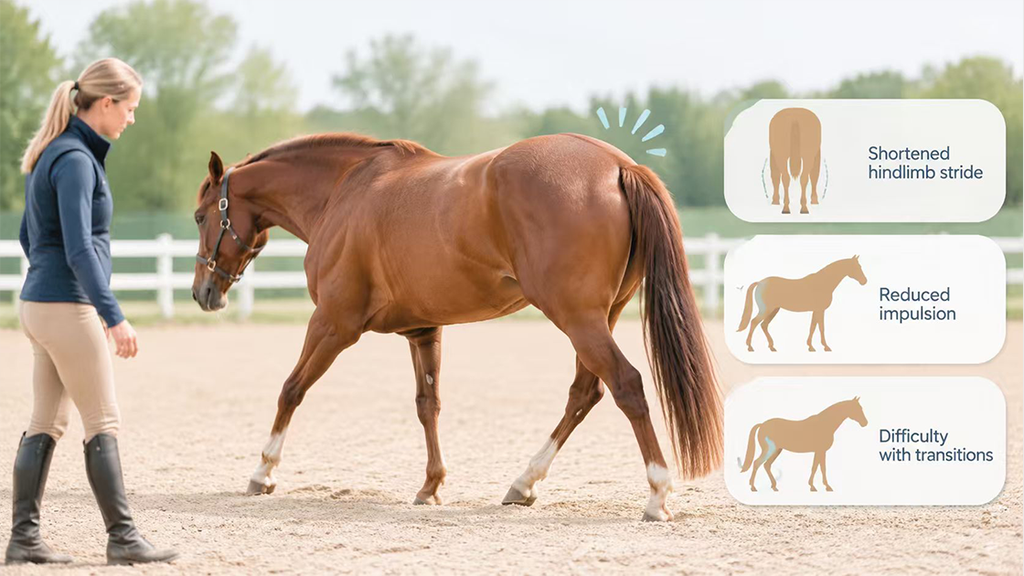
When discomfort affects this area, a horse may have difficulty using its hindquarters evenly. It may shorten its stride, resist movements that require engagement, or show reduced impulsion. These changes can interfere with performance even when the horse does not display an obvious limp.
2. Common Signs of Sacroiliac Region Discomfort
SI region discomfort does not always produce one clear or consistent symptom. Instead, owners and riders may notice several changes in movement, behavior, and athletic ability. Recognizing these signs can help prompt an appropriate veterinary evaluation.
2.1 Changes in Hindlimb Movement
One possible sign is an uneven or shortened hindlimb stride. A horse may appear reluctant to push forward from one or both hindlimbs, particularly during demanding movements. Some horses show difficulty maintaining a consistent rhythm, while others may struggle with transitions between gaits.
The horse may also have trouble with movements that require the hindquarters to step underneath the body. These changes can become more noticeable during collection, lateral work, jumping, or other activities that place greater demands on pelvic stability.
2.2 Behavioral Changes Under Saddle
Physical discomfort can also influence a horse’s behavior. A horse with possible SI region pain may resist transitions, become reluctant to move forward, or show tension when asked to perform movements that require strong hindquarter engagement.
Western performance horses may have difficulty maintaining balance during turns, stops, or rapid changes in direction. Sport horses may show reduced impulsion or reluctance to engage during collected work. However, these behaviors are not specific to SI pain and should not be treated as a diagnosis on their own.
2.3 Why the Symptoms Can Be Difficult to Identify
Several conditions can produce signs similar to SI region discomfort, including hock or stifle problems, back pain, proximal hindlimb muscle injuries, and other causes of hindlimb lameness. A horse may also have more than one source of pain at the same time.
For this reason, a veterinarian needs to consider the horse’s full clinical picture rather than relying on one movement change or behavioral sign. A careful examination helps distinguish SI region problems from other musculoskeletal conditions.
3. Factors That May Contribute to SI Region Discomfort
Sacroiliac region problems can develop through several interacting factors. Training demands, physical conditioning, conformation, and other musculoskeletal conditions may all influence how much stress the region experiences.
3.1 Repetitive Athletic Loading
Western riding and competitive equestrian disciplines often involve repeated movements that place considerable demands on the hindquarters. Activities such as sliding stops, spins, tight turns, jumping, and collected work require strong force production and coordinated pelvic movement.
Repeated loading does not automatically cause an SI condition. However, demanding exercise combined with inadequate recovery or changes in workload may contribute to discomfort in susceptible horses. Sudden increases in training intensity can also challenge the muscles and supporting structures around the pelvis.
3.2 Muscle Imbalance and Reduced Conditioning
The muscles surrounding the pelvis and lumbar region help stabilize the trunk and coordinate hindlimb movement. If these muscles lack strength, endurance, or balanced coordination, the horse may distribute physical loads differently during exercise.
Poor conditioning can make demanding movements more difficult, while prolonged inactivity may reduce muscular support. In addition, an existing injury in another part of the hindlimb can alter movement patterns and place additional stress on the pelvic region.
3.3 Other Musculoskeletal Conditions
Hock, stifle, back, and hindlimb soft-tissue problems may affect how a horse moves and loads its pelvis. In some situations, discomfort in one region can contribute to compensatory movement elsewhere. Conversely, SI region pain may coexist with another musculoskeletal problem.
This relationship makes a whole-horse assessment especially important. Addressing only the area where the horse appears uncomfortable may overlook another condition that contributes to the movement problem.
4. Shockwave Therapy and Laser Therapy in Equine Rehabilitation
Veterinary rehabilitation may include several physical modalities to support comfort and function in horses with musculoskeletal conditions. Extracorporeal shockwave therapy and laser therapy use different forms of energy, so they should not be considered interchangeable or assumed to have the same effects.
4.1 How Shockwave Therapy Works
Extracorporeal shockwave therapy (ESWT) delivers acoustic pressure waves through a treatment applicator to selected tissues. Depending on the device, the technology may use focused shockwaves or radial pressure waves. These forms of energy have different physical characteristics and penetration patterns, so treatment parameters should match the equipment and the intended anatomical target.
In equine practice, veterinarians use ESWT for selected musculoskeletal conditions involving tendons, ligaments, bones, and joints. Its potential role in SI region discomfort relates to the surrounding soft tissues and other structures that a veterinarian identifies as relevant. It should not be described as a method that directly repairs every possible source of SI pain or corrects pelvic instability.
The response to treatment can vary according to the horse’s condition, the tissue involved, and the selected parameters. Veterinary supervision remains important because temporary changes in pain perception may affect how a horse moves and how much activity it can safely tolerate.
4.2 The Role of Shockwave Therapy
Laser therapy, also known as photobiomodulation when it uses appropriate light parameters, delivers light energy to biological tissues. Different laser systems operate at different wavelengths and power levels, which influence how light interacts with tissue.
In equine rehabilitation, clinicians may use laser therapy as part of a broader approach to managing selected soft-tissue and musculoskeletal problems. Its potential role in horses with SI region discomfort may involve supporting comfort in accessible surrounding muscle and soft-tissue areas.
Laser therapy and shockwave therapy have different mechanisms and treatment considerations. A veterinarian or qualified rehabilitation professional should decide whether either modality is appropriate, whether they may complement other care, and which tissues should be assessed.
4.3 Why Treatment Selection Requires an Individual Assessment
The SI region contains several closely related structures, and the source of discomfort may not be obvious from external signs. The veterinarian must consider the horse’s history, movement examination, physical findings, and any additional diagnostic information.
Not every horse with hindquarter discomfort is a suitable candidate for shockwave or laser therapy. The choice depends on the suspected diagnosis, the location and depth of the affected tissues, concurrent injuries, and the horse’s overall health. These modalities should form part of a veterinary rehabilitation plan rather than replace diagnostic evaluation or other necessary care.
5. Supporting Hindquarter Comfort and Long-Term Performance
Physical modalities are only one part of managing a horse with suspected SI region discomfort. Overall progress also depends on appropriate conditioning, workload management, movement assessment, and attention to other sources of pain.
5.1 The Importance of Balanced Conditioning
A balanced conditioning program helps maintain strength, coordination, and muscular endurance throughout the trunk and hindquarters. The horse’s exercise demands should match its current fitness level, with changes in workload introduced gradually.
A rehabilitation professional may consider the horse’s posture, topline development, hindlimb coordination, and ability to perform controlled movements. The aim is to support comfortable movement while avoiding unnecessary strain on the pelvis and surrounding structures.
5.2 Monitoring Movement and Performance
Owners and trainers can help by observing changes in stride quality, willingness to work, transitions, and recovery after exercise. Consistent observations may help the veterinary team understand whether the horse’s comfort and movement are changing over time.
However, improved performance alone does not confirm that the original source of discomfort has resolved. Follow-up assessment should consider both the horse’s movement and its clinical findings. If lameness, resistance, or reduced performance persists, the veterinarian may need to reassess the diagnosis and overall management plan.
FAQ
What are common signs of sacroiliac pain in horses?
Signs may include shortened hindlimb strides, reduced impulsion, difficulty with transitions, resistance during collected work, and changes in performance. These signs can also occur with other conditions.
Can shockwave therapy help horses with SI region discomfort?
A veterinarian may consider ESWT as part of a broader rehabilitation plan for selected musculoskeletal conditions around the SI region. Its suitability depends on the affected tissues and the individual horse’s diagnosis.
Is laser therapy the same as shockwave therapy?
No. Shockwave therapy uses acoustic pressure waves, while laser therapy uses light energy. They have different mechanisms, equipment, and treatment considerations.
Can western performance horses develop SI region discomfort?
Yes. Activities involving repeated stops, turns, spins, and strong hindquarter engagement can place substantial demands on the pelvis and surrounding structures. These activities do not automatically cause an SI condition.
Does hindquarter stiffness always indicate SI pain?
No. Hock, stifle, back, muscle, and other hindlimb conditions can produce similar signs. A veterinary examination is necessary to identify the likely source.
Can a horse return to normal work after SI region discomfort?
The outlook varies with the underlying condition, its severity, and the horse’s overall health. A veterinarian can help determine suitable activity levels and monitor the horse’s progress.
結論
Sacroiliac region discomfort can affect how a horse uses its hindquarters, transfers power, and performs athletic movements. Because the signs often overlap with other musculoskeletal problems, an accurate veterinary assessment is essential before deciding on an appropriate rehabilitation approach. Shockwave therapy and laser therapy may have a role in supporting comfort in selected cases, but neither should be presented as a guaranteed solution for every cause of SI region pain. A well-rounded plan that considers diagnosis, conditioning, workload, and ongoing movement assessment offers a more responsible way to support the horse’s comfort and performance.
参考文献
1. Sacroiliac Joint Abnormalities in Horses – Merck Veterinary Manual
2. Review of the Clinical Diagnosis of Sacroiliac Dysfunction in Horses – Challenges and Limitations
https://pubmed.ncbi.nlm.nih.gov/38556191
3. Extracorporeal Shock Wave Therapy in Equine and Canine Practice
https://pubmed.ncbi.nlm.nih.gov/41791225
4. A Systematic Literature Review of Complementary and Alternative Veterinary Medicine: Extracorporeal Shockwave Therapy
https://pmc.ncbi.nlm.nih.gov/articles/PMC9686741
5. A Systematic Literature Review of Complementary and Alternative Veterinary Medicine: Laser Therapy