

Introdução
You sit at a desk for eight, ten, or even twelve hours a day. You commute in a car, eat lunch at your workstation, and unwind in front of a screen. Then one day, you notice a dull ache deep in your outer hip—pain that worsens when you walk, climb stairs, or lie on that side at night. What you are feeling is not “just a sore muscle.” You may have gluteal tendinopathy, a condition increasingly common among sedentary professionals. Extracorporeal shockwave therapy (ESWT) offers a non-invasive, drug-free solution that targets the root cause of this stubborn pain.
1. What Is Gluteal Tendinopathy and Why Does It Hurt?
1.1 A Tendon Disorder, Not an Inflammation
Gluteal tendinopathy occurs when the tendons connecting your gluteus medius and minimus muscles—located deep in your buttocks—begin to break down or deteriorate. Unlike tendinitis, which involves inflammation and often improves with rest and ice, tendinopathy results from chronic tissue degeneration. Rest alone rarely resolves the condition. The pain typically presents as a deep, persistent ache over the outer hip that can interfere with sleep, work, and daily activities.
1.2 The Anatomical Source of Lateral Hip Pain
Your gluteus medius and minimus run from your hipbone (pelvis) to the greater trochanter, the bony ridge at the top of your thighbone. These muscles stabilize your hip joint every time you stand, walk, or shift your weight. When their tendons degenerate, any activity that requires hip stabilization becomes painful. This condition is also called greater trochanteric pain syndrome (GTPS), a term that encompasses tendinopathy of the hip abductors as well as trochanteric bursitis and external coxa saltans.
1.3 The Underuse Paradox: Why Sitting Harms Your Tendons
It may seem counterintuitive, but underuse—not just overuse—causes tendon degeneration. A sedentary lifestyle deprives your tendons of the normal tensile loading they need to stay healthy. When you sit for hours, your gluteal tendons receive minimal stimulation, leading to gradual deterioration. This makes sedentary workers particularly vulnerable, regardless of whether they exercise occasionally after work.
2. Why Desk Jobs Put You at High Risk for Gluteal Tendinopathy
2.1 The Underuse Mechanism
According to the Cleveland Clinic, the cause of gluteal tendinopathy often comes from inactivity or a generally sedentary lifestyle. Your tendons need regular, appropriate loads to maintain their structure and function. Prolonged sitting removes that stimulus, allowing tendon tissue to weaken and break down. This explains why office workers who sit for 8–10 hours daily may develop hip pain even without a specific injury.
2.2 Gluteal Muscle Weakness and Hip Flexor Tightness
Constant sitting shortens your hip flexors while weakening your gluteal muscles. This muscular imbalance alters how forces travel through your hip joint, placing excessive strain on the gluteal tendons. Over time, even routine activities like walking up stairs or standing up from a chair can overload the already compromised tendon tissue. The result is a self-perpetuating cycle of weakness, imbalance, and pain.
2.3 Additional Risk Factors That Compound the Problem
Several factors can increase your risk or worsen existing gluteal tendinopathy. Weight gain adds excess pressure on the gluteal tendons. Women over age 50, particularly those who have completed menopause, are more prone to this condition due to hormonal changes affecting tendon health. A rapid increase in activity—such as suddenly starting a walking or running program after months of inactivity—can overload tendons that have become deconditioned from prolonged sitting.
3. Treatment Options: What Works and What Falls Short
3.1 Physical Therapy as the Foundation
Targeted physiotherapy and a prescribed exercise program represent the first-line treatment for gluteal tendinopathy. A 2025 systematic review found that exercise and education have moderate strength evidence of a medium effect on pain and function in the short term. Strengthening exercises for the glutes, combined with load management strategies, help restore normal tendon function. However, some patients continue to experience significant pain despite adhering to a structured exercise program.
3.2 The Short-Term Nature of Corticosteroid Injections
Corticosteroid injections offer short-term relief but the benefits diminish over time. A 2025 systematic review reported that corticosteroid injection has moderate strength evidence of only a small effect on pain in the short term. Moreover, repeated injections may weaken tendon tissue, potentially increasing the risk of rupture. For sedentary professionals seeking a long-term solution, corticosteroids rarely provide durable relief.
3.3 Why Shockwave Therapy Is Different
Extracorporeal shockwave therapy (ESWT) delivers acoustic waves to the injured tendon, stimulating cellular repair and promoting neovascularization. The key distinction lies in its mechanism: rather than simply masking pain, shockwave therapy encourages the body’s natural healing processes. For chronic tendinopathies that have failed to respond to conservative care, ESWT offers a non-invasive alternative that addresses the underlying tissue degeneration rather than just managing symptoms.
4. How Shockwave Therapy Works for Gluteal Tendinopathy
4.1 The Mechanism of Action
Shockwave therapy transmits high-energy acoustic waves to the painful site, causing cell stimulation, soft-tissue regeneration, and interruption of the chronic pain cycle. The mechanical forces applied to the tendon activate biological pathways that reduce pain signaling while promoting healing. This dual action—pain relief and tissue repair—makes ESWT particularly effective for chronic tendon disorders that have not improved with conventional treatments.
4.2 What to Expect During a Session
A typical shockwave therapy session begins with the clinician identifying the precise tender points over your outer hip. A handheld applicator delivers acoustic pulses through a gel applied to the skin. You will feel a tapping or percussive sensation at the treatment site. Most patients describe the feeling as deep pressure or mild pinching rather than sharp pain. Each session lasts approximately 10 to 15 minutes, and you can return to work or daily activities immediately afterward without any downtime.
4.3 Typical Reactions and Minor Side Effects
After treatment, some patients experience mild soreness, bruising, or redness in the treated area. These reactions usually resolve within 24 to 48 hours and indicate that the body‘s healing response has been activated. Serious complications are extremely rare when the therapy is administered by a trained professional. However, patients taking blood thinners or those with certain circulatory disorders should discuss their medical history with their provider before undergoing shockwave therapy.
4.4 Maximizing Your Results: The Role of Rest and Rehabilitation
Shockwave therapy works best when combined with appropriate loading and rest strategies. For the first 48 hours after each session, avoid high-impact activities that could overload the healing tendon. Gentle walking and prescribed stretching are generally safe. Your clinician will likely recommend a progressive strengthening program for your gluteal muscles to address the underlying weakness that contributed to your condition. Following this combined approach significantly improves long-term outcomes and reduces the risk of recurrence.
5. Integrating Shockwave Therapy with Rehabilitation
5.1 Exercise and Education as the Core Approach
A 2025 systematic review concluded that exercise and education should serve as the core approach for pain management and function, potentially supplemented by corticosteroid injections or focused shockwave therapy. This means shockwave therapy works best when combined with a structured strengthening program, not as a stand-alone treatment. The pain relief provided by ESWT allows patients to participate more fully in rehabilitation exercises that would otherwise be too uncomfortable.
5.2 Complementing Physical Therapy
When ESWT reduces pain and inflammation, patients can engage in therapeutic exercise more effectively. Research shows that ESWT significantly reduces pain and improves function in patients with gluteal tendinopathy, particularly when paired with therapeutic exercise. A progressive strengthening program targeting the gluteal muscles addresses the underlying weakness that contributed to tendon degeneration in the first place. This integrated approach delivers better long-term outcomes than either treatment alone.
5.3 Long-Term Management for Desk Workers
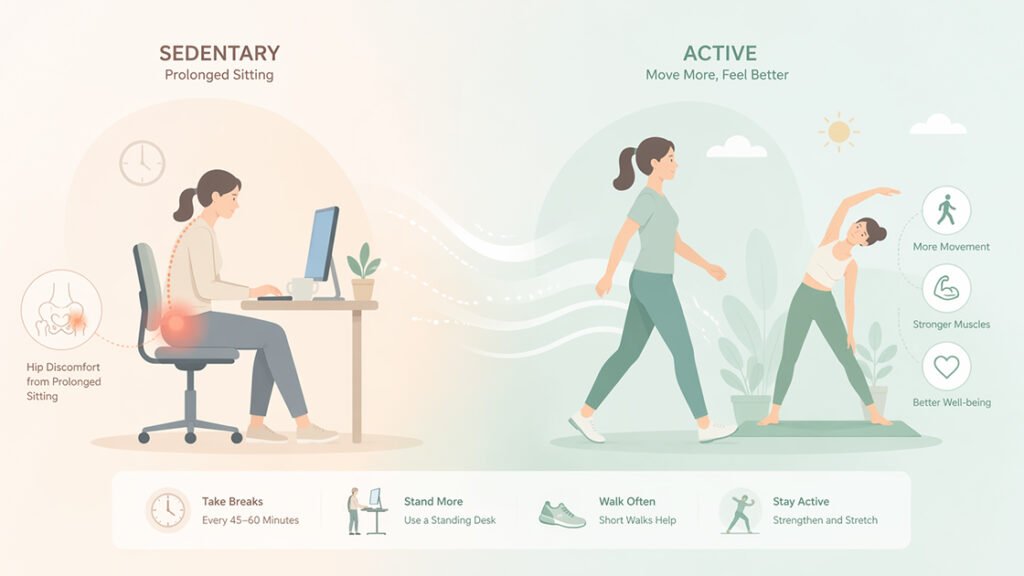
For sedentary professionals, long-term management requires addressing the daily habits that caused the condition. Patients who continue to sit for extended periods without intervention are likely to experience recurrence. Combining shockwave therapy with ergonomic adjustments—such as using a standing desk, taking regular walking breaks every 45 to 60 minutes, and maintaining a consistent glute-strengthening routine—helps prevent relapse and preserves the benefits achieved through treatment.
6. Practical Advice for Desk Workers with Hip Pain
6.1 Ergonomics and Daily Movement Habits
Simple changes to your work routine can significantly reduce stress on your gluteal tendons. Sit with both feet flat on the floor and your hips level, avoiding crossed legs or leaning onto one hip. After sitting for 40 minutes, stand up and perform 5 to 10 minutes of low-intensity movement. Use a standing desk for portions of your day to alternate between sitting and standing postures.
6.2 Exercises to Strengthen Your Glutes
Keeping your glutes strong is essential for preventing gluteal tendinopathy from returning. Squats, lunges, hip thrusts, flexibility training, and foam rolling can help improve mobility and reduce stiffness. Focus on exercises that target hip abduction and external rotation, such as clamshells, side-lying leg lifts, and banded walks. Consistency matters more than intensity—a short daily routine is more effective than an occasional intense workout.
6.3 When to Seek Treatment
If you experience persistent outer hip pain that interferes with sleep, walking, or daily activities, seek professional evaluation. Conservative care should be attempted first, but persistent symptoms warrant consideration of shockwave therapy. The earlier you address gluteal tendinopathy, the better your chances of avoiding chronic pain and long-term disability.
FAQ
Q: Can I continue working at my desk job while receiving shockwave therapy?
A: Yes. Shockwave therapy requires no downtime, and you can return to work immediately after each session.
Q: How many shockwave sessions will I need for gluteal tendinopathy?
A: Most protocols recommend 3 to 4 weekly sessions, delivering 2,000 to 3,000 pulses per session.
Q: Does shockwave therapy hurt?
A: You may feel some discomfort during the treatment as the acoustic waves target the injured tendon. Most patients describe the sensation as deep pressure or mild pinching that resolves quickly.
Q: Is shockwave therapy covered by health insurance?
A: Coverage varies by provider and plan. Many patients pay out-of-pocket, but some plans cover ESWT when prescribed for chronic tendinopathy that has failed conservative care.
Q: Can I do shockwave therapy if I have other hip conditions?
A: A thorough evaluation by a qualified provider is essential to confirm the correct diagnosis. Shockwave therapy is appropriate for gluteal tendinopathy but not for all hip conditions.
Conclusão
For the millions of office workers, remote employees, and sedentary professionals who spend their days sitting, gluteal tendinopathy represents a real and growing occupational hazard. The underuse of gluteal tendons during prolonged sitting leads to tissue degeneration, chronic pain, and reduced quality of life. Extracorporeal shockwave therapy offers a non-invasive, evidence-based solution that targets the root cause of the condition rather than merely masking symptoms. When combined with targeted exercise and improved daily movement habits, shockwave therapy can help desk workers return to pain-free living without medication, injections, or surgery.
Referências
Cleveland Clinic. (2023). Gluteal Tendinopathy: Symptoms, Causes & Treatment.
https://my.clevelandclinic.org/health/diseases/22960-gluteal-tendinopathy
Bremer, T., et al. (2025). The efficacy of gluteal tendinopathy treatments: A systematic review. Clinical Rehabilitation, 39(5), 600–617.
Datt Anand, A., et al. (2025). Extracorporeal Shockwave Therapy in Greater Trochanteric Pain Syndrome: A Systematic Review and Meta-Analysis. Muscles, Ligaments and Tendons Journal, 15(1).
https://www.ejcrim.com/index.php/mltj/article/view/6335
Fulceri, F., et al. (2024). Long-Term Efficacy of Combined Focused and Radial Extracorporeal Shockwave Therapy for Gluteus Medius Tendon Pathology: A Pilot Study. Life, 14(12), 1698.
https://pmc.ncbi.nlm.nih.gov/articles/PMC11680060/
Tenforde, A. S., et al. (2025). Extracorporeal Shockwave Therapy for Tendinopathies Around the Hip and Pelvis: A Systematic Review. HSS Journal.
https://pmc.ncbi.nlm.nih.gov/articles/PMC12018363/
Newkirk, S., et al. (2025). Effect of extracorporeal shockwave therapy on pain reduction and improved functional outcomes for greater trochanteric tendinopathy: A critically appraised topic. Oklahoma State University.