

Introdução
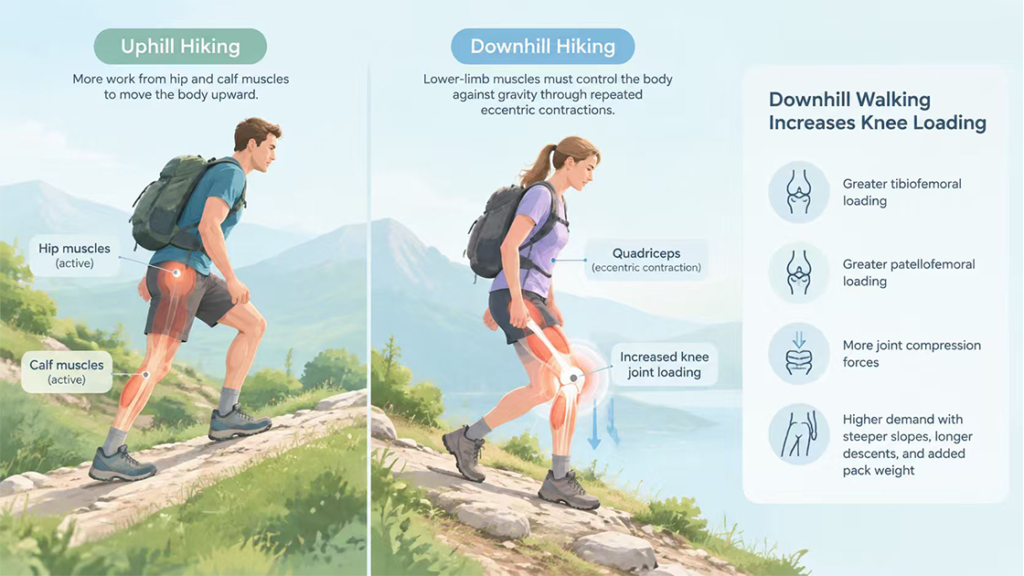
For many hikers, the most challenging part of a mountain trail is not the climb but the descent. A hiker may feel strong and comfortable while walking uphill, only to develop knee pain after several miles of downhill terrain. This pattern makes sense from a biomechanical perspective. Downhill walking increases knee joint loading and requires the quadriceps and other lower-limb muscles to control the body against gravity through repeated eccentric contractions. Research has found greater tibiofemoral and patellofemoral loading during downhill walking than level walking, which may help explain why descents can aggravate existing knee symptoms. For hikers who experience recurring knee discomfort, the goal should not simply be to manage pain after every trail. A comprehensive approach can address training load, lower-limb strength, movement mechanics, recovery, and the specific tissues involved. Shockwave Therapy offers a non-invasive modality that may complement this approach by delivering controlled acoustic energy to selected musculoskeletal tissues. Understanding why downhill hiking stresses the knee can help clinicians determine when and how shockwave therapy may fit into a broader rehabilitation plan.
1. Why Does Downhill Hiking Hurt the Knees?
1.1 The Knee Works Differently on the Descent
Walking downhill changes the mechanical demands placed on the lower extremities. Instead of simply pushing the body forward, the legs must repeatedly absorb energy as the body moves downward. The knee plays an important role in controlling this movement, particularly through eccentric muscle activity.
During an eccentric contraction, a muscle produces force while it lengthens. The quadriceps use this mechanism to control knee flexion during the loading phase of downhill walking. Research comparing level and downhill walking has shown increased lower-limb joint compression forces during descent, including greater tibiofemoral and patellofemoral loading.
For hikers, this repeated loading becomes more important as the trail becomes steeper or longer. A short descent may cause little trouble, while several miles of uneven downhill terrain can create substantial cumulative demand.
1.2 Why Can the Descent Feel Worse Than the Climb?
Uphill and downhill hiking challenge the body in different ways. Uphill walking requires substantial work from the hip and calf muscles to move the body upward. Downhill walking, however, requires the lower-limb muscles to repeatedly control the body’s forward and downward motion.
That difference can explain a common hiking experience: the legs feel tired during the climb, but the knees begin to ache during the descent.
A study examining downhill walking found that knee loading can increase considerably compared with level walking. Another study found that downhill walking produced significantly greater hip, tibiofemoral, and patellofemoral compression forces than level walking.
This does not mean that downhill hiking damages a healthy knee. Rather, it shows why an already sensitive or overloaded knee may respond differently to a long descent.
2. Common Causes of Knee Pain During Hiking
2.1 Patellofemoral Pain and Repetitive Loading
Patellofemoral pain is one possible explanation for anterior knee pain during activities that repeatedly load the knee. Hikers may notice discomfort around or behind the kneecap, particularly during downhill walking, stairs, squatting, or prolonged activity.
The relationship between downhill walking and patellofemoral loading is particularly relevant. Biomechanical research has found that downhill walking can produce substantially greater patellofemoral compressive forces than level walking.
However, not every case of hiking-related knee pain represents patellofemoral pain. Meniscal problems, osteoarthritis, tendon disorders, muscle fatigue, and other conditions can produce similar symptoms. A professional assessment should therefore determine the likely source before selecting a treatment.
2.2 Quadriceps Fatigue and Movement Changes
Long descents can place significant demands on the quadriceps. As fatigue develops, a hiker may unconsciously modify stride length, knee position, trunk position, or foot placement.
These changes can alter how forces move through the lower limb. A hiker who normally controls each step smoothly may begin taking shorter or less controlled steps as the muscles fatigue.
The problem therefore may not start with a single painful event. Instead, repeated loading, fatigue, terrain changes, and altered movement can gradually increase stress around the knee.
2.3 Terrain, Pack Weight, and Trail Distance
Mountain trails rarely provide the consistent surface of a treadmill or paved road. Rocks, roots, loose soil, sharp turns, and uneven steps require constant adjustments from the feet, ankles, knees, and hips.
A backpack adds another variable. Greater external load means the lower limbs must control a larger total body-plus-pack mass with every step.
Trail distance matters as well. A knee that tolerates a short recreational hike may respond differently after several hours of continuous descent. This makes gradual conditioning and appropriate recovery important parts of hiking injury prevention.
3. How Shockwave Therapy Fits Into Knee Recovery
3.1 What Is Shockwave Therapy?
Shockwave Therapy uses acoustic energy to deliver mechanical stimulation to targeted tissues. Clinicians can adjust the energy and frequency according to the treatment objective, anatomical region, and individual presentation.
The technology does not work by simply “breaking up” painful tissue. Instead, therapeutic shockwaves create controlled mechanical stimuli that may influence local biological responses. Research has investigated extracorporeal shockwave therapy across several musculoskeletal conditions, particularly chronic tendon disorders.
For hiking-related knee pain, the clinical question should therefore focus on the underlying tissue problem rather than the hiking activity alone. Shockwave Therapy may have a role when the assessment identifies a suitable musculoskeletal target.
3.2 Why Energy Control Matters
Different knee problems require different treatment strategies. A clinician may need to adjust energy level, frequency, treatment location, and applicator according to tissue depth and sensitivity.
A professional electromagnetic shockwave system can provide an adjustable energy range of approximately 30–210 mJ and a frequency range of 1–16 Hz. This allows practitioners to modify the treatment parameters instead of relying on a single fixed setting.
The ability to control energy matters because higher output does not automatically produce better results. Effective treatment depends on selecting an appropriate dose and applying it to the correct anatomical target.
3.3 Focused Energy for More Precise Targets
Shockwave systems can use different approaches to deliver acoustic energy. Focused shockwaves concentrate energy toward a defined focal region, while radial approaches distribute energy more broadly from the applicator surface.
Focused shockwave therapy can reach deeper tissues and provide more localized energy delivery. Radial shockwave therapy generally produces a broader treatment pattern and can suit more superficial or larger soft-tissue areas. The appropriate choice depends on the tissue involved, treatment depth, and clinical objective.
For a hiker with a clearly identified deeper target, focused energy may offer useful precision. For broader muscular tension around the thigh or lower leg, a wider treatment approach may make more sense.
4. From Trail Pain to a Complete Recovery Strategy
4.1 Shockwave Therapy Is Not a Replacement for Rehabilitation
Knee pain during hiking rarely has just one contributing factor. A rehabilitation plan may need to address strength, mobility, walking mechanics, training volume, footwear, and terrain exposure.
Research on patellofemoral pain consistently supports exercise-based rehabilitation as an important component of conservative management. A large systematic review found positive short-term effects from knee-targeted exercise and combined interventions for pain and function.
Shockwave Therapy can therefore serve as an adjunct rather than a replacement for active rehabilitation. Reducing discomfort may make it easier for a person to participate in appropriate strengthening and movement training.
4.2 Supporting the Muscles Around the Knee
The knee does not operate in isolation. The quadriceps, hamstrings, calf muscles, gluteal muscles, and hip stabilizers all influence lower-limb movement.
After a long hike, a clinician may identify both localized knee symptoms and surrounding muscular tension. A treatment system equipped with multiple applicators can support different treatment areas and delivery patterns. The available system includes several applicator options, including larger and smaller massage heads designed for different body regions.
This flexibility can be useful when the treatment plan addresses the broader kinetic chain rather than focusing only on the location where the hiker feels pain.
4.3 Preparing for the Next Hiking Trip
The objective of recovery should extend beyond getting through the next weekend hike. Hikers who repeatedly experience downhill knee pain may benefit from gradually increasing elevation gain, descent distance, and pack load rather than changing all three variables at once.
Strength training can also prepare the quadriceps, hips, and calves for the eccentric demands of descending. Balance and single-leg control can help the body respond to uneven terrain.
Shockwave Therapy may fit into this preparation when a clinician identifies a suitable target. The broader goal remains improving tissue tolerance and movement capacity so that the knee can better handle future hiking demands.
5. Choosing the Right Approach for Downhill Knee Pain
5.1 Start With the Source of Pain
“Downhill knee pain” describes a situation rather than a diagnosis. Before choosing shockwave therapy, clinicians should consider the location, duration, severity, aggravating activities, previous injuries, and associated symptoms.
Pain directly around the kneecap may point toward a different clinical pathway than pain along the joint line, below the patella, or at the back of the knee.
A professional assessment can help distinguish among patellofemoral pain, tendinopathy, osteoarthritis, muscular overload, and other potential causes. This distinction matters because shockwave therapy has condition-specific evidence, and not every knee problem requires the same intervention.
5.2 Match the Shockwave Parameters to the Target
Modern shockwave systems can provide adjustable energy and frequency rather than a one-size-fits-all treatment. The system discussed here operates from 30 to 210 mJ and 1 to 16 Hz, giving clinicians room to adjust treatment parameters according to the clinical situation.
Applicator selection also matters. Smaller treatment heads can support more localized work, while larger heads can cover broader muscular regions. This approach allows treatment to reflect anatomy instead of forcing every knee presentation into the same protocol.
The clinician should also monitor tissue response and patient tolerance throughout treatment. Parameter adjustment should follow the clinical objective, not simply the maximum available output.
5.3 Combine Treatment With Smarter Hiking Habits
A long-term hiking strategy should reduce unnecessary overload while maintaining fitness. Hikers can gradually build downhill mileage, strengthen the lower limbs, and use appropriate trekking techniques on steep terrain.
Hiking poles may also influence knee loading. Research comparing downhill walking with and without poles found reductions in several external and internal knee-loading measures when poles were used, although the study involved a small sample and controlled laboratory conditions.
These strategies do not eliminate the need for assessment or rehabilitation. Instead, they complement treatment by addressing the mechanical demands that may have contributed to the problem.
FAQ
Why does my knee hurt more when hiking downhill?
Downhill walking requires repeated eccentric control from the quadriceps and increases several knee joint loading measures compared with level walking. Steep slopes, long descents, fatigue, and additional backpack weight can further increase the demand.
Can Shockwave Therapy help downhill knee pain?
Shockwave Therapy may support recovery when the pain comes from a condition or tissue that responds to shockwave treatment. It should not be considered a universal treatment for every type of knee pain, and an appropriate clinical assessment should come first.
Is focused or radial Shockwave Therapy better for hikers?
Neither approach is automatically better. Focused shockwaves can target deeper, more localized tissues, while radial approaches can provide broader stimulation to more superficial areas. The choice depends on the clinical target and treatment goals.
Can I keep hiking while receiving Shockwave Therapy?
Activity decisions depend on the underlying condition and symptom severity. A clinician may recommend modifying distance, elevation gain, descent volume, or pack weight while the tissue recovers rather than stopping all activity.
Can hiking poles reduce knee stress?
Hiking poles may reduce some measures of knee loading during downhill walking. However, they should complement rather than replace strength training, appropriate pacing, and professional management when persistent pain occurs.
Conclusão
Downhill hiking creates a unique mechanical challenge for the knee. Repeated eccentric muscle activity, increased joint compression, uneven terrain, fatigue, and additional pack weight can make the descent more demanding than many hikers expect. Research confirms that downhill walking increases several measures of lower-limb and knee loading compared with level walking, which helps explain why some hikers develop pain only after they start descending. Shockwave Therapy may provide a useful adjunct when a professional identifies an appropriate musculoskeletal target. Modern systems with adjustable energy, frequency, and applicator options allow clinicians to tailor acoustic energy to different tissues and treatment goals. The strongest approach, however, combines appropriate shockwave treatment with progressive strength training, movement assessment, load management, and smarter hiking strategies. For hikers who repeatedly experience knee pain on the descent, understanding the mechanics behind the problem can be the first step toward a more sustainable return to the trail.
Referências
Lower limb joint forces during walking on the level and slopes at different inclinations
https://www.sciencedirect.com/science/article/pii/S0966636216000333
Stress on the Femoropatellar Joint in Downhill Walking—A Biomechanical Study
https://pubmed.ncbi.nlm.nih.gov/8130008
Knee Joint Forces During Downhill Walking With Hiking Poles
https://pubmed.ncbi.nlm.nih.gov/10622357
Efficacy of High-Intensity Laser Therapy for Patellofemoral Pain: A Systematic Review and Meta-Analysis
https://pubmed.ncbi.nlm.nih.gov/42286680
SWAVE-200 Electromagnetic Shockwave Therapy Machine