

Introdução
Competitive gaming requires sustained concentration, precise hand movements, and long periods of sitting. Professional gamers may spend several hours practicing with keyboards, mice, or controllers, placing repeated demands on the wrists, forearms, shoulders, and neck. Over time, these physical demands may contribute to muscle fatigue, tendon irritation, and persistent musculoskeletal discomfort. Although gaming-related pain does not always indicate an injury, recurring symptoms can interfere with comfort, training consistency, and competitive performance. Shockwave therapy, also known as extracorporeal shockwave therapy (ESWT), is an established treatment approach for selected musculoskeletal conditions and may be considered as part of a broader rehabilitation plan when a clinician identifies an appropriate soft tissue problem. This article explores common overuse concerns among professional gamers, explains how shockwave therapy works, and examines the technical features of the SWAVE-200 system.
1. Understanding Musculoskeletal Strain in Professional Gamers
1.1 The Physical Demands of Competitive Gaming
Professional gaming is often viewed as a sedentary activity, but it involves sustained muscular activity and highly repetitive movements. Players may maintain relatively fixed upper-body positions while performing thousands of small hand and finger movements during practice sessions and competitions.
Mouse control, keyboard input, and controller use require coordinated activity from the fingers, wrists, and forearms. Meanwhile, the neck and shoulder muscles help maintain head and upper-body positioning during prolonged screen viewing.
The combination of repetitive movement, limited posture variation, and insufficient recovery time may increase physical strain. Research on esports athletes has reported musculoskeletal complaints involving the neck, shoulders, wrists, and back. However, reported prevalence varies considerably between studies, and the available evidence does not establish that gaming alone causes every reported condition.
1.2 Common Areas of Discomfort
The wrists and hands are frequently involved in gaming-related complaints because they perform continuous, precise movements. Players may experience stiffness, localized discomfort, or fatigue after extended periods of mouse or controller use.
The forearms also contribute significantly to gaming performance. Their muscles control wrist positioning, finger movement, and grip stability. Repetitive contractions may contribute to muscle fatigue or aggravate an existing tendon-related problem.
Neck discomfort is another concern. Looking at a monitor for extended periods, especially when the screen is positioned too low or too far away, may increase the sustained demands placed on the cervical and upper shoulder muscles.
These symptoms can occur independently or together. A proper clinical assessment helps distinguish temporary muscular fatigue from persistent tendon, joint, or nerve-related conditions.
2. Why Gaming May Contribute to Wrist, Forearm, and Neck Overuse
2.1 Repetitive Wrist and Finger Movements
Competitive gaming frequently involves repeated clicking, typing, gripping, and directional control. These movements require coordinated activity from the wrist flexors, wrist extensors, and smaller muscles responsible for finger movement.
When training volume increases without sufficient recovery, players may notice discomfort around the wrist or forearm. Some may also experience reduced movement tolerance during prolonged gaming sessions.
Not all wrist discomfort represents tendinopathy or another structural injury. Conditions such as nerve compression, joint irritation, and muscle fatigue can produce overlapping symptoms. Identifying the underlying source is important before selecting a treatment approach.
2.2 Forearm Muscle Fatigue and Tendon Loading
The forearm contains muscle groups that control wrist and finger flexion and extension. These muscles help players maintain accurate movements while controlling a mouse, keyboard, or gaming controller.
Repeated contractions may place cumulative demands on the muscles and their associated tendons. In some individuals, persistent loading may be associated with tendon irritation or localized soft tissue discomfort.
Gaming-related forearm symptoms may become more noticeable during extended practice, intense competition, or periods of increased training volume. A clinician may assess grip strength, wrist movement, muscle tenderness, and symptom patterns to determine whether the problem involves muscle tissue, a tendon, or another structure.
2.3 Neck and Upper Shoulder Tension
The cervical and upper shoulder muscles help stabilize the head and maintain visual orientation toward a screen. Long periods of sitting with limited posture changes may increase sustained muscular demands.
Forward head positioning, elevated shoulders, and insufficient arm support may contribute to discomfort around the neck and upper trapezius region. Some gamers also report stiffness when turning their heads after prolonged practice.
These symptoms are not necessarily caused by a single muscle or posture. A clinical evaluation should consider cervical joint function, muscular sensitivity, nerve-related symptoms, and other potential contributors.
3. How Shockwave Therapy Works
3.1 Understanding Extracorporeal Shockwave Therapy
Extracorporeal shockwave therapy uses acoustic pressure waves delivered through an applicator placed against the skin. These mechanical waves interact with targeted tissues and produce biological responses that are being studied in musculoskeletal rehabilitation.
Depending on the device and treatment approach, shockwave therapy may be used for selected chronic tendon conditions, muscle-related discomfort, and other musculoskeletal problems. Its potential effects include changes in local tissue signaling and stimulation of biological processes associated with tissue adaptation.
The clinical response depends on several factors, including the condition being treated, the type of shockwave technology, energy settings, treatment location, and individual patient characteristics.
3.2 Potential Applications for Gaming-Related Soft Tissue Problems
For professional gamers, shockwave therapy may be considered when an assessment identifies a suitable chronic tendon or soft tissue condition involving the wrist, forearm, or surrounding muscles.
For example, a clinician may evaluate persistent forearm tendon discomfort associated with repetitive wrist activity. If the presentation is appropriate for ESWT, the treatment may be incorporated into a broader rehabilitation program.
For neck-related symptoms, the treatment target must be selected carefully. Shockwave therapy should not be assumed to address every form of neck pain, and treatment around the cervical region requires appropriate anatomical knowledge and professional judgment.
Importantly, there is currently insufficient direct clinical evidence to establish shockwave therapy as a specific treatment for esports-related overuse injuries. Its possible role should be understood through research on relevant musculoskeletal conditions rather than claims of proven benefits for professional gamers as a group.
4. SWAVE-200 Shockwave Therapy System and Its Technical Features
4.1 Electromagnetic Shockwave Technology
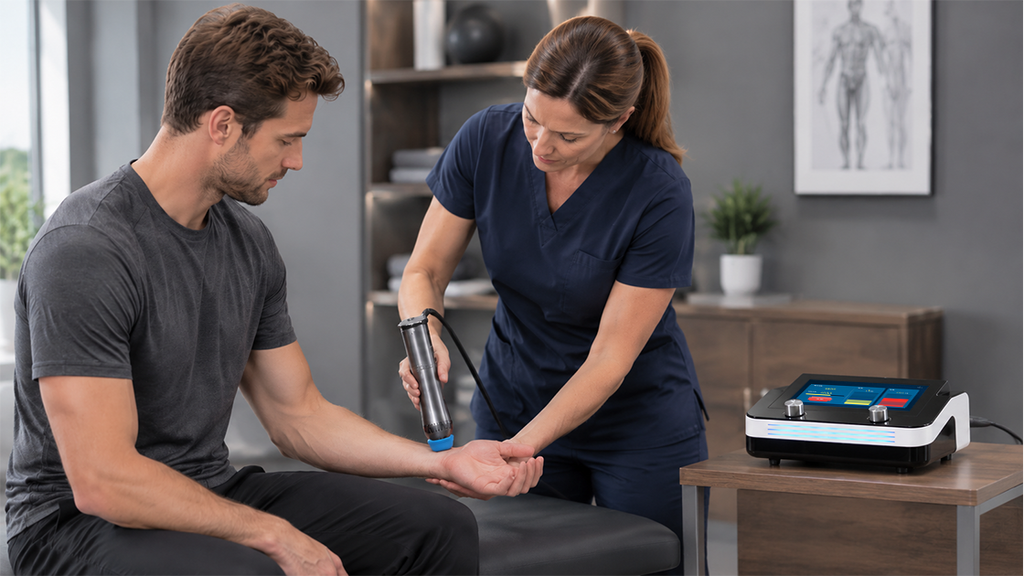
The SWAVE-200 is an electromagnetic shockwave therapy system designed for professional clinical use. According to its product specifications, it offers adjustable energy output from 30 to 210 mJ and an operating frequency range of 1 to 16 Hz.
Adjustable output allows trained practitioners to select treatment parameters according to the clinical target and individual assessment. These settings should not be selected solely according to a patient’s pain level or gaming-related symptoms.
The system is intended for use in clinics, hospitals, and professional rehabilitation settings. It is not recommended for unsupervised home or consumer use.
4.2 Seven Applicators for Different Treatment Areas
The SWAVE-200 includes seven applicators designed for different contact areas and treatment approaches. These include a 36 mm standard head, an 8 mm head, 15 mm convex and concave heads, a 20 mm concave head, a single-point head, and a flat head.
The larger applicator provides a broader contact area, while smaller or more focused contact designs allow practitioners to address more localized treatment regions. The selection depends on the tissue being assessed, the anatomical location, and the intended clinical approach.
For gamers with forearm or wrist complaints, applicator selection should be guided by the specific muscle or tendon involved. Neck and upper shoulder applications also require careful attention to anatomical structures and appropriate treatment boundaries.
4.3 Operating Design and Treatment Control
The product information also describes a 10-million-shot service-life design, air-cooled handpiece, and a constant handpiece temperature range of 31–42°C. Its touchscreen operation and treatment protocols are intended to support professional workflow and parameter management.
These features are relevant to rehabilitation practices that work with different musculoskeletal presentations. However, device specifications alone do not establish clinical effectiveness for a particular diagnosis. Treatment decisions should remain based on clinical evidence, practitioner training, and individual assessment.
5. Integrating Shockwave Therapy Into a Gamer Rehabilitation Plan
5.1 Clinical Assessment Before Treatment
Persistent wrist, forearm, or neck discomfort should be assessed before beginning shockwave therapy. A practitioner may review the player’s training schedule, gaming equipment, symptom duration, movement patterns, and previous injuries.
The assessment should also consider whether symptoms are associated with muscle fatigue, tendon involvement, joint problems, or nerve irritation. Numbness, tingling, unexplained weakness, or symptoms that extend into the hand may require further evaluation rather than immediate soft tissue treatment.
5.2 Combining Treatment With Ergonomic Adjustments
Shockwave therapy, when clinically appropriate, should not replace adjustments to gaming habits and workstation design. A rehabilitation plan may also include progressive strengthening, mobility exercises, and changes to training volume.
Monitor height, chair support, keyboard and mouse positioning, and forearm support can influence the physical demands of gaming. Regular breaks and variations in posture may also help reduce prolonged static loading.
For professional players, recovery planning is particularly important during tournament preparation. Balancing practice intensity with adequate rest can help maintain physical tolerance without relying on passive treatment alone.
5.3 Supporting Long-Term Training Consistency
A structured rehabilitation approach should consider both symptom management and the player’s ability to tolerate gaming-related tasks. Progress may be evaluated through wrist movement, grip function, neck mobility, and the duration of activity that can be completed comfortably.
Treatment plans should be adjusted according to clinical response. If symptoms persist, worsen, or return repeatedly, the underlying diagnosis and rehabilitation strategy may need to be reassessed.
6. Safety and Clinical Considerations
6.1 Professional Evaluation and Appropriate Treatment Selection
Shockwave therapy is not suitable for every type of gaming-related discomfort. Acute injuries, unexplained pain, suspected fractures, significant nerve symptoms, and certain medical conditions require appropriate evaluation before treatment is considered.
Practitioners should review relevant medical history and follow device-specific instructions and clinical safety guidance. Treatment parameters should be selected by trained professionals rather than copied from general protocols.
6.2 Understanding Treatment Limitations
Shockwave therapy does not correct poor workstation ergonomics, eliminate excessive training volume, or replace rehabilitation exercises. It also should not be presented as a guaranteed solution for carpal tunnel syndrome, nerve compression, or nonspecific neck pain.
For professional gamers, the most appropriate approach is a combination of accurate diagnosis, workload management, ergonomic adjustments, and condition-specific rehabilitation. Shockwave therapy may have a supportive role when the identified musculoskeletal condition and available evidence justify its use.
FAQ
1. Can shockwave therapy help with wrist pain from gaming?
It may be considered for selected chronic tendon or soft tissue conditions after clinical assessment. However, not all gaming-related wrist pain is suitable for shockwave therapy.
2. Can professional gamers receive shockwave therapy for forearm discomfort?
Potentially, if a practitioner identifies an appropriate musculoskeletal condition. The treatment approach depends on whether symptoms involve muscle tissue, tendons, joints, or nerves.
3. Is shockwave therapy suitable for neck tension caused by gaming?
It may be considered for certain muscular conditions, but neck treatment requires careful anatomical assessment. It is not a universal treatment for all forms of neck pain.
4. How does the SWAVE-200 support musculoskeletal treatment?
The SWAVE-200 provides electromagnetic shockwave output adjustable from 30 to 210 mJ, a frequency range of 1–16 Hz, and seven applicators for different treatment areas.
5. Can shockwave therapy replace breaks and ergonomic adjustments?
No. It does not replace appropriate workstation design, training-load management, movement breaks, or rehabilitation exercises. These remain important parts of managing gaming-related physical strain.
6. Is the SWAVE-200 designed for home use?
No. The product is intended for professional use in clinics, hospitals, and rehabilitation settings by trained practitioners. It is not recommended for unsupervised home use.
Conclusão
Professional gaming places repeated demands on the wrists, forearms, and neck, making musculoskeletal discomfort an important consideration for competitive players. Although research has documented a substantial burden of physical complaints among esports athletes, the causes and appropriate treatments vary between individuals. Shockwave therapy may be considered as one component of rehabilitation for selected chronic tendon or soft tissue conditions, but direct evidence for gaming-specific injuries remains limited. The SWAVE-200 offers adjustable electromagnetic shockwave output, multiple applicators, and professional treatment controls for clinical environments. When used following appropriate assessment, it may form part of a broader care strategy that also addresses ergonomics, physical conditioning, and recovery habits.
Referências
- Do Esports Players Experience Pain? Pain Prevalence of Esports Players: A Systematic Review and Meta-analysis. Sports Medicine – Open.
https://pubmed.ncbi.nlm.nih.gov/41483384/ - Musculoskeletal Disorders in eSports Athletes: A Systematic Review. Journal of Experimental Orthopaedics.
https://pubmed.ncbi.nlm.nih.gov/42255400/ - Musculoskeletal Pain Is Common in Competitive Gaming: A Cross-Sectional Study Among Danish Esports Athletes. BMJ Open Sport & Exercise Medicine.
https://pmc.ncbi.nlm.nih.gov/articles/PMC7876625/ - Musculoskeletal Pain in eSports Players: Clinical Implications for Ergonomics, Exercise, and Preventive Physiotherapy.
https://pubmed.ncbi.nlm.nih.gov/41275338/ - SWAVE-200 Electromagnetic Shockwave Therapy Machine – Product Specifications and Applicators.
https://www.shockwavemachines.com/swave-200-best