

Введение
The alarm clock rings. You swing your legs out of bed. And then it hits you — a sharp, stabbing pain deep in your heel that makes you gasp and grab the nightstand for support. Every morning starts this way. The pain eases after you limp around for a few minutes, but that first step feels like stepping on broken glass. For millions of people over 50 — especially women who spend their days on their feet cooking, cleaning, chasing grandchildren or working part‑time retail shifts — this morning ritual is a daily reminder that heel pain is stealing the simple joy of walking. Extracorporeal shockwave therapy offers a non‑invasive, drug‑free way to help manage chronic heel pain associated with plantar fasciitis and heel spurs, so you can step out of bed without dread.
1. Understanding Heel Spurs and Why Morning Pain Is So Severe
Heel pain that strikes hardest with the first steps of the day has a distinctive name: post‑static dyskinesia. It is a hallmark of plantar fasciitis, often accompanied by a bony heel spur. Understanding why this happens — and why it keeps returning — is the first step toward relief.
1.1 What Is a Heel Spur and How Does It Relate to Plantar Fasciitis
A heel spur is a small, bony outgrowth that forms on the underside of the heel bone, where the plantar fascia attaches. The plantar fascia is a thick band of tissue that runs along the bottom of your foot, supporting the arch. When this tissue becomes chronically irritated, the body deposits calcium in the stressed area, eventually forming a spur. Many people think the spur itself is the cause of their pain, but that is not always accurate. The real source of discomfort is the surrounding inflammation and micro‑tears in the plantar fascia. The fascia — not the bone — is what screams when you take that first morning step.
1.2 Why the First Step in the Morning Hurts the Most
During sleep, the plantar fascia shortens and relaxes. When you suddenly stand and place your full weight on the foot, the fascia is stretched from its shortened position, tugging at its attachment on the heel bone. If the tissue is already inflamed, that sudden stretch creates a sharp, tearing sensation. The same mechanism explains why pain often improves after a few minutes of walking — gentle movement warms up the tissue and gradually lengthens the fascia. However, as the day goes on and you stay on your feet, the pain may return or shift to a dull, aching sensation. People who stand for long periods on hard floors often find that their heel hurts more after rest periods, not during activity.
1.3 Why Middle-Aged and Older Women Are Disproportionately Affected
Women in their fifties and sixties are diagnosed with plantar fasciitis and heel spurs at much higher rates than men. Lifestyle factors play a role: women often spend long hours on their feet in the home kitchen, working as nurses, cashiers, or teachers, all jobs that involve prolonged standing on hard surfaces. Weight gain after menopause increases the load on the plantar fascia. The natural loss of soft tissue padding in the heel with age leaves less cushion against impact. Hormonal changes may also affect the elasticity of connective tissue. For a homemaker who cannot simply sit down for a week, the pain becomes a daily battle that interferes with everything from grocery shopping to enjoying a walk with the dog.
2. How Extracorporeal Shockwave Therapy Targets Chronic Heel Pain
Extracorporeal shockwave therapy delivers high‑energy acoustic waves to the painful area, triggering the body‘s own healing response. For chronic plantar fasciitis and associated heel spurs — especially cases that have not improved with rest, ice, stretching, or over‑the‑counter inserts — shockwave therapy offers a powerful non‑surgical option.
2.1 What Shockwave Therapy Is and How It Reaches Deep Foot Tissues
Unlike a topical cream or a basic massage, shockwave therapy sends focused or radial pressure waves several centimeters into the tissue. The energy penetrates skin, fat, and muscle to reach the inflamed plantar fascia and the surrounding bone attachment. These waves create micro‑mechanical forces at the cellular level. The body perceives this mechanical stimulation as a controlled micro‑trauma, which triggers a natural inflammatory‑like healing response. Blood flow increases dramatically in the treated area, bringing oxygen and nutrients that support tissue repair. Over time, the body clears damaged tissue, breaks down scar tissue, and stimulates the regeneration of healthier fascia fibers.
2.2 How Shockwave Therapy Helps Manage Morning Pain
The mechanism of shockwave therapy is sometimes described as “turning on the body‘s repair switch.” When the acoustic waves hit the injured tissue, several biological processes activate. Pain transmission can be temporarily down‑regulated through a process often called the gate control mechanism. New blood vessels form in the area, a process called angiogenesis, which improves the delivery of healing factors to the chronically under‑nourished fascia. For patients who have a visible heel spur on X‑ray, shockwave therapy may help reduce the sensitivity of the surrounding soft tissue and, in some cases, contribute to the resorption of calcified deposits. More importantly, the therapy reduces the local inflammation that makes that first morning step feel like a knife stab. After a course of treatment, patients often describe the morning pain as a mild tug rather than a sharp stab.
2.3 What the Evidence Shows About Shockwave for Plantar Fasciitis
Systematic reviews and meta‑analyses have examined shockwave therapy in patients with chronic plantar fasciitis. A systematic review and meta‑analysis concluded that ESWT has been proven to be a successful treatment for plantar fasciitis, with outcomes comparable to other non‑surgical modalities. Another meta‑analysis found that plantar fascia thickness is significantly decreased after ESWT intervention in patients with plantar fasciitis. Clinical reports indicate that ESWT helps alleviate pain and functional limitations associated with plantar fasciitis. Many patients who have lived with heel pain for months or years find that a course of shockwave therapy provides meaningful relief that allows them to return to normal daily activities without the constant reminder of pain.
3. The Shockwave Advantage Over Traditional Approaches
Women who have struggled with heel pain have often tried many remedies: ice bottles rolled under the foot, elaborate stretching routines, gel heel cups, oral anti‑inflammatories, and sometimes even corticosteroid injections. Each approach has limitations that shockwave therapy helps overcome.
3.1 Why Corticosteroid Injections Carry Risks for Long‑Term Foot Health
Steroid injections are sometimes offered for plantar fasciitis, and they can provide dramatic short‑term pain relief. However, the relief is often temporary; the pain frequently returns within weeks or months. More importantly, corticosteroid injections carry significant risks: they can weaken the plantar fascia, making it more vulnerable to rupture; they can cause fat pad atrophy in the heel, reducing natural cushioning and leading to deeper, harder‑to‑treat pain; and each injection introduces a small risk of infection. A systematic review of the literature noted that corticosteroid injection provides only short‑term relief while carrying several risks. For someone who simply wants to walk comfortably without repeated trips to the clinic, shockwave therapy offers a safer, longer‑lasting alternative.
3.2 Why Surgery Is Often a Last Resort People Want to Avoid
Surgical release of the plantar fascia is an option, but it is rarely the first choice. The operation requires an incision, weeks of restricted weight‑bearing, and a lengthy recovery before returning to normal activity. Complications can include nerve damage, persistent pain, and arch instability. Many women in their fifties and sixties have family obligations or part‑time work that simply cannot accommodate a surgical recovery period. Shockwave therapy requires no incision, no anesthesia, and — most importantly — no recovery downtime. You walk into the clinic, receive treatment, and walk out. You can drive yourself home and continue your normal daily routine. For someone who cannot afford to be off their feet, this convenience is a game‑changer.
3.3 A Non‑Invasive Option That Fits a Busy Homemaker’s Life
The woman who wakes up to heel pain is often the same person who runs the household: she cooks, she cleans, she shops, she drives the grandchildren to school. She does not have time for lengthy physical therapy or multiple doctor‘s visits. Shockwave therapy sessions are brief — typically 10 to 15 minutes per foot — and spaced one week apart for three to five sessions. There is no downtime, no special shoes to buy, and no complicated home exercise program to follow. You attend the session, and you go back to your life. For a busy homemaker who is pulled in many directions, this simplicity is precisely what makes shockwave therapy appealing.
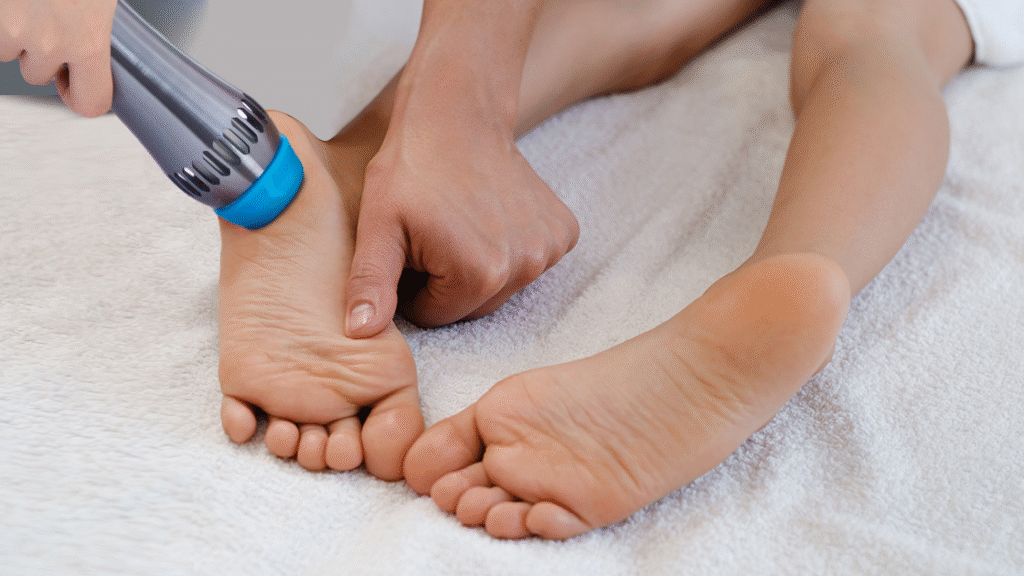
4. What to Expect During and After Shockwave Therapy
Understanding what happens before, during, and after a shockwave session helps reduce anxiety and set realistic expectations. The treatment is straightforward, but knowing what to expect makes it easier to commit to the full course.
4.1 Preparing for Treatment and What Most People Feel
Before your first session, it helps to wear loose pants that can be rolled up easily to expose your foot and ankle. Avoid applying thick creams or ointments on your heel on the day of treatment, as they may interfere with the therapy. No anesthesia or special fasting is needed. Most people describe the sensation as a deep, focused thumping or a rapid tapping in the heel area. The feeling is noticeable but generally tolerable. A common misconception is that “more pain means better results”; in reality, the clinician adjusts the intensity based on your comfort level, so you receive effective help without unbearable discomfort. Many patients are surprised at how quick and manageable each session is — often just a few minutes per foot.
4.2 What to Expect in the Days Following Treatment
It is common to experience mild soreness, warmth, or redness in the treated area for a day or two after a session. This reaction is a sign that the body‘s healing mechanisms have been activated. Normal activities can be resumed immediately after treatment. Most patients do not need to modify their daily routine in any way. The morning pain that used to be sharp may become duller after the first session. For many patients, meaningful improvement is noticed after the second or third treatment, rather than immediately. Patience is important: the body needs time to repair tissue and reduce inflammation. The full effect is often appreciated several weeks after completing the entire series of treatments.
4.3 How Many Sessions Are Typically Needed
Clinical protocols vary, but most patients with chronic plantar fasciitis benefit from three to five sessions, spaced approximately one week apart. Some patients notice a reduction in pain after a single session; most see progressive improvement after two or three. Patients who have had heel pain for more than six months may need the full course of five sessions. If pain persists after the initial series, a secondary course may be considered after a waiting period of several months. Over 80 percent of patients with chronic heel pain report less pain or no pain after completing shockwave therapy, according to clinical reports. The key is completing the full course rather than stopping after one or two sessions.
5. Building Long‑Term Foot Comfort After Shockwave Therapy
Shockwave therapy helps break the cycle of chronic inflammation, but maintaining foot health requires ongoing attention. A few simple habits can extend the benefits of treatment and prevent the pain from returning.
5.1 Recognizing That One Treatment Course Is Not a Lifetime Cure
The goal of shockwave therapy is to manage the acute symptoms of plantar fasciitis to the point where daily life is no longer dominated by heel pain. For many patients, this means that after a course of treatment, the morning pain is gone or greatly reduced, and walking is comfortable. However, the underlying biomechanics that contributed to the problem — such as foot arch mechanics, tight calf muscles, or time spent on hard floors — remain. Continuing with gentle calf stretches, wearing supportive shoes even around the house, and avoiding walking barefoot on hard floors can help prevent recurrence. Shockwave therapy buys you relief; respectful daily habits maintain it.
5.2 Complementary Habits That Support Heel Comfort
Simple changes make a real difference. Stretching the calf muscles and the plantar fascia gently each morning — before you stand up — can reduce the sudden stretch that triggers pain. Tugging the toes toward the shin while still lying in bed, using a towel or your hands, warms up the fascia before weight‑bearing. Wearing shoes with good arch support and a cushioned heel, even when doing housework, reduces the repeated impact that irritates the plantar fascia. Replacing worn‑out walking shoes every few months is important for active people. Avoiding prolonged standing on hard concrete surfaces — using a padded mat in the kitchen — also helps.
5.3 When to Consider a Second Course of Treatment
Some patients experience a return of symptoms months or even years after a successful course of shockwave therapy. This does not mean that the therapy failed; it means that the underlying mechanical stresses have accumulated again. A second course of three to five sessions is often just as effective as the first. Some clinicians recommend preventive single sessions every six to twelve months for patients with chronic foot problems. The decision to repeat treatment depends on your symptom pattern and quality of life. For a homemaker or retiree who treasures their daily walk, a second course is often well worth the investment in comfort.
FAQ
Q1: Does shockwave therapy for heel spurs hurt during the procedure?
Most people describe the sensation as deep thumping or rapid tapping. It is noticeable but generally tolerable. The clinician adjusts the intensity based on your feedback.
Q2: How soon will I notice less morning pain?
Many patients notice a reduction in sharp morning pain after the second or third session. Full improvement often occurs several weeks after completing treatment.
Q3: Can I walk normally right after a session?
Yes. There is no downtime. You can leave the clinic and resume all normal activities immediately.
Q4: How many sessions will I need for chronic heel pain?
Most patients benefit from three to five sessions spaced about one week apart. Some patients need a second course after several months.
Q5: Who should not receive shockwave therapy?
In general, pregnant women, people with acute infection or open skin wounds in the treatment area, and individuals with electronic implants such as pacemakers should avoid shockwave therapy. A proper evaluation is always needed before treatment.
Заключение
The morning alarm that once announced a sharp, stabbing pain in your heel does not have to define your day. Extracorporeal shockwave therapy gives homemakers, retirees, and anyone who spends their days on their feet a non‑invasive, drug‑free way to help manage chronic heel pain without surgery, needles, or downtime. You can step out of bed without hesitation, walk through your day without limping, and reclaim the simple pleasure of moving freely. Your feet carry you through life; with the right help, they can do so without pain.
Ссылки
Mayo Clinic. Physical Medicine and Rehabilitation.
Mayo Clinic News Network. Mayo Clinic Q and A: Shockwave therapy may help relieve foot problem.
https://newsnetwork.mayoclinic.org
National Institute for Health and Care Excellence (NICE). Extracorporeal shockwave therapy for refractory plantar fasciitis.
PubMed. Extracorporeal shock wave therapy shows comparative results with other modalities for the management of plantar fasciitis: A systematic review and meta-analysis.
https://pubmed.ncbi.nlm.nih.gov
PubMed. Effects of kinesio taping versus extracorporeal shock wave therapy on pain in the treatment of plantar heel pain secondary to plantar fasciitis and a calcaneal spur: A retrospective clinical trial.
https://pubmed.ncbi.nlm.nih.gov
PMC. Comparison of extracorporeal shock wave therapy and high-intensity laser therapy in the treatment of calcaneal spur-related symptoms: clinical outcomes and functional improvement.