

Введение
A young ballerina finishes her barre warm‑up and moves into center practice. As she rises onto demi‑pointe for the twentieth time, a sharp pain shoots through the second toe of her right foot. By evening, her foot feels like someone drove a nail through the metatarsal head. Ballet pushes the foot to its absolute limit, and the second metatarsal—often the longest toe—bears the brunt of every relevé and jump. Over months of training, microscopic cracks develop faster than the body can repair them. Traditional treatment demands weeks in a walking boot, which can ruin an audition season. Extracorporeal shockwave therapy (ESWT) offers a different path: high‑energy acoustic waves delivered directly to the fracture site to awaken the bone’s healing capacity and shorten recovery.
1. Why the Ballerina‘s Second Toe Cracks First
The second metatarsal is the most commonly fractured bone in a dancer’s foot because of the unique biomechanics of ballet.
1.1 The Demands of En Pointe and Demi‑Pointe
On demi‑pointe, a dancer transfers many times her body weight through the metatarsal heads. The second toe is usually the longest, so it takes the first and hardest contact with the floor. This repetitive cyclical bending fatigues the bone like bending a paperclip back and forth. Small cracks appear in the cortex, and without intervention, they can become full stress fractures. The constant loading leaves no time for the bone to repair itself naturally, which is why dancers often suffer from this type of overuse injury.
1.2 The Second Metatarsal: A Structural Weak Point
The second metatarsal sits in a relatively fixed position compared to the first and fifth metatarsals, which have more mobility. This rigidity means it absorbs a disproportionate share of the impact during jumps and landings. Additionally, the blood supply to the base of the second metatarsal is less robust than that of the metatarsal head, making it slower to heal once injured. Dancers who train many hours each week without enough rest days place this slender bone under continuous strain, and eventually the microscopic damage accumulates faster than the body can remodel it.
1.3 Why Dancers Often Ignore the Early Signs
Ballet culture encourages pushing through discomfort, so early warning signs like a dull ache in the foot are often dismissed. The dancer continues rehearsals, and the pain gradually shifts from a nuisance to a sharp, localized sting right over the second metatarsal. By the time the dancer reports the injury, the bone may have a visible crack on imaging. Ignoring the early ache allows a stress reaction to progress to a full stress fracture, which then requires a much longer recovery. Recognizing the first twinge is essential, but shockwave therapy can still help even after a fracture has formed.
2. How Shockwave Therapy Accelerates Bone Healing
Extracorporeal shockwave therapy uses high‑energy acoustic pulses to stimulate bone repair, a technology originally developed for breaking up kidney stones but now adapted for musculoskeletal healing.
2.1 The Mechanical Trigger for Healing
When a shockwave passes through soft tissue and reaches bone, it creates rapid pressure changes that convert into mechanical stress within the bone. This stress mimics the natural signals that tell bone to remodel and strengthen. Controlled acoustic energy disrupts any fibrous tissue that may be blocking the healing site and activates the bone‑forming cells called osteoblasts. The mechanical kick‑start wakes up the bone’s own repair machinery, which otherwise might remain sluggish due to poor blood flow or chronic overload.
2.2 Improving Blood Supply and New Vessel Growth
One of the main reasons metatarsal stress fractures heal slowly is the limited blood supply to the affected area. Shockwave therapy addresses this by upregulating factors that encourage the growth of new capillaries. More blood vessels mean more oxygen and nutrients delivered directly to the fracture site. This improved circulation also clears away metabolic waste products that keep pain receptors activated. Without this vascular boost, the bone relies on a sparse network of small vessels, and healing drags on for weeks. Shockwave essentially builds a better supply line for repair.
2.3 Directing Stem Cells Toward Bone Formation
Beyond blood flow, shockwave influences which types of cells populate the fracture site. The acoustic energy encourages primitive stem cells to become osteoblasts (bone‑building cells) rather than fibroblasts that would form disorganized scar tissue. This shift from scar formation to genuine bone regeneration is critical for a stress fracture. Instead of simply filling the crack with weak fibrous tissue, the body lays down new, strong bone that can withstand the demands of ballet. The result is a more durable repair that reduces the chance of the same spot breaking again.
3. Practical Application for Ballet Dancers
Every day off is a step backward for a dancer, so shockwave therapy is designed to fit into their demanding schedule with minimal disruption to training.
3.1 What Happens During a Shockwave Session
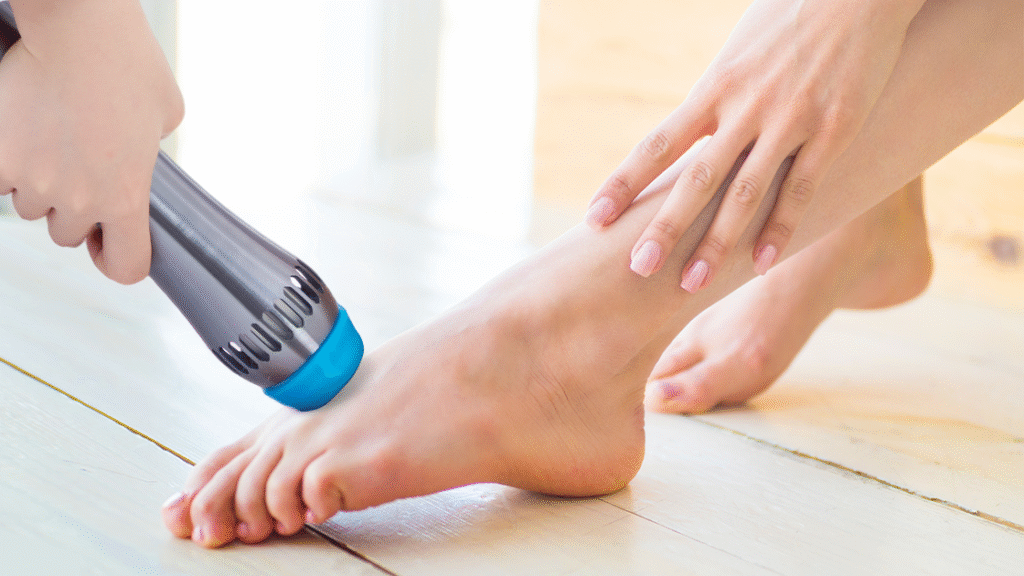
A focused shockwave session for a metatarsal stress fracture is straightforward and relatively short. The dancer lies down with the foot extended, and a small amount of gel is applied to the skin over the fracture site. A handheld applicator then delivers thousands of acoustic pulses to the area. The sensation is a deep, percussive thumping that may feel intense but not sharply painful. No needles, no medication, and no sedation are required. The entire treatment lasts between 8 and 12 minutes, after which the dancer can walk out of the clinic and resume normal daily activities.
3.2 Post‑Treatment Sensations and What They Mean
After a shockwave session, the foot may feel sore or achy for 24 to 48 hours. This post‑treatment soreness is a normal sign that the healing cascade has been activated. The bone and surrounding tissues are responding to the acoustic energy by starting the repair process. Some dancers also notice mild redness or tenderness to touch over the metatarsal. These effects are temporary and typically resolve on their own without any special care. A short period of soreness is a small price to pay for the significant acceleration in bone healing that follows.
3.3 Number of Sessions and Progression of Healing
A typical treatment plan for a metatarsal stress fracture involves several sessions spaced about one week apart. Fresh injuries generally require fewer sessions, while chronic fractures that have been present for months may need a few more. The bone does not heal instantly after the first session; the shockwave stimulates the biological process, and the body still needs time to lay down new bone. Dancers often notice that the sharp pain during walking or relevé decreases after the first or second session. By the end of the full course, the bone has remodeled sufficiently to allow a return to full ballet practice.
3.4 What the Dancer Must Do Between Sessions
Between shockwave sessions, the dancer must avoid activities that cause sharp pain, such as full jumps or repeated high‑relevé work. However, complete immobilization is not necessary and may even slow the healing process. Gentle walking in supportive shoes, upper‑body strength training, and low‑impact cardiovascular exercise like stationary cycling are acceptable. The key is to offload the metatarsal heads while still keeping the rest of the body conditioned. Once imaging confirms that the fracture has healed, the dancer can gradually reintroduce jumping and pointe work.
4. Long‑Term Foot Health for a Dancing Career
A single stress fracture often signals underlying issues in training technique or foot biomechanics. Addressing these factors helps prevent a second fracture.
4.1 Strengthening the Foot’s Intrinsic Muscles
After the fracture has healed, dancers benefit from a targeted strengthening program for the small muscles inside the foot. Toe spreading exercises, short‑foot drills, and resistance band work for the peroneals improve how the foot distributes load across the metatarsal heads. Stronger foot muscles absorb some of the force that would otherwise stress the bone directly. This is especially important for the second metatarsal, which naturally carries a higher load. A few minutes of daily foot exercises can make a substantial difference in preventing recurrence.
4.2 Shoe, Floor, and Rehearsal Modifications
Pointe shoes should be properly fitted and replaced as soon as the box softens, because a worn‑out shoe increases impact forces on the metatarsals. Studio floors also matter; hard surfaces amplify the shock of each jump, while sprung or marley floors absorb some of that energy. Dancers who have suffered a second‑metatarsal stress fracture should consider reducing the total number of high‑impact repetitions per week and incorporating more cross‑training days. These adjustments do not reduce artistry but protect the bone from repeated overload.
4.3 Recognizing the First Whisper of Trouble
A stress fracture rarely appears without warning. Dancers should learn to recognize prodromal signs: a dull ache in the second metatarsal that worsens with activity and improves with rest, tenderness when pressing on the bone, or a feeling of “bruising” without a specific injury. At the first hint of these symptoms, reducing jump volume and scheduling an earlier shockwave session can often limit the injury to a mild stress reaction, requiring fewer treatments and almost no time away from the barre.
Часто задаваемые вопросы (FAQ)
Q1: Will shockwave therapy hurt during the treatment?
Most dancers feel a deep tapping or thumping sensation. It is intense but not sharp. No anesthesia is needed, and any discomfort ends when the session stops.
Q2: How soon can I go back to pointe after shockwave?
You must wait until follow‑up imaging shows complete bone healing. This typically takes several weeks from the first session. Rushing pointe work risks a reinjury that will keep you off stage much longer.
Q3: Can I do barre exercises during the treatment weeks?
Light barre without jumps or full relevé may be allowed, but always follow your clinician’s advice. The goal is to stimulate healing, not to keep dancing at full performance intensity.
Q4: Is shockwave therapy safe for a young dancer?
Yes, when applied correctly. The acoustic energy is directed precisely at the fracture site and does not harm growing bone or growth plates when used by an experienced provider.
Q5: Will the stress fracture come back after shockwave?
If you return to the same training volume without addressing underlying biomechanics, recurrence is possible. Combining shockwave with foot strengthening and smarter load management greatly reduces that risk.
Заключение
The second metatarsal does not have to be the end of a ballerina‘s season. Stress fractures in this vulnerable bone are common but no longer require months of passive rest in a boot. Extracorporeal shockwave therapy delivers targeted acoustic energy that awakens the bone’s own healing machinery, stimulates new blood vessel growth, and shortens recovery time. With a protocol of weekly sessions, dancers can return to the studio faster, with stronger bone and a clear plan to prevent recurrence. The stage is waiting. Shockwave therapy helps you step back onto it.
Ссылки
Dall’Oca C, et al. Stress fractures of the base of the metatarsal bones in young trainee ballet dancers. Int Orthop. 2012;36(3):531‑536.
https://pubmed.ncbi.nlm.nih.gov/21874523/
Taki M, et al. Extracorporeal shock wave therapy for resistant stress fractures in athletes. J Orthop Surg. 2017;25(2):1‑5.
https://pubmed.ncbi.nlm.nih.gov/28631562/
Rompe JD, et al. Shock wave therapy for chronic plantar fasciopathy. Br Med Bull. 2007;81‑82:183‑208.
https://pubmed.ncbi.nlm.nih.gov/17586808/
Wang CJ. Extracorporeal shockwave therapy in musculoskeletal disorders. J Orthop Surg Res. 2012;7:11.
https://www.ncbi.nlm.nih.gov/pmc/articles/PMC3342896/
Al-Abbasi H, et al. The effectiveness of shockwave therapy in treating stress fractures: a systematic review. Phys Ther Sport. 2021;47:147‑155.
https://www.sciencedirect.com/science/article/abs/pii/S1466853X20304571