

Введение
The release of a bowling ball looks effortless from the stands, but for the bowler, a tremendous amount of force travels through the wrist in a split second. The repetitive gripping, swinging, and releasing—sometimes dozens of times per game and hundreds of times per week—place unique demands on the small tendons and ligaments on the inner side of the wrist. Over time, many bowlers begin to notice a dull ache along the ulnar side, the area below the pinky finger, especially after a long practice session or a tournament weekend. That nagging soreness may start as a mild annoyance, but without proper attention, it can progress to a persistent pain that affects performance and takes the enjoyment out of the game. For bowlers who have tried rest, ice, or over‑the‑counter measures without lasting relief, extracorporeal shockwave therapy offers a non‑invasive, drug‑free option that may help manage this common overuse condition.
1. Understanding Ulnar‑Sided Wrist Tendinitis in Bowlers
The ulnar side of the wrist refers to the region along the pinky finger side of the hand. This area contains several critical structures that stabilize the wrist during gripping and rotational movements. For bowlers, the repeated action of holding the ball, swinging the arm, and releasing the ball places significant stress on these tissues, making the ulnar wrist a common site of overuse injury.
1.1 The Structures Involved
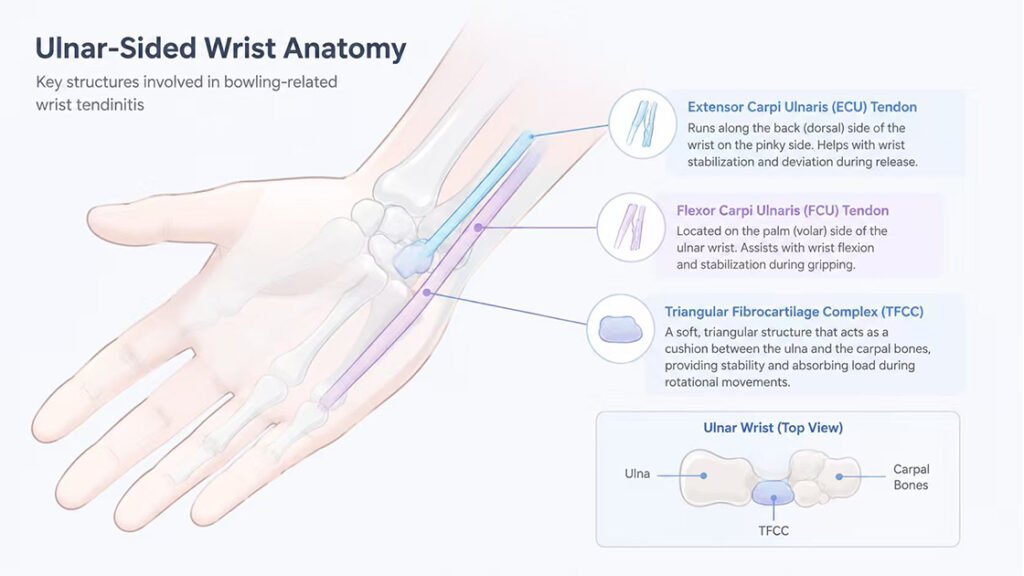
Several tendons cross the ulnar side of the wrist, but one of the most commonly affected in bowlers is the extensor carpi ulnaris (ECU) tendon, which runs along the back of the wrist on the pinky side and helps control wrist deviation and stabilization during the release. The flexor carpi ulnaris (FCU) tendon, located on the palm side of the ulnar wrist, is also vulnerable to repetitive strain from gripping the ball. Additionally, the triangular fibrocartilage complex (TFCC)—a small but important structure that cushions the joint between the ulna and the carpal bones—can become irritated from the twisting forces generated during the release. When these structures are overloaded repeatedly without adequate recovery, they can develop inflammatory or degenerative changes that lead to persistent wrist discomfort.
1.2 How Bowling Mechanics Contribute to Strain
The bowling delivery involves a coordinated sequence of motions that place specific demands on the wrist. As the bowler approaches the foul line, the wrist must maintain a stable position to control the ball‘s orientation. At the moment of release, the wrist typically undergoes a rapid ulnar deviation—a movement where the hand bends toward the pinky side—combined with a degree of rotation. This action generates high tensile and shear forces on the ulnar‑side tendons and ligaments. When a bowler uses a ball that is too heavy or when the finger holes do not fit properly, the wrist must work harder to maintain control, increasing the load on these already vulnerable structures. Over time, the cumulative effect of these forces can exceed the tissue‘s ability to repair itself, leading to the gradual onset of tendinitis.
1.3 Recognizing the Symptoms
Bowlers with ulnar‑sided tendinitis typically notice a dull, aching pain along the pinky side of the wrist, often felt most strongly after bowling rather than during the activity itself. The discomfort may worsen with certain movements, such as turning a doorknob, lifting a heavy object, or even performing a wrist curl exercise. Some bowlers also experience mild swelling or tenderness when pressing on the affected tendons. In more advanced cases, the pain may interfere with grip strength, making it harder to hold the ball securely or to control its release. Night pain or morning stiffness that improves with gentle movement is another common complaint. Recognizing these early warning signs is important because addressing the problem early can prevent it from becoming a chronic condition that requires a longer recovery period.
2. From Tendon Overload to Tendinopathy
Many people assume that wrist pain after bowling means inflammation of the tendon, often using the term “tendinitis” loosely. However, the underlying process in chronic overuse conditions is often different from acute inflammation. Understanding this distinction helps explain why simple rest and anti‑inflammatory measures sometimes fail to provide lasting relief.
2.1 The Degenerative Nature of Chronic Overuse
When a tendon is subjected to repetitive loads beyond its capacity, the cells within the tendon—called tenocytes—can become stressed and dysfunctional. Instead of maintaining healthy collagen fibers, the tendon begins to show disorganized fiber structure, an increase in ground substance, and sometimes the formation of small areas of cell death. This condition, known as tendinopathy, is more accurately described as a degenerative process rather than a purely inflammatory one. The suffix “‑itis” implies inflammation, but in chronic overuse tendinopathy, classic inflammatory cells are often not the dominant finding. This explains why anti‑inflammatory medications or ice may provide temporary relief but do not address the underlying tissue degeneration.
2.2 Why Rest Alone Often Isn’t Enough
A bowler who takes a week off may notice that the wrist feels better. However, when they return to the lanes, the pain often comes back quickly. The reason is that the structural changes within the tendon—the disorganized collagen, the reduced blood flow in the affected area, and the abnormal nerve growth that sometimes accompanies tendinopathy—remain even after a period of rest. The tendon does not need passive rest alone; it needs active remodeling. The damaged collagen must be replaced with properly aligned fibers, and the local environment must become more favorable for healing. This need for tissue remodeling is where therapies like shockwave therapy may offer a different approach.
3. How Shockwave Therapy Supports Tendon Healing
Extracorporeal shockwave therapy delivers high‑energy acoustic pulses through the skin directly to the injured tendon. The mechanical energy from these shockwaves triggers a cascade of biological responses that can support the body‘s own repair mechanisms. For bowlers with chronic ulnar‑sided wrist pain, this approach offers a non‑invasive alternative to injections or prolonged rest.
3.1 Mechanotransduction and Cellular Activation
When shockwaves reach the injured tendon, the mechanical pressure stretches and compresses cells in ways that activate specific signaling pathways. This process, called mechanotransduction, converts physical forces into biochemical signals that influence how cells behave. Tenocytes—the specialized cells within the tendon—respond by increasing their production of growth factors and proteins that are essential for tissue repair. This activation shifts the local environment from a state of chronic degeneration toward a more active healing phase. The mechanical input also releases biologically active molecules from the extracellular matrix, further amplifying the repair signal without introducing any foreign substance into the body.
3.2 Promoting New Blood Vessel Formation
One of the key challenges in treating chronic tendinopathy is that the injured area often has poor blood supply. The ECU and FCU tendons, like many tendons, have relatively limited vascularity in their mid‑portions. Poor blood flow means that oxygen, nutrients, and healing cells cannot reach the damaged tissue efficiently. Shockwave therapy stimulates the formation of new capillary networks around the treated tendon, a process known as neovascularization. Better blood flow brings oxygen and nutrients to the tenocytes, supports the removal of metabolic waste products that accumulate in degenerated tissue, and creates an environment more favorable for tissue remodeling.
3.3 Influencing Pain and Tendon Mechanics
Beyond its effects on tissue healing, shockwave therapy can influence how the nervous system processes pain signals. The acoustic pulses may temporarily alter nerve signaling in the treated area, providing a period of reduced discomfort that allows bowlers to move their wrists more comfortably. Additionally, by helping to break down small adhesions or soften fibrotic tissue around the affected tendons, shockwave therapy may improve the smooth gliding of tendons as the wrist moves through its normal range of motion. This can reduce the friction and irritation that contribute to the sensation of catching or pain during the release motion.
4. What Bowlers Can Expect from Shockwave Therapy
For bowlers considering shockwave therapy for their ulnar wrist pain, understanding the typical course of treatment helps set realistic expectations. The therapy is not an immediate solution but rather a process that supports the body‘s own healing over several weeks.
4.1 Number of Sessions and the Treatment Course
A standard course of shockwave therapy for chronic tendinopathy often involves three to five sessions spaced about one week apart. Each session is relatively brief, typically lasting only a few minutes, with the applicator positioned over the tender area on the ulnar side of the wrist. The total number of sessions may vary depending on the severity and chronicity of the condition. Some bowlers notice improvement after the first session or two, while others require the full series to experience meaningful change. The full benefit of shockwave therapy often becomes apparent several weeks after completing the sessions, as the tissue remodeling process takes time.
4.2 What the Sensation Feels Like
During the treatment, the shockwave applicator delivers rapid acoustic pulses. Many bowlers describe the sensation as a series of firm taps or a deep tapping feeling against the skin. The intensity can be adjusted, and most practitioners start with lower energy, gradually increasing based on the bowler‘s comfort. Unlike electrical stimulation, shockwave therapy does not cause muscle contraction. The discomfort, if any, stops as soon as the applicator lifts. Some individuals experience mild soreness in the treated area for a day or two after the session, similar to the feeling after a deep massage. This temporary response is normal and generally subsides on its own.
4.3 Activity During the Treatment Period
Bowlers can usually continue their normal daily activities during a course of shockwave therapy. However, it is generally advisable to avoid bowling or other activities that provoke significant wrist pain for a short period after each session to allow the tissue to respond to the treatment. Many practitioners recommend taking a few days of rest from bowling after each session, then gradually returning to activity as comfort allows. This approach helps prevent the treated tendon from being immediately overloaded before the healing response has had a chance to begin.
5. Supporting Wrist Health Alongside Shockwave Therapy
Shockwave therapy works most effectively when bowlers also address the factors that contributed to their wrist pain in the first place. The treatment supports tissue healing, but maintaining that improvement requires attention to equipment, technique, and daily habits.
5.1 Equipment Considerations
The weight of the bowling ball and the fit of the finger holes play significant roles in wrist stress. A ball that is too heavy forces the wrist muscles to work harder to control the swing and release, increasing the load on the ulnar‑side tendons. Similarly, finger holes that do not fit properly can cause the bowler to grip the ball more tightly than necessary, creating additional tension in the wrist. Having the ball fitted by a professional can reduce unnecessary strain. Some bowlers also benefit from using a wrist support or brace during practice to provide external stability and reduce the demands on the injured tissues.
5.2 Graduated Return to Bowling
Returning to full activity too quickly after a period of wrist pain risks perpetuating the cycle of injury. A better approach involves gradually reintroducing bowling, starting with shorter sessions or fewer games, and paying close attention to how the wrist responds. If pain returns or worsens, additional rest or a modification in technique may be needed. Bowlers should avoid the mindset of “playing through the pain,” as this often leads to worsening of the underlying tissue damage. Giving the wrist adequate recovery time between sessions, rather than bowling on consecutive days, can also support the healing process.
5.3 Stretching and Strengthening
Gentle stretching of the wrist flexors and extensors can help maintain flexibility and reduce stiffness. A simple stretch involves extending the arm straight with the palm facing up, gently pulling the fingers downward with the opposite hand. Strengthening the muscles around the wrist, forearm, and shoulder creates better stability throughout the kinetic chain, reducing the compensatory load on the ulnar wrist. Exercises such as wrist curls with a light weight, rubber band finger extensions, and grip strengthening can be introduced gradually once acute pain has subsided. Bowlers should perform these exercises without sharp pain and increase intensity slowly over time.
FAQ
Q1: Is shockwave therapy painful for ulnar wrist tendinitis?
Most bowlers describe a tapping or deep percussion sensation that is uncomfortable but brief. The session is short, and any discomfort stops when the applicator lifts.
Q2: How many sessions does a bowler typically need?
A common approach involves three to five sessions spaced about one week apart. Some bowlers notice improvement after two sessions, while others benefit from the full series.
Q3: Can I keep bowling during shockwave therapy?
Most practitioners recommend avoiding bowling for a day or two after each session to allow the tissue to respond. After that, gradual return to bowling is usually acceptable as comfort allows.
Q4: How soon after treatment will I feel less wrist pain?
Some bowlers notice a change within a week or two. However, the most noticeable improvement often takes several weeks to appear as the tissue remodels.
Q5: Does shockwave therapy work for all types of wrist tendinitis?
Shockwave therapy is most effective for chronic overuse tendinopathy where the tissue has undergone degenerative changes. It is not typically used for acute injuries or inflammatory conditions that have not yet become chronic.
Заключение
Bowlers understand the satisfaction of a well‑executed release, but for many, that satisfaction is tempered by a persistent ache on the ulnar side of the wrist. The repetitive gripping, swinging, and releasing that define the sport can, over time, lead to degenerative changes in the tendons that rest alone cannot reverse. For bowlers who have tried ice, rest, and other measures without lasting relief, extracorporeal shockwave therapy offers a non‑invasive, drug‑free option that works through mechanotransduction, neovascularization, and modulation of pain signaling. By supporting the body’s own healing processes, shockwave therapy may help bowlers manage their wrist discomfort and continue enjoying the sport they love. When combined with proper equipment fit, sensible training habits, and attention to early warning signs, it represents a valuable addition to a bowler‘s wrist care plan.
Ссылки
Lee YJ, et al. – Bowling: Occupational Hazards of the Wrist and Hand in Elite Tenpin Bowlers
https://pmc.ncbi.nlm.nih.gov/articles/PMC7982155
Extracorporeal Shock Wave Therapy (ESWT): Mechanisms, Applications, and Clinical Evidence in Musculoskeletal, Joint, and Spine Disorders
Bowling World Blog – Common Bowling Injuries and How to Prevent Them
https://bowlingworld.com/blog/common-bowling-injuries-and-how-to-prevent-them
Insidious Ulnar Sided Forearm Pain in Softball Pitcher and Bowler
https://scholarlycommons.henryford.com/fordreports/vol2/iss1/13
Экстракорпоральная ударно-волновая терапия для лечения боли в опорно-двигательном аппарате: сравнительный обзор
https://pubmed.ncbi.nlm.nih.gov/32565598
Shockwave Therapy Treatment Protocol for Tendinopathy