

Введение
You grip the paddle for another long training session on flat water. By the fifth kilometer, a sharp, burning pain flares up on the back of your wrist, just above the thumb side. You shake it off, finish the set, and spend the next day unable to open a jar or turn a doorknob without wincing. This is not a sprain or a simple strain. This is intersection syndrome, a specific overuse injury of the wrist common among kayakers who log thousands of strokes each week. Traditional advice—rest, ice, anti‑inflammatories—may calm the symptoms temporarily, but the pain returns as soon as you pick up the paddle again. Extracorporeal shockwave therapy (ESWT) offers a different solution. By delivering high‑energy acoustic waves directly into the inflamed tendon sheaths, shockwave therapy breaks the cycle of chronic irritation and helps kayakers return to the water without sitting out an entire season.
1. Why the Kayaker’s Wrist Is Vulnerable
The repetitive motion of paddling places unique stress on the tendons that cross the back of the wrist. Understanding this mechanism explains why intersection syndrome is so common among paddlers.
1.1 The Anatomy of Intersection Syndrome
Intersection syndrome affects the area where two sets of tendons cross. The radial wrist extensors (extensor carpi radialis brevis and longus) run deep, while the thumb abductors and extensors (abductor pollicis longus and extensor pollicis brevis) cross over them about 5 to 8 cm above the wrist joint. Every time a kayaker pulls the paddle through the water, these tendons slide against each other. With thousands of repetitions, the friction causes peritendinitis—inflammation of the sheath around the tendons, not the tendons themselves. The result is swelling, pain, and a characteristic creaking or grinding sensation when moving the wrist.
1.2 How Paddling Produces the Injury
In a standard paddling stroke, the wrist moves from extension to flexion while the hand grips the paddle shaft. The thumb side of the wrist bears much of the load, especially during the catch and pull phases. If the paddle shaft is too thick, if the paddler grips too tightly, or if the technique involves excessive wrist deviation, the crossing tendons are compressed and rubbed with each stroke. Over a 10‑km paddle, the wrist may perform 2,000 to 3,000 deep, loaded repetitions. This relentless friction inflames the tendon sheaths, and without intervention, the condition becomes chronic.
1.3 Why Rest Alone Does Not Work
Unlike a muscle strain that heals with simple rest, intersection syndrome involves a mechanical friction problem. Even after the inflammation subsides, the anatomical crossing of the tendons remains. When the paddler returns to the water, the same rubbing motion restarts the cycle. Anti‑inflammatory medications reduce swelling temporarily but do not change the relationship between the tendons. Ice and bracing only mask the symptoms. What the injured tissue needs is a stimulus that remodels the sheath, reduces adhesions, and allows the tendons to glide smoothly again. That is exactly what shockwave therapy provides.
2. How Shockwave Therapy Heals the Wrist
Shockwave therapy uses high‑energy acoustic waves to penetrate deep into soft tissue. For intersection syndrome, the shockwave targets the inflamed tendon sheath and the surrounding fascia, triggering a cascade of healing responses.
2.1 Breaking Down Adhesions and Fibrosis
Chronic intersection syndrome leads to the formation of adhesions—sticky bands of fibrous tissue that bind the tendon sheaths together. These adhesions are the reason the wrist feels tight and produces a grinding sensation with movement. The acoustic waves from shockwave therapy generate mechanical shear forces that physically disrupt these adhesions. The micro‑trauma breaks up the disorganized scar tissue, freeing the tendons to slide independently. This mechanical effect is felt almost immediately, as many patients report improved range of motion after the first session.
2.2 Stimulating Neovascularization
Inflamed tendon sheaths have poor blood flow, which is why they fail to heal on their own. Shockwave therapy upregulates vascular endothelial growth factor (VEGF), a protein that signals the body to grow new capillaries. Within a few weeks after treatment, the previously hypoxic area becomes flooded with fresh, oxygen‑rich blood. Improved circulation brings immune cells to clear inflammatory debris and delivers the nutrients necessary for tissue repair. This vascular response is the key to long‑term healing, not just temporary symptom relief.
2.3 Modulating Pain and Inflammation
Shockwave also directly affects the nerve fibers that transmit pain signals. The acoustic energy temporarily overloads small, pain‑conducting nerve fibers, a phenomenon called hyperstimulation analgesia. This provides immediate pain relief that can last for hours or days after a session. At the same time, the shockwave reduces levels of pro‑inflammatory mediators such as substance P and prostaglandin E2. The combination of pain relief and anti‑inflammatory effect allows kayakers to begin gentle rehabilitation exercises sooner, accelerating the overall recovery timeline.
2.4 Why Shockwave Works When Other Treatments Fail
Intersection syndrome is a mechanical problem as much as an inflammatory one. Topical creams and oral medications address only the chemical side of inflammation. Cortisone injections reduce swelling powerfully but carry a risk of tendon weakening and rupture with repeated use. Surgery to release the tendon sheaths is effective but requires weeks of immobilization. Shockwave therapy sits in the middle: it provides the mechanical disruption needed to break adhesions, the biological stimulus to heal the sheath, and the pain relief to keep the athlete moving. All of this happens without needles, without incisions, and without time away from daily activities.
3. Practical Application for Kayakers
For a paddler, every missed training day affects endurance and technique. Shockwave therapy is designed to fit around a kayaking schedule, not shut it down.
3.1 What a Treatment Session Looks Like
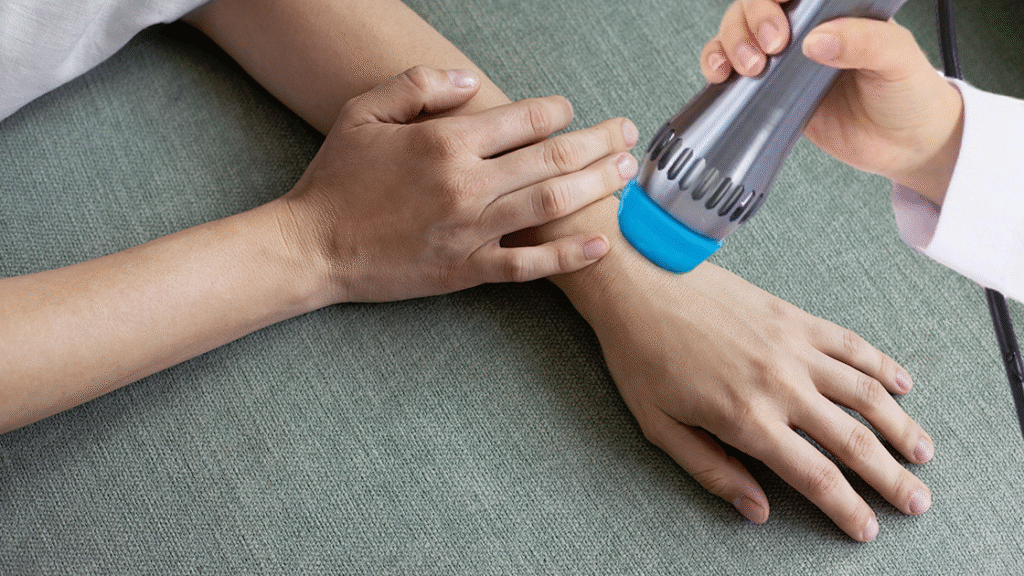
A shockwave session for intersection syndrome lasts 8 to 12 minutes. The kayaker sits with the forearm resting on a table, palm down. The clinician applies ultrasound gel to the dorsal wrist, about 5 to 8 cm above the joint where the tendons cross. Using a focused or radial handpiece depending on the depth of the target, they deliver 1,500 to 2,500 pulses. The sensation is a deep, rapid tapping—uncomfortable but tolerable. No anesthesia, no needles, and no sedation are required. After the session, the wrist may feel sore for 24 to 48 hours, which is a normal sign that the healing process has been activated.
3.2 Number of Sessions and Spacing
A typical protocol for intersection syndrome involves three to five sessions spaced about one week apart. Mild cases with recent onset may resolve after three sessions. Chronic conditions that have been present for months may need five or six sessions. The wrist does not heal instantly after the first treatment. Each session builds on the previous one, gradually breaking down adhesions and stimulating new blood vessel growth. Kayakers often notice reduced pain during paddling after the second session and near‑complete resolution after the fourth. Full tissue remodeling takes four to six weeks after the final session.
3.3 What to Do Between Sessions
Between shockwave sessions, avoid activities that cause sharp pain, such as heavy paddling or gripping exercises. However, complete rest is not required. Gentle range‑of‑motion movements, such as wrist circles and passive stretching of the thumb extensors, help maintain mobility. Ice can be used for the first 24 hours after a session if soreness is intense, but avoid anti‑inflammatory medications like ibuprofen, as they may blunt the healing signal that shockwave relies on. Wearing a lightweight wrist wrap for support during daily activities is acceptable, but do not immobilize the joint completely.
3.4 Returning to the Water
Do not return to full paddling immediately after a shockwave session. Wait at least 48 hours after the final session before picking up a paddle. When you do return, start with short, low‑intensity paddles of 10 to 15 minutes. Focus on technique: relax your grip, keep your wrists neutral, and avoid excessive radial deviation. Gradually increase duration and intensity over two weeks. If pain returns, back off and schedule a maintenance session. Most kayakers resume full training four to six weeks after starting shockwave therapy, with a wrist that feels stronger and more resilient than before the injury.
4. Long‑Term Prevention for Paddlers
Once the wrist has healed, kayakers need to address the factors that caused intersection syndrome in the first place. Prevention is more effective than repeated treatment.
4.1 Paddle Fit and Technique
A paddle shaft that is too thick forces the hand to grip wider, increasing stress on the radial wrist tendons. Choose a shaft diameter that allows a relaxed grip. For many paddlers, a smaller‑diameter paddle or one with ergonomic shaping can reduce wrist strain. Additionally, avoid gripping the paddle too tightly. A death grip transmits shock directly to the wrist with each stroke. Practice holding the paddle with just enough force to control it, not to crush it. Video analysis of your stroke can reveal excessive wrist deviation or a “breaking” wrist position that needs correction.
4.2 Strengthening and Flexibility
Weak wrist extensors are more prone to injury. After the acute pain has resolved, incorporate eccentric wrist extension exercises using a light dumbbell or resistance band. Stretch the thumb abductors and extensors gently before and after paddling: hold the thumb down with the opposite hand while bending the wrist toward the pinky side. A strong, flexible wrist handles the repetitive load of paddling much better. A five‑minute daily routine of wrist circles, finger spreads, and gentle stretching can make a significant difference over a season.
4.3 Recognizing Early Warning Signs
Intersection syndrome rarely appears suddenly. Most kayakers experience a dull ache or a “tight” feeling on the back of the wrist after long paddles. The pain may disappear within hours but returns earlier on the next outing. A popping or grinding sensation with wrist movement is another early sign. At the first hint of these symptoms, reduce paddling volume by half and pay attention to grip technique. Schedule a shockwave session promptly rather than waiting for the pain to become sharp and constant. Early intervention often limits the condition to a mild irritation that resolves with just two or three shockwave sessions.
Часто задаваемые вопросы (FAQ)
Q1: Does shockwave therapy hurt during the treatment?
Most kayakers feel a deep, rapid tapping sensation. It is intense but not sharp. Any discomfort stops immediately when the session ends.
Q2: How soon after shockwave can I paddle again?
Wait at least 48 hours after the final session. Start with short, easy paddles and gradually build up over two weeks.
Q3: Will the wrist pain come back after treatment?
If you return to the same paddle fit, grip, and technique without changes, recurrence is possible. Combine shockwave with equipment adjustments and strengthening to prevent it.
Q4: Can I use shockwave therapy between race days?
Yes. Many competitive paddlers schedule a single maintenance session during a light training week to keep the tendon sheaths healthy and prevent flare‑ups.
Q5: How do I know if I have intersection syndrome and not something else?
Intersection syndrome causes pain on the back of the wrist about 5–8 cm above the joint, on the thumb side. If you hear a creaking sound when you move your wrist, that is a strong clue.
Заключение
The burning pain on the back of your wrist does not have to end your paddling season. Intersection syndrome is a predictable injury for kayakers who put in the kilometers, but it is also highly treatable. Extracorporeal shockwave therapy breaks the cycle of friction, adhesions, and chronic inflammation by physically disrupting scar tissue, stimulating new blood vessel growth, and calming pain signals. With a typical three to five session protocol, kayakers can return to the water with a wrist that glides smoothly through each stroke. The paddle is still there. Shockwave therapy makes sure you can grip it without wincing.
Ссылки
Smart Laser Therapy. Class IV Laser Therapy for Sports Injuries.
FotonMedix. Class IV Laser Therapy Protocols for Rotator Cuff Tendinopathy: A Clinician’s Guide to HILT.
Hamblin MR. Mechanisms and applications of the anti‑inflammatory effects of photobiomodulation. AIMS Biophys. 2017;4(3):337‑361.
https://pmc.ncbi.nlm.nih.gov/articles/PMC5523874/
Elnaggar RK, et al. High‑intensity versus low‑level laser therapy in treatment of patients with subacromial impingement syndrome: a randomized, double‑blind, controlled trial. Lasers Med Sci. 2025;40:8.
https://link.springer.com/article/10.1007/s10103-024-04262-1
Effects of high‑intensity laser therapy on subacromial impingement syndrome: a systematic review and meta‑analysis. Springer Medicine. 2024.