

Introducción
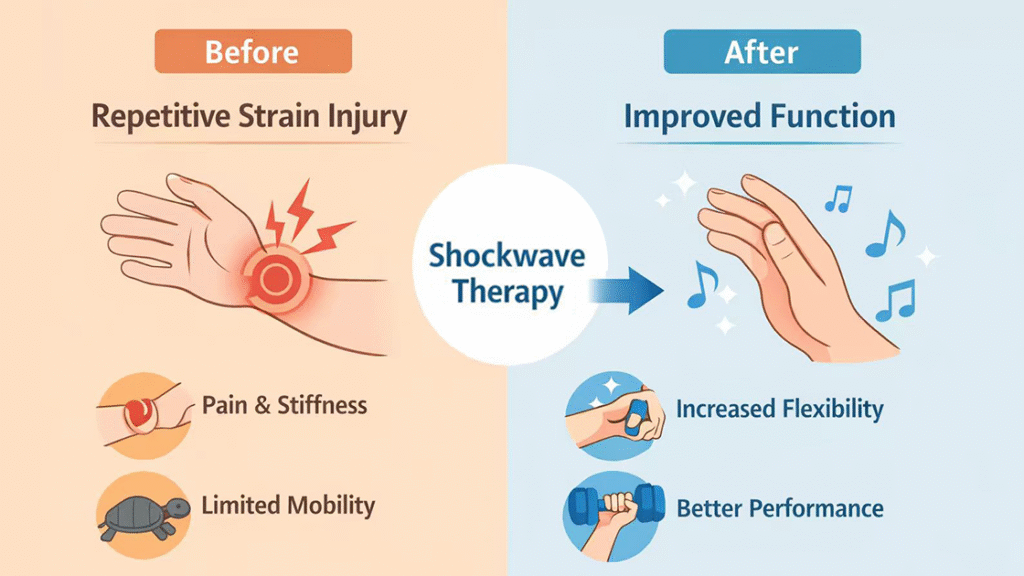
For professional musicians, physical performance is inseparable from artistic expression. Hours of daily practice, repetitive fine motor movements, and sustained postures place exceptional demands on the musculoskeletal system. Over time, these demands often lead to repetitive strain injuries (RSI), a common yet career-threatening issue in musicians. Shockwave therapy has emerged as a non-invasive treatment option that addresses chronic pain and soft tissue dysfunction while preserving the precision and control essential for musical performance.
1. Understanding Repetitive Strain Injuries in Musicians
Before exploring treatment options, it is important to understand why RSI develops so frequently in musicians and how it affects their ability to perform.
1.1 What Are Repetitive Strain Injuries (RSI)?
Repetitive strain injuries refer to a group of musculoskeletal conditions caused by cumulative microtrauma from repeated movements or sustained loading. In medical terms, RSI involves chronic overload of muscles, tendons, fascia, and sometimes peripheral nerves. Unlike acute injuries, RSI develops gradually as tissue repair fails to keep pace with repeated mechanical stress. This imbalance often leads to pain, stiffness, reduced endurance, and impaired motor coordination.
1.2 Why Musicians Are at High Risk
Musicians are uniquely vulnerable to RSI due to the combination of repetition, precision, and duration. Instrument-specific techniques often require thousands of identical movements each day, frequently performed under static or asymmetrical postures. Additionally, performance pressure may discourage adequate rest, increasing cumulative tissue strain. Over time, these factors contribute to chronic overload of the upper limbs, neck, and shoulder girdle.
1.3 Common RSI Conditions in Musicians
Common repetitive strain conditions in musicians include tenosynovitis, tendinopathy, and myofascial pain syndrome. Pianists and string players frequently experience wrist and forearm issues, while wind and brass musicians may develop shoulder and cervical discomfort. In some cases, prolonged tissue irritation can also contribute to nerve compression symptoms such as tingling or weakness.
2. Basics of Shockwave Therapy
Understanding how shockwave therapy works provides important context for its role in managing musician-related RSI.
2.1 What Is Shockwave Therapy?
Terapia de ondas de choque, also known as extracorporeal shockwave therapy (ESWT), uses high-energy acoustic waves delivered to targeted tissues. These waves are generated outside the body and transmitted through the skin without incisions. Clinically, this therapy is widely used in sports medicine, orthopedics, and rehabilitation to treat chronic musculoskeletal disorders.
2.2 How Shockwave Therapy Works at the Tissue Level
At the cellular level, this therapy stimulates mechanotransduction, a process in which mechanical signals are converted into biochemical responses. This stimulation can enhance local blood flow, promote angiogenesis, and activate cellular repair mechanisms. Additionally, shockwaves may help modulate pain by influencing nerve signaling and reducing chronic inflammatory activity in affected tissues.
2.3 Safety and Tolerability for Musicians
One of the key advantages of shockwave therapy for musicians is its non-invasive nature. Treatments do not require anesthesia and typically involve minimal downtime. When applied correctly, this therapy does not impair fine motor control, making it suitable for individuals who rely on precise hand and finger movements.
3. How Shockwave Therapy Helps Musicians with RSI
With a clear understanding of its mechanisms, the specific benefits of shockwave therapy for musicians become easier to appreciate.
3.1 Pain Reduction Without Performance Suppression
Unlike systemic pain medications, shockwave therapy targets pain at its source without altering central nervous system function. This allows musicians to experience pain relief without sedation, cognitive impairment, or loss of coordination. As a result, performance quality can be maintained throughout the treatment process.
3.2 Improving Soft Tissue Elasticity and Mobility
Chronic RSI often leads to reduced tissue elasticity and the formation of adhesions within muscles and fascia. Shockwave therapy can help disrupt these adhesions and restore normal tissue mobility. Improved elasticity supports smoother movement patterns, reducing mechanical stress during performance.
3.3 Supporting Tendon and Muscle Healing
In chronic tendinopathies, normal healing processes are often stalled. Shockwave therapy has been shown to stimulate tendon remodeling and cellular activity associated with tissue repair. For musicians, this means improved load tolerance and reduced recurrence of symptoms during prolonged practice sessions.
3.4 Potential Benefits for Nerve-Related Symptoms
Although shockwave therapy does not directly treat nerve damage, it may reduce pressure and irritation around peripheral nerves by improving surrounding soft tissue quality. This can help alleviate secondary nerve-related symptoms such as discomfort or altered sensation.
4. Treatment Planning for Musicians
Effective outcomes depend not only on the therapy itself but also on how it is integrated into a musician’s routine.
4.1 Pre-Treatment Functional Assessment
Before initiating shockwave therapy, a thorough functional assessment is essential. This includes evaluating playing posture, instrument-specific movements, and pain-provoking tasks. Understanding the musician’s performance schedule and technical demands allows clinicians to tailor treatment without disrupting professional commitments.
4.2 Typical Shockwave Therapy Protocols
Treatment protocols vary depending on the affected area and severity of symptoms. Common target regions include the wrist, forearm, shoulder, and cervical muscles. Sessions are usually performed once weekly over several weeks, with energy levels adjusted to ensure comfort and therapeutic effectiveness.
4.3 Integrating Shockwave Therapy with Music Practice
Shockwave therapy is most effective when combined with appropriate load management. Musicians are often advised to continue playing at a modified intensity, incorporating rest periods and gentle mobility exercises. This balanced approach supports tissue recovery while maintaining technical proficiency.
5. Advantages and Limitations
Like any medical intervention, shockwave therapy has both strengths and limitations that should be clearly understood.
5.1 Advantages of Shockwave Therapy for Musicians
Shockwave therapy offers targeted pain relief, supports tissue healing, and minimizes reliance on medication. Its non-invasive nature and short recovery time make it particularly appealing for professional musicians who cannot afford prolonged interruptions in practice or performance.
5.2 Limitations and Considerations
Shockwave therapy is not appropriate for acute tears, fractures, or severe neurological conditions. Additionally, outcomes depend on accurate diagnosis and proper technique. Some individuals may require multiple sessions, and results are optimized when therapy is part of a comprehensive rehabilitation plan.
Preguntas frecuentes
Can musicians continue practicing during shockwave therapy?
Yes, most musicians can continue practicing with adjusted intensity.
Is shockwave therapy safe for hands and wrists?
When properly applied, it is considered safe for delicate structures.
How soon can pain relief be expected?
Some experience improvement within a few sessions, while others require more time.
Does shockwave therapy affect fine motor control?
No, it does not interfere with coordination or precision.
How is it different from massage therapy?
Shockwave therapy targets deeper tissue responses at a cellular level.
Conclusión
Repetitive strain injuries pose a significant challenge to musicians, threatening both performance quality and career longevity. Shockwave therapy offers a scientifically grounded, non-invasive option that addresses pain, tissue dysfunction, and impaired mobility without compromising fine motor skills. When integrated into a personalized rehabilitation strategy, it can play a valuable role in supporting the long-term health and performance of professional musicians.
Referencias
Wang, C. J.
An overview of shock wave therapy in musculoskeletal disorders.
Chang Gung Medical Journal, 2003.
https://pubmed.ncbi.nlm.nih.gov/14676941
Speed, C. A.
A systematic review of shockwave therapies in soft tissue conditions.
British Journal of Sports Medicine, 2004.
https://bjsm.bmj.com/content/38/4/398
Mariotto, S., et al.
Extracorporeal shock waves: From lithotripsy to anti-inflammatory action by NO production.
Nitric Oxide, 2005.
https://pubmed.ncbi.nlm.nih.gov/15653175
Wang, C. J.
Mechanism of shock wave in tendon and bone healing.
Clinical Orthopaedics and Related Research, 2003.
https://pubmed.ncbi.nlm.nih.gov/14672579
Costa, M. L., et al.
Extracorporeal shock wave therapy in the management of chronic soft tissue conditions.
The Surgeon, 2010.