

Introducción
Many adults begin noticing a gradual change in how their bodies recover from physical strain as they move through midlife. Activities that once required little recovery time—walking long distances, lifting moderate loads, exercising recreationally, or even maintaining prolonged sitting postures—can begin producing lingering stiffness, localized soreness, and delayed tissue responsiveness. This slower recovery is not necessarily the result of injury but reflects measurable biological changes within connective tissue systems. Advances in regenerative rehabilitation technologies such as shockwave therapy are increasingly being explored for their ability to support circulation, stimulate cellular signaling pathways, and enhance tissue adaptability in aging musculoskeletal environments.
1 Understanding Why Soft Tissue Recovery Slows with Age
Before exploring the role of shockwave therapy, it is essential to understand the physiological mechanisms responsible for delayed healing responses in connective tissues over time.
1.1 Reduced Collagen Turnover in Connective Tissue Structures
Collagen remodeling plays a central role in maintaining tendon resilience, ligament stability, and fascial elasticity. As individuals age, fibroblast activity gradually declines, reducing the efficiency of collagen synthesis and cross-link repair within connective tissues. This contributes to reduced tensile strength and slower adaptation following mechanical loading. Micro-stress that previously resolved quickly may begin to persist longer, creating sensations of stiffness or tightness after normal activity levels. Shockwave therapy has been shown to stimulate fibroblast proliferation and extracellular matrix signaling pathways that support collagen remodeling processes important for maintaining structural tissue responsiveness.
1.2 Declining Microvascular Circulation Efficiency
Healthy recovery depends heavily on microvascular circulation delivering oxygen and nutrients to connective tissue environments. With aging, capillary density may decrease while endothelial responsiveness becomes less efficient. These changes reduce tissue oxygenation and slow metabolic waste clearance following daily activity. As a result, tissues remain in a prolonged recovery state rather than returning quickly to baseline function. Mechanical stimulation generated during shockwave therapy promotes angiogenic signaling responses that support localized microcirculation improvement and enhance nutrient transport efficiency in soft tissue repair environments.
1.3 Changes in Cellular Energy Production Capacity
Mitochondrial efficiency plays a central role in tissue repair performance. Over time, reductions in mitochondrial ATP production capacity influence muscle contractile recovery and connective tissue maintenance. Lower cellular energy availability affects protein synthesis pathways responsible for restoring micro-damaged tissue fibers following routine movement stress. Shockwave therapy influences mechanotransduction signaling mechanisms that may enhance metabolic responsiveness within aging tissue environments, helping support energy-dependent regenerative processes required for structural resilience.
2 Common Signs of Slower Soft Tissue Recovery in Midlife Adults
Recognizing early indicators of reduced recovery performance allows individuals to address functional tissue changes before chronic discomfort patterns develop.
2.1 Prolonged Muscle Stiffness After Routine Activity
One of the earliest indicators of slower connective tissue recovery is delayed resolution of post-activity stiffness. Activities such as walking extended distances, performing light resistance exercise, or maintaining static posture positions may produce lingering tightness lasting longer than expected. This stiffness reflects slower fascial hydration restoration and reduced elasticity recovery within muscle compartments. Shockwave therapy supports mechanical stimulation of connective tissue layers that influence fascial glide properties and improve hydration exchange between tissue planes important for restoring movement comfort.
2.2 Increased Sensitivity at Tendon Attachment Points
Tendon insertion regions are especially vulnerable to age-related adaptive changes because they experience concentrated mechanical load transfer forces. Sensitivity near the heel, knee, shoulder, or elbow may appear gradually without clear injury history. These symptoms often reflect early enthesopathic adaptation rather than acute structural damage. Shockwave therapy is widely recognized for supporting biological signaling responses at tendon attachment interfaces, promoting vascular activity and improving metabolic exchange conditions that help maintain insertional tissue resilience.
2.3 Slower Recovery Between Exercise Sessions
Many active adults begin noticing increased recovery intervals between workouts despite maintaining similar training intensity. This reflects reduced protein synthesis responsiveness within connective tissues and slower neuromuscular coordination restoration following physical stress exposure. Shockwave therapy supports neuromuscular signaling pathways involved in adaptive recovery responses by enhancing tissue stimulation patterns that promote improved responsiveness to mechanical loading environments.
3 Biological Mechanisms Behind Shockwave Therapy in Aging Tissue Support
Understanding the physiological basis of shockwave therapy helps explain why it is increasingly used in recovery-focused rehabilitation environments.
3.1 Mechanotransduction Activation in Connective Tissue Cells
Shockwave therapy delivers controlled acoustic energy pulses that interact with cellular mechanoreceptors embedded within connective tissue matrices. These signals activate intracellular communication pathways responsible for regulating tissue adaptation responses. Fibroblast stimulation increases extracellular matrix remodeling activity, supporting elasticity restoration and tensile strength maintenance within aging tissue environments. Mechanotransduction responses represent one of the primary biological explanations for improved tissue adaptability following shockwave stimulation in rehabilitation settings.
3.2 Stimulation of Angiogenic Growth Factor Expression
Angiogenesis plays a central role in maintaining connective tissue health as individuals age. Shockwave therapy stimulates signaling molecules such as vascular endothelial growth factor, which contributes to the formation of new microvascular networks within targeted treatment regions. Enhanced vascularization improves oxygen delivery efficiency and supports metabolic waste removal processes necessary for maintaining healthy tissue recovery cycles following daily activity exposure.
3.3 Enhancement of Localized Metabolic Exchange Efficiency
Soft tissue recovery depends heavily on efficient exchange of nutrients, oxygen, and inflammatory mediators between cells and surrounding extracellular environments. Shockwave therapy improves permeability within targeted tissue zones, supporting balanced metabolic exchange conditions. These physiological responses help aging connective tissue systems maintain responsiveness to daily mechanical demands while reducing the likelihood of chronic stiffness progression.
4 Key Soft Tissue Regions Most Affected by Age-Related Recovery Changes
Certain anatomical structures demonstrate earlier adaptive recovery changes than others due to their biomechanical load exposure patterns.
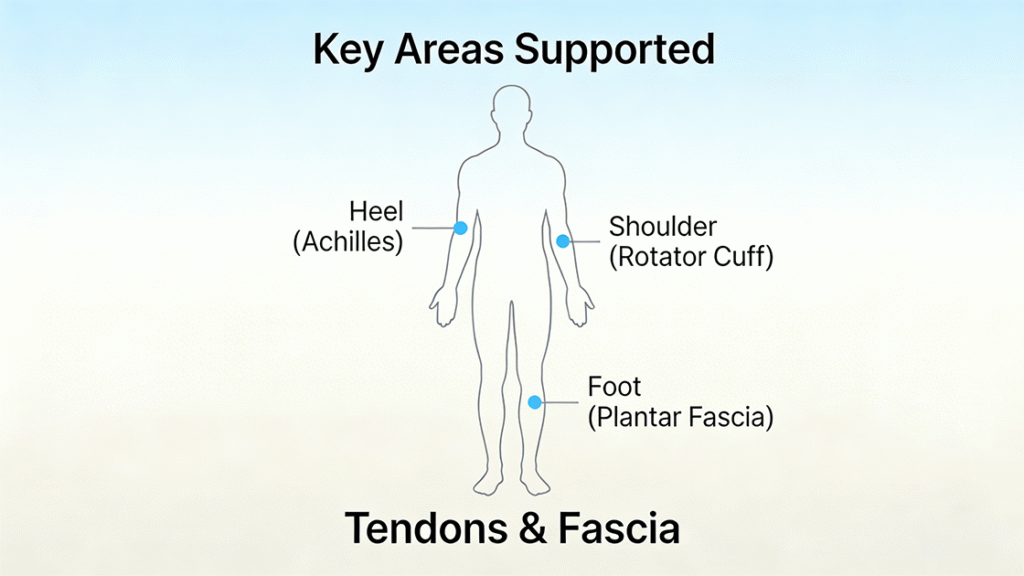
4.1 Achilles Tendon Load Adaptation Changes
The Achilles tendon experiences continuous loading during walking, standing, and balance stabilization activities. Over time, reduced collagen turnover and microvascular responsiveness influence its recovery capacity following repetitive mechanical stress exposure. Individuals may notice morning stiffness or reduced elasticity during movement transitions. Shockwave therapy supports tendon metabolic responsiveness by promoting localized vascular signaling activity that helps maintain structural load tolerance in aging tendon environments.
4.2 Rotator Cuff Tendon Responsiveness Decline
Rotator cuff tendons play a central role in shoulder stabilization and functional mobility during reaching movements. Age-related changes in tendon vascular supply influence recovery performance following repetitive overhead or lifting activity exposure. Reduced resilience may present as persistent tightness rather than acute injury symptoms. Shockwave therapy supports connective tissue responsiveness in shoulder stabilization systems by stimulating circulation-related signaling mechanisms that influence tendon adaptation capacity.
4.3 Plantar Fascia Elasticity Reduction Over Time
The plantar fascia contributes significantly to energy transfer efficiency during walking and standing activities. Reduced fascial hydration exchange and elasticity restoration speed may lead to stiffness sensations during early morning movement transitions. Shockwave therapy influences fascial tissue responsiveness through mechanical stimulation that supports hydration dynamics and connective tissue flexibility maintenance important for efficient gait mechanics.
5 Lifestyle Factors That Influence Age-Related Recovery Speed
Although biological aging contributes to slower healing responses, daily movement behavior strongly influences how these changes develop over time.
5.1 Reduced Daily Movement Variability
Movement variability plays a central role in maintaining connective tissue adaptability. Repetitive motion environments limit multidirectional mechanical stimulation necessary for healthy tissue remodeling. Shockwave therapy introduces controlled mechanical stimulation signals that help support connective tissue responsiveness in individuals exposed to limited movement variability patterns throughout daily routines.
5.2 Sedentary Work Environments and Tissue Load Distribution
Prolonged sitting alters load distribution across posterior chain muscle systems and reduces circulation efficiency in lower extremity connective tissues. Over time, this contributes to stiffness accumulation within fascia and tendon environments. Shockwave therapy supports restoration of localized circulation responsiveness that helps maintain tissue adaptability despite prolonged sitting exposure patterns common in modern work environments.
5.3 Decreased Hydration Exchange Within Fascial Networks
Hydration exchange between fascial layers plays a critical role in maintaining smooth movement efficiency. Aging connective tissue systems demonstrate slower fluid exchange responsiveness following prolonged static posture exposure. Shockwave therapy supports mechanical stimulation of fascial sliding interfaces that contribute to improved hydration dynamics within connective tissue environments important for restoring movement comfort.
6 Evidence Supporting Shockwave Therapy for Aging-Related Tissue Adaptation Support
Scientific literature continues to explore the role of acoustic stimulation technologies in maintaining connective tissue performance across the lifespan.
6.1 Fibroblast Activation Research Findings
Experimental studies demonstrate that shockwave stimulation increases fibroblast proliferation activity within connective tissue matrices. These cellular responses contribute to improved extracellular matrix remodeling efficiency and support collagen synthesis processes important for maintaining structural resilience in aging soft tissue systems exposed to repetitive mechanical stress environments.
6.2 Angiogenesis-Related Clinical Observations
Clinical investigations evaluating shockwave therapy demonstrate increased expression of angiogenic growth factors within treated tissue zones. Improved vascularization supports enhanced oxygen delivery efficiency and promotes balanced metabolic exchange conditions that contribute to improved recovery responsiveness in aging connective tissue structures exposed to daily functional loading demands.
6.3 Improvements in Tissue Elasticity Responsiveness
Emerging rehabilitation studies suggest that acoustic stimulation technologies influence connective tissue elasticity restoration patterns through mechanotransductive signaling pathways. Improved elasticity responsiveness supports efficient load transfer behavior within musculoskeletal systems and contributes to maintaining movement comfort as connective tissue adaptability changes over time.
FAQ
Why does soft tissue recovery slow with age?
Reduced collagen production, circulation efficiency changes, and mitochondrial energy decline contribute to slower healing responses.
Can shockwave therapy support connective tissue elasticity?
Research suggests acoustic stimulation supports collagen remodeling and vascular signaling processes involved in elasticity maintenance.
Is slower recovery always a sign of injury?
Not necessarily. Many changes reflect natural connective tissue adaptation patterns rather than structural damage.
Which areas benefit most from shockwave therapy support?
Tendons, fascia, and insertional connective tissues commonly demonstrate improved responsiveness following stimulation.
Conclusión
Slower soft tissue recovery is one of the most common musculoskeletal changes associated with aging, affecting tendon resilience, fascial elasticity, and neuromuscular adaptation capacity even in physically active individuals. Rather than representing structural injury, these changes reflect evolving biological conditions within connective tissue systems that respond differently to mechanical loading over time. Shockwave therapy offers a scientifically supported approach for enhancing circulation signaling pathways, stimulating collagen remodeling responses, and improving tissue adaptability in aging recovery environments. As rehabilitation science continues advancing toward regenerative support strategies, acoustic stimulation technologies are becoming increasingly valuable tools for maintaining functional movement performance across the lifespan.
Referencias
Wang CJ. Shock Wave Therapy Enhances Tendon Healing
https://pubmed.ncbi.nlm.nih.gov/17496545
Speed C. A Systematic Review of Shockwave Therapy in Soft Tissue Conditions
https://pubmed.ncbi.nlm.nih.gov/15208287
Hausdorf J. Extracorporeal Shockwave Therapy Effects on Connective Tissue
https://pubmed.ncbi.nlm.nih.gov/17157753
Notarnicola A. Biological Effects of Shockwave Therapy
https://pubmed.ncbi.nlm.nih.gov/26611067
Mittermayr R. Shockwave Therapy Improves Microcirculation