

Introduction
Knee pain when climbing stairs is one of the most common early warning signs of anterior knee dysfunction. Many individuals initially notice discomfort only during stair ascent or descent, yet this seemingly minor symptom may reflect underlying tendon overload, cartilage irritation, or patellofemoral joint imbalance. Over time, these biomechanical stresses can progress into chronic conditions such as patellar tendonitis or chondromalacia patella if left unaddressed. Shockwave Therapy has emerged as an advanced non-invasive treatment option designed to stimulate tissue regeneration, improve circulation, and reduce localized inflammation in affected knee structures. Understanding how this therapy supports recovery helps individuals recognize effective strategies for restoring knee stability and maintaining long-term joint health.
1. Understanding Why Knee Pain Occurs When Climbing Stairs
Stair climbing places unique mechanical demands on the knee joint that differ significantly from level walking. Recognizing these forces helps explain why symptoms often appear during this activity before becoming noticeable elsewhere.
1.1 Increased Load on the Patellofemoral Joint
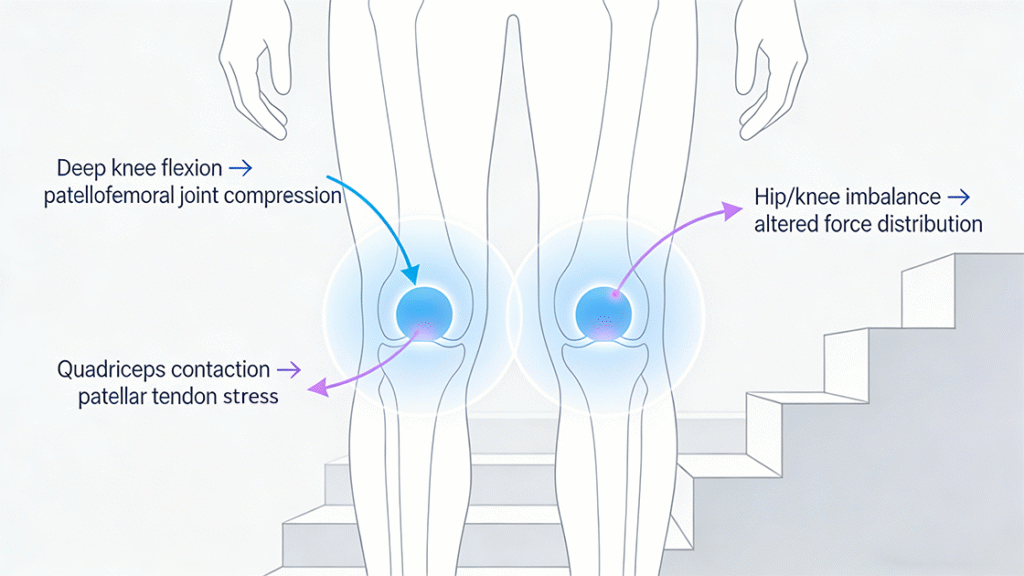
During stair ascent, the knee flexes more deeply than during normal walking, increasing compressive forces between the patella and femoral trochlea. This elevated pressure stresses the cartilage surfaces that guide patellar motion within the joint groove. When alignment becomes altered or cartilage resilience decreases, friction increases and discomfort develops in the anterior knee region. Over time, repetitive stair use can worsen this irritation and contribute to structural degeneration if supportive tissues fail to adapt effectively.
1.2 Stress on the Patellar Tendon During Step Elevation
Each upward step requires strong quadriceps contraction to extend the knee against gravity. This action transfers mechanical load directly through the patellar tendon, which anchors the quadriceps mechanism to the tibia. Repeated stair climbing under conditions of muscle imbalance or fatigue increases strain within tendon fibers. Micro-trauma accumulates gradually, triggering inflammatory responses and reducing tendon elasticity, which contributes to localized tenderness below the kneecap.
1.3 Biomechanical Imbalance Between Hip and Knee Stabilizers
Efficient stair movement depends not only on the knee but also on coordinated activation of surrounding hip musculature. Weakness in hip abductors and external rotators alters lower-limb alignment, shifting stress toward the anterior knee compartment. As alignment changes persist, patellar tracking becomes less efficient, increasing mechanical pressure across joint surfaces and accelerating symptom progression.
2. Common Conditions Linked to Stair-Related Knee Pain
Although multiple structures contribute to knee stability, certain conditions are particularly associated with discomfort during stair climbing.
2.1 Patellar Tendonitis and Repetitive Tendon Overload
Patellar tendonitis develops when repetitive loading exceeds the tendon’s capacity for repair. Stair climbing amplifies quadriceps demand, making this activity especially provocative for individuals with early tendon degeneration. Collagen micro-damage within the tendon weakens structural integrity and increases sensitivity to mechanical stress. As degeneration progresses, localized pain just below the kneecap becomes more noticeable during activities involving knee extension under resistance.
2.2 Chondromalacia Patella and Cartilage Softening
Chondromalacia patella refers to degeneration or softening of cartilage beneath the kneecap. Stair descent in particular increases shear forces across this cartilage surface, which may aggravate symptoms even when walking on flat ground remains comfortable. Reduced cartilage resilience compromises smooth joint movement, increasing friction and irritation during repetitive bending activities.
2.3 Patellofemoral Pain Syndrome in Active Individuals
Patellofemoral pain syndrome represents one of the most frequent causes of anterior knee discomfort. It often develops gradually due to altered movement mechanics rather than acute injury. Stair climbing exposes these movement inefficiencies early because the activity demands controlled eccentric muscle contraction and joint stabilization under load.
3. How Shockwave Therapy Supports Tendon and Cartilage Recovery
Shockwave Therapy introduces controlled acoustic pressure waves into affected tissues, initiating biological responses that support structural healing within overloaded knee components.
3.1 Enhancement of Local Blood Circulation
Improved microvascular circulation represents one of the primary physiological responses triggered by acoustic stimulation. Increased oxygen delivery supports metabolic activity within damaged tendon fibers and surrounding connective tissues. Enhanced circulation also accelerates removal of inflammatory by-products that contribute to persistent discomfort during stair movement.
3.2 Activation of Collagen Remodeling in Patellar Tendons
Tendon health depends heavily on collagen organization and tensile strength. Shockwave stimulation encourages fibroblast activity responsible for producing new collagen fibers. As remodeling progresses, tendon resilience improves, allowing tissues to better tolerate repetitive loading associated with stair climbing and daily mobility demands.
3.3 Stimulation of Regenerative Responses in Cartilage-Supporting Structures
Although cartilage itself has limited regenerative capacity, surrounding tissues play an important role in joint stability and load distribution. Acoustic stimulation enhances biological signaling pathways that improve soft-tissue support around the patellofemoral joint, indirectly reducing mechanical stress on cartilage surfaces.
4. Risk Factors That Increase the Likelihood of Stair-Related Knee Pain
Several lifestyle and biomechanical factors contribute to increased vulnerability within the anterior knee compartment.
4.1 Sudden Changes in Activity Level
Rapid increases in physical activity, particularly stair use during exercise routines or daily commuting, can overload knee tissues that have not yet adapted to increased demand. Without gradual conditioning, repetitive strain accumulates quickly within tendons and cartilage interfaces.
4.2 Muscle Imbalance Between Quadriceps and Hip Stabilizers
Efficient knee tracking depends on coordinated muscle activation across multiple joints. Weak hip stabilizers shift load toward the patellar tendon and cartilage surfaces, increasing susceptibility to irritation during stair climbing tasks.
4.3 Previous Knee Injuries Affecting Movement Mechanics
Even minor ligament sprains or earlier episodes of tendon irritation can alter movement patterns long after symptoms resolve. These subtle biomechanical changes increase stress concentration within the anterior knee during activities requiring controlled knee flexion.
5. Long-Term Functional Benefits of Shockwave Therapy for Anterior Knee Pain
Supporting recovery at the cellular level contributes to meaningful improvements in daily mobility and joint resilience.
5.1 Improved Load Tolerance During Functional Movement
As tendon strength improves through collagen remodeling, tissues become more capable of managing repetitive loading associated with stair climbing and other weight-bearing movements. This increased tolerance supports smoother joint motion and reduced discomfort.
5.2 Reduction of Chronic Inflammation Within Knee Structures
Persistent low-grade inflammation often contributes to recurring anterior knee pain episodes. Acoustic stimulation helps regulate inflammatory signaling pathways, allowing tissues to return toward physiological balance.
5.3 Support for Long-Term Patellofemoral Joint Stability
Restoring neuromuscular coordination and improving tissue resilience contributes to better patellar tracking across the femoral groove. This improved alignment reduces cumulative stress across joint surfaces and supports long-term knee health.
FAQ
Why does my knee hurt when climbing stairs but not walking on flat ground?
Stair climbing increases patellofemoral pressure and tendon loading more than level walking.
Is stair-related knee pain an early warning sign of tendon problems?
Yes, it often indicates early patellar tendon overload or tracking imbalance.
Can Shockwave Therapy support recovery from anterior knee pain?
It helps stimulate circulation and collagen remodeling in affected tissues.
Does cartilage irritation contribute to stair pain symptoms?
Yes, especially in conditions such as chondromalacia patella.
Is this condition common in active adults?
Yes, particularly in individuals with repetitive knee loading activities.
Conclusion
Knee pain when climbing stairs often reflects early dysfunction within the patellar tendon or patellofemoral joint rather than a simple temporary strain. Identifying these warning signs early allows individuals to explore targeted non-invasive interventions that support structural recovery before symptoms progress into chronic limitations. Shockwave Therapy provides a biologically active approach to improving circulation, stimulating collagen remodeling, and enhancing joint stability, making it a valuable option for addressing anterior knee discomfort associated with stair movement patterns.
Références
Patellar Tendinopathy Overview
https://www.ncbi.nlm.nih.gov/books/NBK538149
Chondromalacia Patella
https://www.ncbi.nlm.nih.gov/books/NBK459195
Extracorporeal Shockwave Therapy in Tendinopathies
https://www.ncbi.nlm.nih.gov/pmc/articles/PMC6029898
Patellofemoral Pain Syndrome Clinical Review