

Introduction
For horses, transport and cold weather represent more than temporary discomfort. These conditions place significant stress on the musculoskeletal system, particularly the tendons and joints. Long journeys in trailers subject the limbs to sustained vibration and restricted movement. Cold temperatures reduce tissue elasticity and impair circulation. Together, these factors can leave a horse stiff, sore, and vulnerable to injury. For owners and trainers who invest years in conditioning their animals, the period following transport or cold exposure presents a critical window for recovery. Extracorporeal shockwave therapy offers a non-invasive, drug-free approach that may support the body’s natural healing processes and help horses return to full function more quickly.
1. The Stress of Transport on the Equine Musculoskeletal System
Transporting a horse exposes the animal to a unique combination of physical and physiological stressors. The effects are not limited to the immediate post-transport period but can persist for days, affecting performance and increasing injury risk.
1.1 The Mechanical Demands of Trailering
Standing in a moving trailer subjects the horse’s limbs to continuous vibration and oscillation. The suspension of the trailer transmits road imperfections directly to the horse’s legs, creating microtrauma in tendons and ligaments. The horse must constantly adjust its posture to maintain balance, placing uneven loads on different muscle groups. This sustained, repetitive stress can lead to fatigue and minor tissue damage that accumulates over the course of a journey. Even a few hours of transport can produce measurable changes in tendon stiffness and joint fluid composition.
1.2 Reduced Circulation and Joint Stiffness
Prolonged standing in a confined space limits the horse’s ability to move freely. The normal pumping action of muscles, which helps circulate blood and synovial fluid, is reduced. This can lead to decreased joint lubrication and increased stiffness. The accumulation of metabolic waste products in the tissues contributes to soreness and reduced flexibility. Without adequate recovery, these effects can persist for several days, affecting the horse’s performance and comfort.
1.3 Skin Barrier Stress and the Role of Laser Rejuvenation Approaches
Transport is also a source of psychological stress. The unfamiliar environment, noise, and vibration can elevate cortisol levels, which may impair immune function and slow tissue repair. A stressed horse may also be more reluctant to move freely after transport, leading to further stiffness and reduced circulation.
2. The Effect of Cold Exposure on Tendon Health
Cold weather presents additional challenges for equine athletes. The response of tendons and other soft tissues to low temperatures is complex and can have lasting effects on performance.
2.1 Reduced Tissue Elasticity
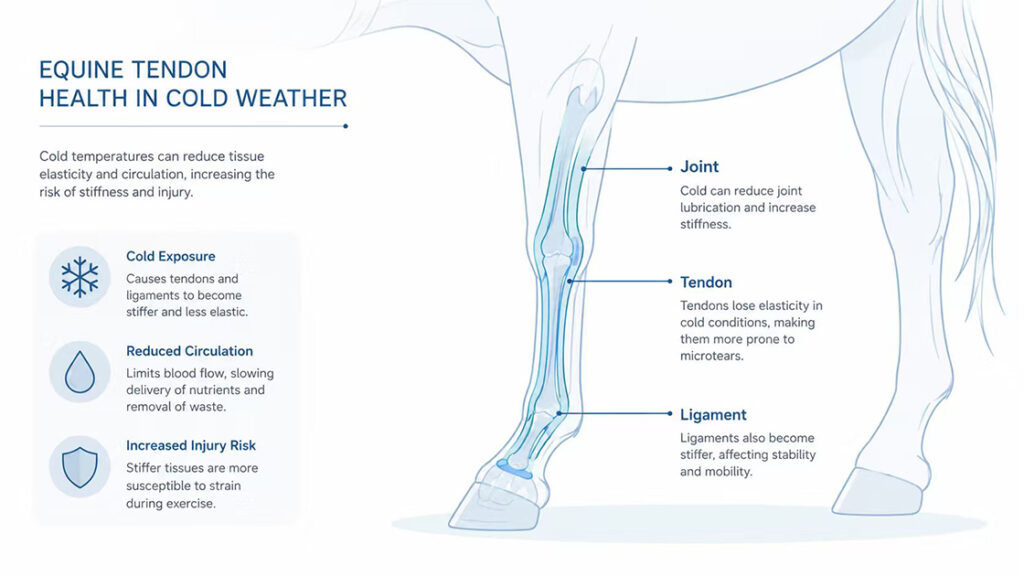
Low temperatures cause tendons and ligaments to become stiffer and less elastic. The collagen fibers that give tendons their tensile strength become less pliable, reducing the tissue’s ability to absorb and dissipate energy. This increased stiffness makes the tendon more susceptible to strain during exercise, as it cannot accommodate the same range of motion without risk of microtearing. Even after the horse returns to a warmer environment, the effects on tissue elasticity may persist for some time.
2.2 Impaired Circulation and Slower Healing
Cold exposure causes peripheral vasoconstriction, reducing blood flow to the extremities. This limits the delivery of oxygen and nutrients to the tendons and joints, slowing the repair of any microtrauma that may have occurred. The reduced circulation also impairs the removal of metabolic waste products, contributing to stiffness and soreness. Over time, repeated cold exposure without adequate recovery may contribute to degenerative changes in the tendon.
2.3 Increased Injury Risk
The combination of increased stiffness and reduced blood flow makes cold weather a high-risk period for tendon injuries. Horses that are exercised vigorously after being exposed to cold are particularly vulnerable. The tendon cannot accommodate the forces of high-speed exercise as effectively, increasing the likelihood of strain or tear. Understanding this risk is essential for owners and trainers who want to protect their horses during colder months.
3. How Shockwave Therapy Supports Recovery
Extracorporeal shockwave therapy delivers acoustic waves to targeted tissues, stimulating biological responses that support healing and recovery. The therapy is non-invasive and does not require sedation, making it suitable for use in a variety of equine patients.
3.1 Stimulating Cellular Activity
When shockwaves reach the tissues, the mechanical pressure activates mechanotransduction pathways. These pathways convert mechanical signals into biochemical activity, influencing the behavior of cells involved in tissue repair. Fibroblasts are stimulated to produce new collagen, while the release of growth factors promotes the formation of new blood vessels. This cellular activity supports the repair of microtrauma and may help restore tissue elasticity after cold exposure or transport.
3.2 Improving Blood Flow
One of the key effects of shockwave therapy is its ability to enhance circulation. The acoustic waves promote neovascularisation, the formation of new capillary networks, in the treated area. Improved blood flow brings oxygen and nutrients to the tissues while carrying away metabolic waste products. This is particularly valuable after transport, when circulation may be compromised, and after cold exposure, when vasoconstriction has reduced perfusion.
3.3 Reducing Pain and Promoting Comfort
Shockwave therapy also influences pain signaling. The mechanical energy can alter the transmission of pain impulses, providing a period of reduced sensitivity. For a horse recovering from transport or cold exposure, this may translate to greater comfort and a willingness to move more freely. The therapy may support relaxation and help restore normal movement patterns.
4. Clinical Application in Equine Practice
Veterinarians have increasingly incorporated shockwave therapy into equine rehabilitation protocols. Its application extends to a range of conditions, and it can be particularly valuable in the post-transport and post-exposure recovery periods.
4.1 Treating Transport-Related Stiffness
Horses that arrive at a new location after a long journey often present with stiffness and reduced range of motion. Shockwave therapy can be applied to the affected tendons, ligaments, and muscles to support recovery. The therapy addresses the microtrauma accumulated during transport and may help restore normal tissue function more quickly than rest alone.
4.2 Addressing Cold-Induced Tendon Changes
For horses that have been exposed to cold conditions, shockwave therapy may help reverse some of the changes induced by low temperatures. By stimulating collagen production and improving circulation, the therapy can support the restoration of tissue elasticity and reduce stiffness. This may help reduce the risk of injury when the horse returns to training.
4.3 Supporting the Return to Work
The ultimate goal of any recovery protocol is to return the horse to full function. Shockwave therapy can be integrated into a structured rehabilitation program that includes controlled exercise, stretching, and monitoring. By supporting tissue repair and reducing discomfort, the therapy may help horses transition more smoothly back into training.
5. Practical Considerations for Owners and Trainers
For owners and trainers interested in using shockwave therapy as part of their horses’ recovery protocols, several practical considerations can help optimize outcomes.
5.1 Timing of Treatment
The timing of shockwave therapy can influence its effectiveness. Treatment soon after transport or cold exposure may help address acute stiffness and microtrauma. In some cases, a series of treatments over several days or weeks may be recommended to support ongoing recovery.
5.2 Integrating with Other Recovery Strategies
Shockwave therapy works best when combined with other supportive measures. Warm-up and cool-down routines, proper nutrition, and adequate hydration all support tissue health. Gradual reintroduction to exercise, starting with walking and progressing to more demanding work, helps the tissues adapt without being overloaded.
5.3 Monitoring Progress
Regular assessment of the horse’s condition helps determine the effectiveness of the treatment and guide any adjustments to the recovery protocol. Observation of gait, range of motion, and response to palpation can provide valuable information about the horse’s progress.
FAQ
Q1: Is shockwave therapy painful for the horse?
Most horses tolerate the treatment well. The sensation is often described as tapping or pressure rather than pain, and sedation is rarely required.
Q2: How many sessions does a horse typically need?
The number varies depending on the horse’s condition and response to treatment. Some horses benefit from a single session, while others may require a series of treatments.
Q3: Can the horse return to work immediately after treatment?
A period of rest or controlled exercise is usually recommended after treatment to allow the tissues to respond. The specific protocol depends on the individual case.
Q4: Is shockwave therapy suitable for all horses?
A thorough evaluation by a veterinarian helps determine whether shockwave therapy is appropriate for a specific horse and condition.
Q5: How soon after transport can shockwave therapy be used?
Treatment can often be administered within a day or two of transport, depending on the horse’s condition and the veterinarian’s assessment.
Conclusion
Transport and cold exposure place unique demands on the equine musculoskeletal system. The stiffness, reduced circulation, and microtrauma that result from these conditions can affect performance and increase the risk of injury. Extracorporeal shockwave therapy offers a non-invasive, supportive approach that may help horses recover more quickly. By stimulating cellular activity, improving blood flow, and reducing discomfort, the therapy supports the body’s natural healing processes. When integrated with appropriate rest, nutrition, and gradual return to exercise, shockwave therapy may help horses return to full function with less stiffness and greater comfort.
Références
Equine Shockwave Therapy: Applications and Benefits.
https://www.shockwavemachines.com
Shockwave Therapy for Horses: How It Works and When to Use It.
https://www.smartpakequine.com
Managing Transport Stress in Horses.
Cold Weather and Equine Tendon Health.
Rehabilitation Protocols for Equine Tendon Injuries.