

Introduction
A sharp twist during a tackle, a sudden change of direction, or an awkward landing from a header. For many soccer players, that moment marks the beginning of a meniscus injury. The meniscus cushions the knee joint, and when it tears, players face pain, swelling, and uncertainty about their return to the pitch. Surgery used to seem like the only real option. But that picture is changing. Evidence increasingly favours conservative management for many meniscus injuries. Outcomes from non‑invasive treatments often match those of arthroscopic repair. Among these options, shockwave therapy has emerged as a promising tool that may help players recover faster, reduce pain, and avoid the operating room.
1. The Meniscus and Its Role in Football
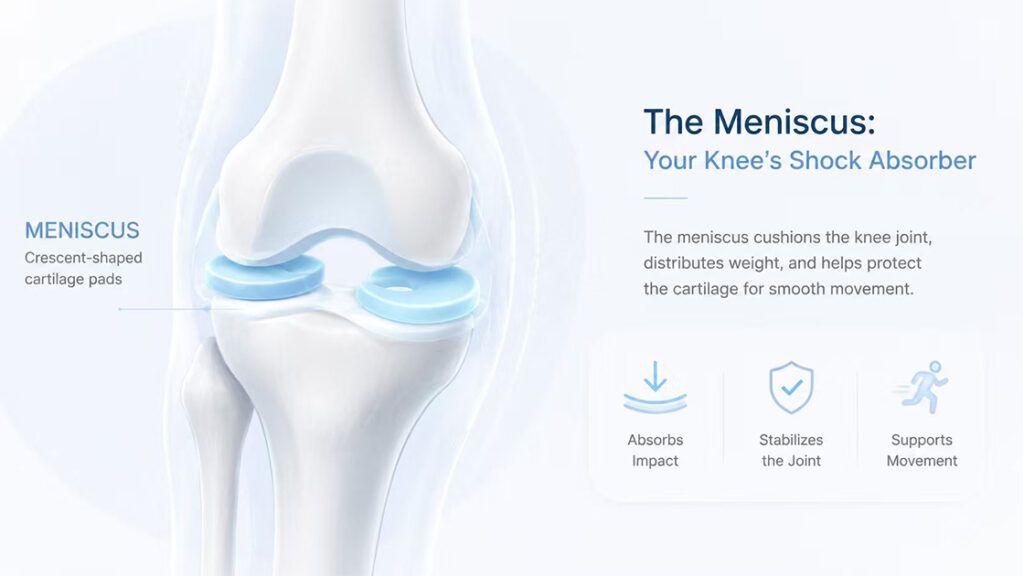
The meniscus serves as a critical shock absorber in the knee. Each knee contains two crescent‑shaped cartilage pads, one on the inner side and one on the outer side. These pads distribute weight across the joint, provide stability, and protect the articular cartilage from excessive wear.
1.1 How Meniscus Injuries Happen in Football
Football places extraordinary demands on the knee. Sudden pivots, rapid decelerations, and direct collisions all create forces that can injure the meniscus. A player may twist the knee while the foot remains planted on the ground. Or they may land awkwardly after a jump. These movements can cause the meniscus to tear. The injury may occur as an acute event, with sharp pain and immediate swelling. Or it may develop gradually as a degenerative process. Degenerative meniscus tears result from years of accumulated mileage on the knees. They are particularly common in older players.
1.2 Why Meniscus Injuries Heal Slowly
The meniscus has a limited blood supply. Only the outer third receives adequate blood flow. The inner two‑thirds lack direct vascular supply and rely on diffusion for nutrients. This poor vascularity makes healing slow and uncertain. Tears in the inner zone may never heal on their own. Even in the outer zone, healing can take months. This biological challenge explains why meniscus injuries often linger. It also explains why players struggle to return to their previous level of performance.
2. How Shockwave Therapy Supports Meniscus Healing
Shockwave therapy delivers acoustic pressure waves to the injured tissue. These waves pass through the skin and soft tissues to reach the meniscus. The mechanical energy triggers biological responses that support healing.
2.1 The Cellular Response to Shockwaves
When shockwaves reach the meniscus, they stimulate cell activity. The acoustic waves activate mechanotransduction pathways. These pathways convert mechanical signals into cellular responses. This process amplifies blood flow and upregulates the body‘s repair system. Shockwave therapy can also break up calcification and scar tissue. It stimulates healthy tissue and cell regeneration. It reduces inflammation and relieves nerve pain. Preclinical work shows that shockwaves enhance meniscal cell proliferation and cartilage repair. This effect occurs even in the avascular zones where healing normally stalls.
2.2 Modulating Inflammation and Protecting Cartilage
Inflammation plays a central role in meniscus injuries. Excessive inflammation can delay healing and contribute to cartilage degeneration. Shockwave therapy modulates inflammatory factors in the meniscus and knee joint. It promotes meniscal tear healing in the avascular zone. It also alleviates cartilage degeneration. This dual effect makes this therapy valuable for athletes. It promotes healing while protecting the joint from further damage.
2.3 Improving Tissue Quality and Reducing Pain
Shockwave therapy improves meniscus tissue quality. Patients often show better tissue integrity after treatment. The therapy reduces pain and improves function. Players who receive shockwave therapy report less pain and better mobility. This allows them to progress through rehabilitation more smoothly. The treatment provides a window of improved comfort that lets players engage more fully in their recovery programme.
3. What the Research Shows
The scientific literature on shockwave therapy for meniscus injuries continues to grow. The findings are encouraging.
3.1 Clinical Observations in Patients
Clinical evidence supports the use of shockwave therapy for meniscus injuries. A randomized trial found that patients with degenerative meniscus tears who received this therapy had improved MRI tissue quality and reduced pain compared to controls. Patients often experience pain relief after treatment. MRI scans sometimes show improved tissue quality. The therapy appears to produce measurable biological changes in the meniscus. Combining shockwave therapy with other treatments can produce even better outcomes. The combination alleviates pain more effectively and achieves faster functional recovery. It also reduces complications.
3.2 Healing in the Avascular Zone
The avascular zone of the meniscus normally struggles to heal. Shockwave therapy may help address this challenge. Research in animal models shows that shockwave treatment improves meniscal healing scores. The therapy modulates inflammatory factors. It alleviates cartilage degeneration. This suggests that shockwave therapy may help heal tears in areas of the meniscus that were previously considered untreatable without surgery.
4. Integrating Shockwave Therapy with Rehabilitation
Shockwave therapy works most effectively as part of a comprehensive recovery programme. When combined with structured rehabilitation exercises, the therapy may offer synergistic benefits that improve healing rates and enhance overall functional outcomes.
4.1 Supporting Active Recovery
Shockwave therapy can reduce pain and inflammation enough to allow players to engage more fully in their prescribed exercises. This is a significant advantage. High pain levels often reduce a player‘s ability to participate in strengthening or mobility work. This leads to a cycle of disuse and chronic weakness. By decreasing pain and enhancing local tissue healing, shockwave therapy helps break this cycle. Players can then perform the exercises that build strength, flexibility, and neuromuscular control around the knee.
4.2 Addressing Limitations of Exercise Alone
Despite the proven benefits of exercise, chronic meniscus injuries often involve persistent inflammation and tissue degeneration that limit the effectiveness of exercise alone. Structural disruptions may not respond adequately to exercise without additional stimulatory modalities. This is where shockwave therapy adds value. It provides the mechanical stimulus needed to jump‑start tissue repair, so that rehabilitation exercises can have a greater impact.
4.3 Combining with Other Regenerative Approaches
Some practitioners combine shockwave therapy with other regenerative treatments. Research shows that combining shockwave therapy with platelet‑rich plasma can better alleviate pain, achieve faster functional recovery, and significantly reduce complications compared to either treatment alone. This integrated approach offers players more options for customising their recovery plan.
5. Long‑Term Benefits and Considerations
For soccer players, the appeal of shockwave therapy extends beyond the immediate recovery period.
5.1 Avoiding Surgery and Its Risks
One significant advantage of shockwave therapy is that it offers a non‑surgical pathway. Surgery carries risks such as infection, blood clots, and anaesthesia complications. Recovery from meniscus surgery can take three months or longer. Shockwave therapy requires no incisions and no hospital stay. It also requires no prolonged immobilisation. For players who want to return to the pitch quickly, avoiding surgery makes a substantial difference.
5.2 Potentially Slowing Osteoarthritis
Meniscus injuries increase the risk of developing knee osteoarthritis. Damage to the meniscus alters joint mechanics. It exposes the articular cartilage to excessive loads. By promoting meniscal healing and modulating inflammation, shockwave therapy may help slow osteoarthritis progression. This represents an important potential benefit for athletes concerned about long‑term joint health.
5.3 Supporting Return to Sport
The ultimate goal for any injured soccer player is to return to the pitch. Shockwave therapy can help accelerate this process. It reduces pain and improves tissue quality. It allows players to engage more fully in their rehabilitation. Unlike some treatments that require extended rest, shockwave therapy allows players to remain active while their meniscus heals. This active recovery approach helps players maintain their fitness. It also avoids the deconditioning that often accompanies prolonged injury layoffs.
FAQ
Q1: Is shockwave therapy painful for a meniscus injury?
Most players describe a tapping or deep percussion sensation that is uncomfortable but brief. The session is short, and any discomfort stops when the treatment ends.
Q2: How many sessions does a soccer player typically need?
A common protocol involves several sessions spaced about one week apart. Some players notice improvement after two or three sessions, while others benefit from a longer series.
Q3: Can I continue training during shockwave therapy?
Yes, but you should avoid activities that cause sharp pain. Most players continue with modified training and rehabilitation exercises during the treatment period.
Q4: How soon after treatment will I feel less knee pain?
Some players notice a change within a few sessions. The most noticeable improvement often takes several weeks to appear as the tissue heals and remodels.
Q5: Does shockwave therapy work for all types of meniscus tears?
Shockwave therapy shows the most promise for degenerative tears and tears in the avascular zone. A thorough evaluation helps determine if it is an appropriate option for your specific injury.
Conclusion
Meniscus injuries can sideline a soccer player for weeks or months. The fear of never returning to full form can be as debilitating as the injury itself. For players who want to avoid surgery and accelerate their recovery, shockwave therapy offers a non‑invasive, drug‑free option. The acoustic waves stimulate cellular activity, improve blood flow, modulate inflammation, and promote tissue healing. This occurs even in areas of the meniscus that traditionally struggle to repair themselves. When combined with a structured rehabilitation programme, shockwave therapy may help players return to the pitch faster and with greater confidence. For many players, this treatment represents a genuine alternative to the operating room.
Références
Hashimoto S, et al. – Extracorporeal shockwave therapy for degenerative meniscal tears results in a decreased T2 relaxation time and pain relief: An exploratory randomized clinical trial. Knee Surgery, Sports Traumatology, Arthroscopy, 2024.
https://pubmed.ncbi.nlm.nih.gov/39101450
Huang M, et al. – Single‑Dose Radial Extracorporeal Shock Wave Therapy Modulates Inflammation During Meniscal Tear Healing in the Avascular Zone. American Journal of Sports Medicine, 2024.
https://journals.sagepub.com/doi/10.1177/03635465231221725
Li J, et al. – The efficacy of extracorporeal shock wave combined with platelet rich plasma in the treatment of knee osteoarthritis with meniscus injury: A retrospective analysis.
https://pubmed.ncbi.nlm.nih.gov
Combining Shockwave Therapy with Rehabilitation Exercises – Shockwave Machines
https://www.shockwavemachines.com/combining-shockwave-therapy-rehabilitation-exercises.html
Joint Rescue Mission: How Shockwave Therapy Rebuilds from Within – Shockwave Machines