

Introduction
Swimming is often praised as the perfect full-body workout. It is low impact, builds endurance, and engages nearly every major muscle group. Yet for those who spend hours in the pool, the repetitive overhead motion of the stroke creates a predictable pattern of strain. The shoulder rotates through thousands of cycles per session, while the upper back works constantly to stabilize the scapula and maintain proper body position in the water. Over time, this relentless repetition can lead to rotator cuff overload and chronic upper back tightness—conditions that not only limit performance but also increase the risk of more serious injury. For swimmers who have tried rest, stretching, and traditional therapy without lasting relief, extracorporeal shockwave therapy offers a non-invasive option that targets the underlying tissue dysfunction and supports long-term recovery.
1. The Overhead Athlete’s Dilemma
Swimmers, along with baseball pitchers and volleyball players, belong to a category of athletes known as overhead athletes. These sports place extraordinary repetitive stress on the shoulder, elbow, upper back, and core. The demands of swimming require repetitive shoulder elevation and rotation, explosive speed, and strong kinetic chain coordination from the spine, hips, and core.
1.1 Why Swimming Creates Chronic Strain
The swimming stroke relies on a precise sequence of movements. The shoulder must rotate through its full range of motion with each pull, while the scapular stabilizers work continuously to maintain proper alignment. This pattern, repeated thousands of times in a single practice, creates unique stress patterns that can lead to micro-tears in tendons, chronic inflammation, scar tissue buildup, and tightness in the rotator cuff and scapular stabilizers. Elite swimmers have an increased likelihood of already having chronic, irreversible tendinopathic changes in their rotator cuff, which further complicates their management. The rotator cuff fatigue from overuse contributes to impingement, and imbalances between internal and external rotators only worsen the problem.
1.2 The Overlooked Role of the Upper Back
While shoulder pain receives most of the attention, the upper back plays an equally critical role in swimming performance. The rhomboids, upper trapezius, and levator scapulae must work together to stabilize the scapula during each stroke. When these muscles become tight or irritated, mechanics begin to break down. This tension in the upper back can restrict shoulder motion, reduce power output, and contribute to a cycle of pain and dysfunction that affects the entire kinetic chain.
2. Understanding Rotator Cuff Overload
Rotator cuff overload is not a single condition but a spectrum of issues that arise from the repetitive demands of swimming. It encompasses rotator cuff tendinopathy, bursitis, and impingement syndrome. This condition is one of the most common causes of shoulder pain in overhead athletes.
2.1 The Mechanism of Injury
During the swimming stroke, the rotator cuff tendons pass through a narrow space beneath the acromion. With each repetition, these tendons can become pinched or irritated, leading to inflammation and microtrauma. Over time, this repeated insult can cause the tendon to degenerate, losing its strength and elasticity. The cumulative effect is a shoulder that feels weak, painful, and less responsive to training.
2.2 Signs of Overload
Swimmers experiencing rotator cuff overload often notice pain during or after training, particularly during the pull phase of the stroke. The shoulder may feel weak, and overhead movements may become uncomfortable. In some cases, the pain may radiate into the upper back or down the arm. These symptoms often worsen with increased training volume and may not resolve with rest alone.
3. How Shockwave Therapy Works
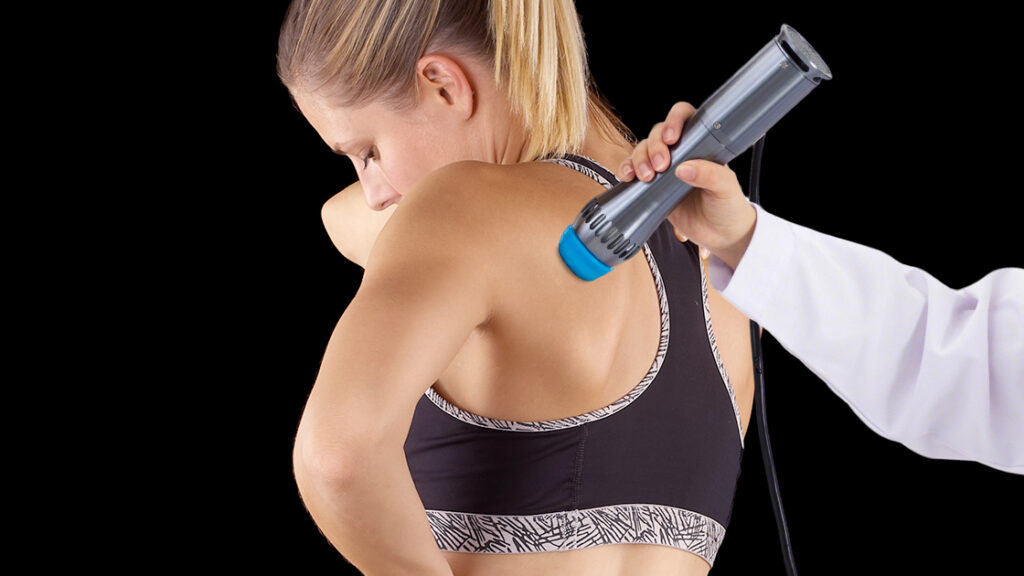
Extracorporeal shockwave therapy (ESWT) uses acoustic sound waves to stimulate tissue healing at the cellular level. Unlike medications that mask pain or rest that simply allows time for healing, shockwave therapy actively promotes the body’s natural repair processes.
3.1 Breaking Down Scar Tissue and Adhesions
The repetitive microtrauma of swimming leads to the formation of fibrotic scar tissue that restricts motion. Shockwave therapy delivers targeted acoustic waves directly to these areas, breaking down adhesions in the rotator cuff muscles, scapular stabilizers, and upper back. This helps restore proper movement patterns and allows for more fluid, powerful mechanics.
3.2 Reducing Chronic Inflammation
Overuse injuries often involve inflammation that never fully resolves. The acoustic waves from shockwave therapy improve circulation and reduce inflammatory chemicals, helping athletes recover faster between practices and competitions. This effect is particularly valuable for swimmers who train year-round and need to maintain consistent performance.
3.3 Stimulating Collagen Formation
Tendon injuries such as rotator cuff tendinopathy and swimmer‘s shoulder respond extremely well to shockwave therapy because it promotes collagen regeneration. This strengthens the tendon rather than just masking symptoms, providing a more durable solution for chronic conditions.
3.4 Restoring Scapular Mechanics
The muscles around the shoulder blade play a critical role in proper shoulder function. Shockwave therapy helps release tightness in the upper trapezius, rhomboids, levator scapulae, serratus anterior, and latissimus dorsi. This restores proper shoulder mechanics and reduces the risk of reinjury.
4. Clinical Evidence for Swimmers
Research supports the use of shockwave therapy for swimmers with shoulder and upper back issues. Recent studies have examined treatment methods for shoulder impingement syndrome in swimmers, finding that exercise combined with shockwave therapy ranked highly for improving shoulder flexion.
4.1 Pain Reduction and Functional Improvement
Research on shockwave therapy for shoulder impingement syndrome shows that ESWT significantly reduces pain over a period of several months. Patients receiving shockwave therapy demonstrate meaningful improvement in functional activities compared to other interventions. The evidence indicates that shockwave therapy is more effective than other interventions in reducing pain and enhancing functional activities in adults with shoulder impingement syndrome.
4.2 A Complementary Approach
The research suggests that exercise-based rehabilitation remains central to managing shoulder impingement syndrome in swimmers. Several adjunctive interventions, including shockwave therapy, show favorable findings for selected outcomes, especially pain relief and shoulder rotational function. This highlights the value of combining shockwave therapy with a structured exercise program for optimal results.
5. Integrating Shockwave Therapy into a Swim Training Program
For swimmers considering shockwave therapy, understanding how to integrate it into their training routine can maximize its benefits.
5.1 When to Seek Treatment
Swimmers should consider shockwave therapy when conservative measures such as rest, stretching, and strengthening have not provided lasting relief. It is particularly useful for chronic conditions that have resisted traditional therapy. The therapy can also be used proactively to address tightness and prevent injuries from developing.
5.2 What to Expect
Shockwave therapy is typically administered in a series of sessions. The treatment itself is non-invasive and does not require downtime, allowing swimmers to continue their training with appropriate modifications. The acoustic waves may cause some discomfort during the procedure, but this is generally brief and well tolerated.
5.3 Combining with Exercise and Rehabilitation
The most effective approach combines shockwave therapy with exercise-based rehabilitation. A comprehensive program should include strengthening exercises for the rotator cuff and scapular stabilizers, stretching for tight muscles, and modifications to swimming technique to reduce strain on the shoulder and upper back.
FAQ
Q1: Is shockwave therapy painful for swimmers?
Most swimmers describe the sensation as tapping or deep pressure rather than pain. The treatment is generally well tolerated.
Q2: How many sessions does a swimmer typically need?
The number varies depending on the severity of the condition. Many swimmers benefit from a series of sessions, often three to five, spaced about a week apart.
Q3: Can I continue swimming during treatment?
Yes, but it is advisable to modify training intensity and avoid movements that cause sharp pain. Your healthcare provider can guide you on appropriate activity levels.
Q4: How soon after treatment will I feel improvement?
Some swimmers notice relief within a few sessions. The most significant improvement often becomes apparent over several weeks as the tissue heals and remodels.
Q5: Does shockwave therapy work for chronic upper back tightness?
Yes. Shockwave therapy can effectively release tightness in the rhomboids, upper trapezius, and other scapular stabilizers, helping restore proper mechanics.
Conclusion
Rotator cuff overload and chronic upper back tightness are common challenges for swimmers, but they do not have to limit performance or enjoyment of the sport. Extracorporeal shockwave therapy offers a non-invasive, drug-free approach that addresses the underlying tissue dysfunction rather than simply masking symptoms. By breaking down scar tissue, reducing inflammation, and promoting collagen formation, shockwave therapy helps restore proper shoulder and upper back mechanics. When combined with exercise-based rehabilitation and appropriate training modifications, it can help swimmers return to the water with greater comfort and confidence.
Références
Overhead Athletes: Why Baseball Players, Volleyball Players, and Swimmers Benefit from Shockwave Treatment
Therapeutic efficacy study on shoulder impingement syndrome in swimmers: a network meta-analysis
https://www.medrxiv.org/content/10.64898/2026.06.11.26355435v1
Extracorporeal shockwave therapy as a treatment option for shoulder impingement syndrome: a systematic review and meta-analysis
https://bfpt.springeropen.com/counter/pdf/10.1186/s43161-025-00300-3.pdf
Shockwave Information – Revive Studio
https://www.revivestudio.com.au/shockwave-information
Shockwave Therapy for Athletes – Faster Recovery, Stronger Comeback
https://www.head2toeclinic.com/shockwave-therapy-for-athletes-faster-recovery-stronger-comeback