

はじめに
High-performance racehorses are exposed to extreme biomechanical stress during training and competition. Even when a race ends without visible lameness, microscopic damage to hooves, tendons, and ligaments is common. These subclinical injuries often accumulate silently, eventually leading to chronic inflammation, reduced elasticity, and compromised athletic longevity. Shockwave therapy has become an essential regenerative tool in modern equine sports medicine. Rather than masking pain, it activates biological repair mechanisms that restore tissue integrity at the cellular level. In post-race recovery programs, shockwave therapy supports hoof and ligament regeneration, accelerates healing timelines, and reduces the likelihood of re-injury when horses return to training.
1. Post-Race Musculoskeletal Stress in Performance Horses
Understanding the physiological toll of racing is the foundation for selecting effective regenerative therapies.
1.1 Mechanical Load on Hooves and Ligaments
During racing, a horse’s distal limbs absorb repetitive high-impact forces. The suspensory apparatus, flexor tendons, collateral ligaments, and hoof laminae are particularly vulnerable. Each stride produces microstrain that can disrupt collagen fibers and impair blood supply. While the horse may remain outwardly sound, these micro-injuries weaken structural integrity over time, increasing susceptibility to more severe damage.
1.2 Subclinical Injury and Delayed Symptoms
One of the greatest challenges in equine sports medicine is the delayed presentation of injury. Ligament degeneration and hoof bruising often progress without obvious clinical signs until damage becomes advanced. By the time lameness appears, tissue quality may already be compromised, requiring extended rehabilitation. Early regenerative intervention is therefore critical.
1.3 Limitations of Conventional Recovery Methods
Rest, anti-inflammatory medications, and corrective shoeing remain cornerstones of equine recovery. However, these methods do not actively stimulate tissue regeneration. Prolonged rest can also lead to muscle loss, reduced proprioception, and delayed return to peak condition. Regenerative therapies aim to close this gap by enhancing the body’s intrinsic healing capacity.
2. Biological Mechanisms of 衝撃波治療 in Equine Tissue
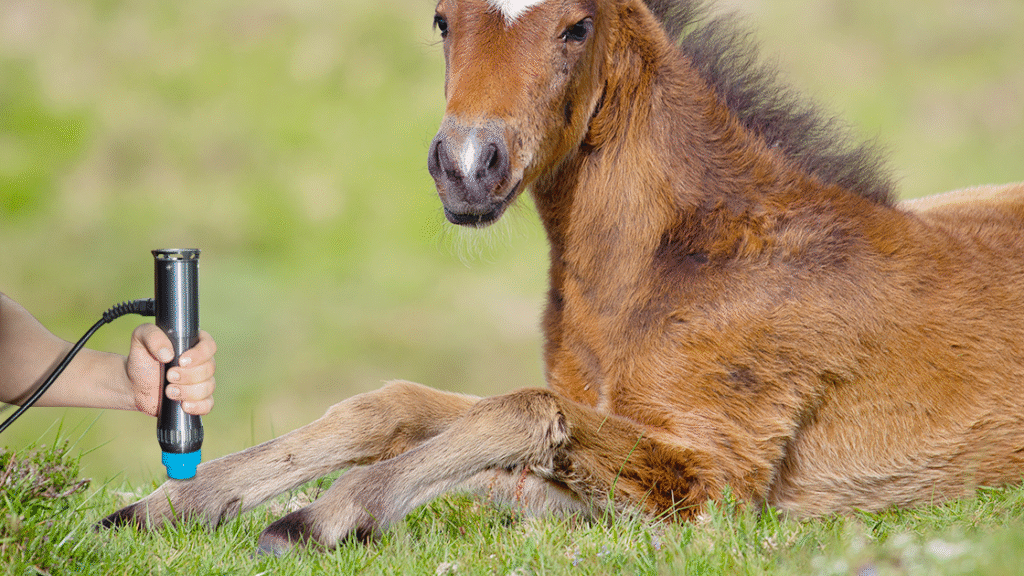
Shockwave therapy exerts its effects through well-documented physiological processes that support tissue regeneration.
2.1 Acoustic Stimulation and Angiogenesis
Extracorporeal shockwave therapy delivers high-energy acoustic waves that penetrate deeply into soft tissue and bone interfaces. These waves create controlled microtrauma, triggering a cascade of biological responses. One of the most significant effects is angiogenesis, the formation of new blood vessels. Increased vascularization improves oxygen delivery, nutrient exchange, and metabolic waste removal in injured hooves and ligaments.
2.2 Cellular Activation and Collagen Remodeling
Shockwave therapy stimulates fibroblasts and tenocytes, the cells responsible for producing collagen. This activation promotes collagen synthesis and realignment along physiological stress lines. Proper collagen organization is essential for restoring tensile strength and elasticity in ligaments and tendons, enabling them to withstand the demands of high-speed locomotion.
2.3 Neuromodulation and Anti-Inflammatory Effects
Beyond structural repair, shockwave therapy influences nerve signaling pathways. It reduces nociceptor sensitivity and modulates inflammatory mediators such as substance P. As inflammation decreases, horses experience improved comfort and range of motion, facilitating earlier engagement in controlled rehabilitation exercise.
3. Regenerative Benefits in Post-Race Rehabilitation
The clinical value of shockwave therapy becomes most evident when examining its impact on recovery outcomes.
3.1 Accelerated Healing Timelines
By enhancing blood flow and cellular activity, shockwave therapy shortens the biological healing phase. Horses often demonstrate earlier improvements in gait symmetry and weight-bearing tolerance. This allows veterinarians and trainers to reintroduce low-impact conditioning sooner, preserving cardiovascular fitness and muscular balance.
3.2 Structural Resilience and Injury Prevention
Regenerated tissues display superior biomechanical properties compared to scar-dominated healing. Improved collagen alignment and ligament elasticity reduce the likelihood of reinjury under repetitive racing loads. This resilience is particularly valuable for horses with demanding competition schedules.
3.3 Long-Term Hoof and Soft Tissue Health
Regular integration of shockwave therapy into post-race care supports long-term tissue vitality. Enhanced circulation and metabolic activity contribute to healthier hooves, improved shock absorption, and sustained performance capacity throughout a horse’s career.
4. Combining Shockwave Therapy with Laser Therapy
Modern equine rehabilitation increasingly relies on multimodal regenerative strategies.
4.1 Complementary Mechanisms of Shockwave and Laser Therapy
While shockwave therapy provides mechanical stimulation, therapeutic laser therapy—particularly Class IV laser systems—operates through photobiomodulation. Laser therapy increases mitochondrial ATP production, reduces oxidative stress, and supports anti-inflammatory pathways at the cellular level. Together, these modalities address both mechanical and biochemical dimensions of tissue healing.
4.2 Clinical Advantages of Combined Regenerative Protocols
When used together, shockwave and laser therapy enhance each other’s effects. Shockwave-induced vascularization improves laser energy absorption, while laser therapy accelerates cellular repair between shockwave sessions. This integrated approach is increasingly favored in elite equine rehabilitation programs.
5. Practical Application in Post-Race Horses
Effective use of shockwave therapy requires careful planning and professional oversight.
5.1 Equipment Selection and Treatment Planning
Veterinary-grade shockwave devices allow precise control of energy flux density and pulse frequency. Treatment protocols must be tailored to tissue depth, injury severity, and the horse’s overall condition. Diagnostic imaging often guides treatment targeting and progression.
5.2 Treatment Preparation and Safety
Most horses tolerate shockwave therapy without sedation. Proper restraint, calm handling, and accurate localization of treatment zones are essential. Skin integrity and hoof condition should always be assessed prior to therapy to ensure safety.
5.3 Monitoring Outcomes and Adjusting Protocols
Progress is evaluated through gait analysis, palpation, and performance metrics. As tissues regenerate, treatment intensity and frequency may be adjusted. Continuous collaboration between veterinarians, trainers, and farriers ensures optimal rehabilitation outcomes.
FAQ
Is shockwave therapy suitable immediately after racing?
Treatment timing depends on veterinary evaluation and tissue condition.
Does shockwave therapy replace rest?
No, it complements structured rest and controlled rehabilitation.
Can it be used preventively?
Yes, many programs apply shockwave therapy proactively to reduce injury risk.
Is it safe for repeated use?
When applied correctly, it is considered safe and well tolerated.
結論
Post-race hoof and ligament regeneration is critical to maintaining soundness and performance in competitive horses. Shockwave therapy offers a scientifically grounded, non-invasive solution that promotes vascularization, collagen remodeling, and pain modulation. When integrated with laser therapy and structured rehabilitation, it supports faster recovery, improved tissue resilience, and long-term athletic longevity. For equine professionals committed to evidence-based care, shockwave therapy represents a cornerstone of modern post-race rehabilitation.
参考文献
McClure, S. R., et al.
Extracorporeal shockwave therapy for musculoskeletal disorders in horses.
Veterinary Clinics of North America: Equine Practice
https://www.sciencedirect.com/science/article/pii/S0749073910000706
Notarnicola, A., & Moretti, B.
The biological effects of extracorporeal shock wave therapy.
Journal of Biological Regulators and Homeostatic Agents
https://pubmed.ncbi.nlm.nih.gov/22338698
Dahlberg, J., et al.
Effect of extracorporeal shock wave therapy on tendon healing in horses.
Equine Veterinary Journal
https://onlinelibrary.wiley.com/doi/full/10.1111/evj.13345
Wang, C. J.
An overview of shock wave therapy in musculoskeletal disorders.
Chang Gung Medical Journal
https://pubmed.ncbi.nlm.nih.gov/18335536
Shockwave Machines – Veterinary Indications