

Введение
Gymnastics is one of the most physically demanding sports, placing extreme stress on the foot and ankle. High-impact jumps, tumbling, and repetitive landings often result in muscle strains, ligament injuries, and chronic inflammation. Traditional recovery methods, such as rest, ice, and physical therapy, are helpful but sometimes insufficient for athletes who need rapid and safe recovery. Ударно-волновая терапия has emerged as a scientifically validated, non-invasive treatment option that accelerates tissue repair, reduces pain, and enhances mobility. This article explores how shockwave therapy works, its benefits for gymnasts, common foot and ankle injuries, recovery mechanisms, injury prevention strategies, and practical tips for integrating therapy into training routines.
1. Understanding Shockwave Therapy
Before examining its application in gymnastics, it is essential to understand the mechanism, depth, and biological effects of shockwave therapy.
1.1 What is Shockwave Therapy?
Shockwave therapy delivers high-energy acoustic waves to injured tissues, stimulating cell regeneration and tissue repair. The mechanical pressure waves induce angiogenesis (new blood vessel formation), increase collagen synthesis, and enhance fibroblast activity. By promoting these cellular processes, shockwave therapy accelerates the repair of tendons, ligaments, and fascia while reducing chronic inflammation. Additionally, the therapy modulates pain-signaling pathways, providing non-invasive analgesic effects. Its non-surgical nature makes it particularly appealing for gymnasts who need to maintain a rigorous training schedule without prolonged downtime.
1.2 How It Works for Foot and Ankle Injuries
Shockwave therapy is effective for foot and ankle injuries because it penetrates deep into soft tissues such as tendons, ligaments, and the plantar fascia. The therapy enhances microcirculation and oxygen delivery, promoting the removal of metabolic waste and reducing localized edema. For conditions like plantar fasciitis, Achilles tendinopathy, and ankle sprains, shockwave therapy accelerates collagen fiber realignment, strengthens weakened connective tissue, and reduces pain signals. Athletes benefit from faster recovery, improved flexibility, and reduced re-injury risk, enabling them to resume training more efficiently.
1.3 Advantages for Gymnasts
For gymnasts, shockwave therapy provides multiple advantages. It speeds up recovery after intensive training sessions, mitigates pain from chronic overuse injuries, and improves foot and ankle stability crucial for precise landings and jumps. Unlike oral anti-inflammatory medications, it avoids systemic side effects, making it safer for long-term use. Moreover, regular therapy sessions can prevent tissue degeneration and enhance joint mobility, which is particularly valuable for athletes performing complex routines requiring both strength and flexibility.
2. Common Foot and Ankle Injuries in Gymnasts
Extreme gymnastics movements place high demands on the foot and ankle, increasing susceptibility to specific injuries. Understanding these injuries is essential for targeted shockwave therapy application.
2.1 Ankle Sprains and Ligament Strains
Ankle sprains occur frequently during uneven landings or rapid directional changes. They often involve partial or complete ligament tears, resulting in swelling, instability, and pain. Shockwave therapy stimulates tissue regeneration, increases blood flow, and accelerates fibroblast proliferation, which is critical for ligament repair. Athletes often notice reduced swelling and faster restoration of proprioception and joint stability, enabling them to safely return to training without compromising performance.
2.2 Plantar Fasciitis and Heel Pain
Repetitive impact and overloading of the plantar fascia can lead to plantar fasciitis, causing heel pain and stiffness, particularly during morning landings. Shockwave therapy enhances collagen synthesis and extracellular matrix remodeling, reducing inflammation and alleviating discomfort. By improving plantar fascia elasticity, the therapy allows gymnasts to perform jumps and pivots more safely while minimizing pain. Studies show that athletes receiving regular shockwave treatments experience faster recovery than those relying solely on conventional rest and stretching techniques.
2.3 Stress Fractures and Microtrauma
High-impact repetitive training can result in stress fractures or microtrauma in the metatarsals and tarsal bones. Shockwave therapy stimulates osteogenesis and vascularization, promoting bone healing alongside soft tissue recovery. By enhancing cellular metabolism in surrounding ligaments and tendons, the therapy not only speeds up fracture repair but also prevents compensatory injuries in other foot or ankle structures. Athletes benefit from reduced recovery time and lower risk of secondary injuries during intense training periods.
3. How Shockwave Therapy Supports Recovery
Shockwave therapy promotes recovery through several mechanisms, addressing both acute injuries and chronic overuse.
3.1 Accelerating Soft Tissue Healing
The therapy increases cellular ATP production and stimulates fibroblast activity, which accelerates the repair of ligaments, tendons, and fascia. In gymnasts, this is particularly important for recovering from microtears caused by repetitive landings or high-impact jumps. The enhanced healing process reduces delayed onset muscle soreness (DOMS) and allows athletes to resume training sooner. Integrating therapy sessions with stretching or light conditioning improves tissue elasticity and overall performance.
3.2 Reducing Pain and Inflammation
Shockwave therapy modulates the expression of pro-inflammatory cytokines such as TNF-α and IL-6 while promoting anti-inflammatory mediators. This dual action alleviates both acute and chronic pain without the use of NSAIDs or other medications. Athletes often report immediate pain reduction after therapy, enabling them to participate in training and competitions while tissue repair continues. Its non-invasive analgesic effect makes it suitable for athletes requiring ongoing treatment throughout a training season.
3.3 Enhancing Flexibility and Stability
By stimulating collagen formation and improving local blood flow, shockwave therapy enhances joint mobility and tissue elasticity. For gymnasts, improved flexibility in the foot and ankle reduces the likelihood of sprains, strains, and overuse injuries. Enhanced stability and proprioception allow for safer execution of complex skills such as flips, twists, and landings, ultimately contributing to better performance and reduced risk of recurrent injuries.
4. Injury Prevention Strategies for Gymnasts
Beyond recovery, shockwave therapy can serve as a preventive tool for maintaining long-term foot and ankle health.
4.1 Pre-Training Applications
Applying shockwave therapy before training sessions preconditions the soft tissue by increasing blood flow and tissue elasticity. This proactive approach reduces the risk of ankle sprains and plantar fascia injuries during high-intensity routines. Pre-training therapy can be especially beneficial during competition season or before performing high-difficulty maneuvers, ensuring muscles and ligaments are ready for impact.
4.2 Regular Maintenance Sessions
Ongoing, scheduled shockwave therapy sessions help maintain foot and ankle tissue resilience. By regularly stimulating collagen and fibroblast activity, gymnasts can reduce the cumulative effects of microtrauma and prevent chronic inflammation. Maintenance therapy is particularly effective for athletes engaging in daily or near-daily practice, as it supports continuous recovery and minimizes training interruptions.
4.3 Integration with Other Recovery Techniques
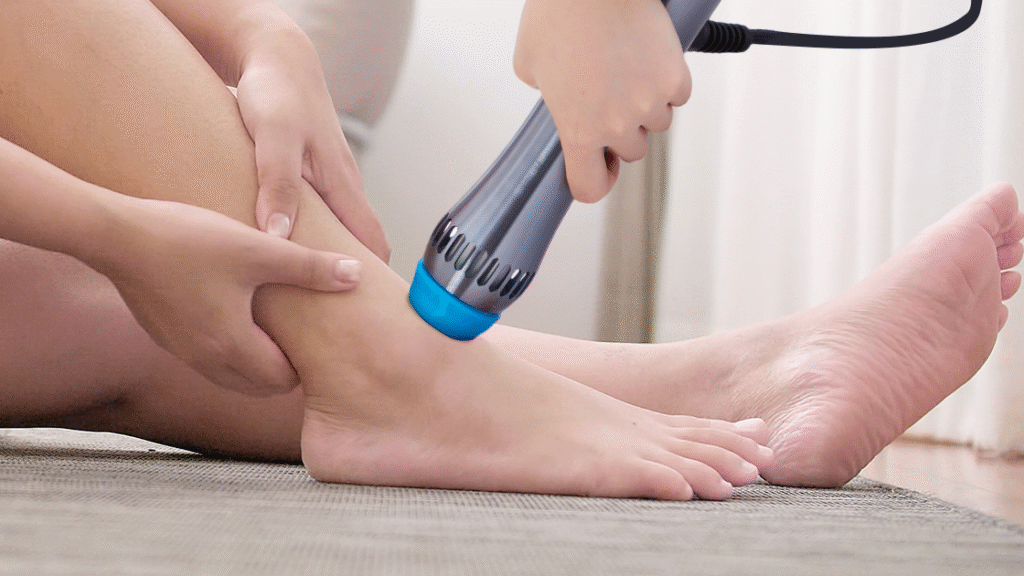
Shockwave therapy is most effective when combined with complementary methods such as stretching, massage, cryotherapy, and nutrition. This integrated approach enhances recovery speed, reduces inflammation, and improves overall musculoskeletal health. For gymnasts, a comprehensive recovery plan ensures that foot and ankle tissues remain strong and flexible, supporting optimal performance while reducing injury risk.
5. Practical Tips for Gymnasts
To maximize benefits, gymnasts should integrate shockwave therapy into their routines strategically.
5.1 Timing and Frequency
Typical sessions last 5–15 minutes per injured area, with a frequency of 2–3 times per week depending on training intensity. Timing should align with practice schedules, either pre-training for tissue preconditioning or post-training for recovery, to ensure maximum effectiveness without interfering with performance.
5.2 Monitoring Recovery
Tracking improvements in pain levels, flexibility, and jumping performance helps optimize therapy outcomes. Recording recovery progress allows athletes and coaches to adjust therapy parameters and training intensity as needed. Consistent monitoring ensures that tissues are not overstressed, reducing the likelihood of secondary injuries.
5.3 Consistency and Integration
Long-term results are best achieved through regular, consistent therapy rather than sporadic sessions. Combining shockwave therapy with stretching, nutrition, and massage maximizes recovery, enhances tissue resilience, and supports ongoing injury prevention. For gymnasts, integrating therapy into daily or weekly routines ensures both immediate recovery and long-term musculoskeletal health.
FAQ
Is shockwave therapy safe for gymnasts?
Yes. It is non-invasive and generally safe, with minor temporary effects like redness or warmth at the treatment site.
How soon can results be noticed?
Athletes often experience reduced pain and improved flexibility after 1–2 sessions. Tissue repair may continue over several weeks.
Can it replace other recovery methods?
No. Shockwave therapy complements physical therapy, stretching, and other recovery techniques for enhanced outcomes.
Does it prevent future injuries?
Yes. Regular use improves tissue resilience, flexibility, and joint stability, reducing the risk of recurrent injuries.
Заключение
Shockwave therapy provides gymnasts with a scientifically validated, non-invasive solution for foot and ankle injuries. It accelerates tissue repair, reduces inflammation, enhances flexibility, and supports injury prevention. By integrating therapy into pre-training routines, post-training recovery, and long-term maintenance plans, athletes can safely maintain high training intensity, perform complex skills, and minimize downtime due to injuries. When combined with stretching, massage, and nutrition, shockwave therapy becomes a cornerstone of comprehensive gymnast care.
Ссылки
NCBI – Shockwave Therapy in Musculoskeletal Injuries:
https://www.ncbi.nlm.nih.gov/pmc/articles/PMC6334075
Journal of Orthopaedic Surgery – Shockwave Therapy for Tendinopathies:
https://journals.sagepub.com/doi/10.1177/2309499018767171
Sports Health – Non-invasive Therapies in Athletic Recovery:
https://journals.sagepub.com/doi/full/10.1177/1941738119835475