

Introduction
Dance, whether ballet, contemporary, or other high-intensity styles, places enormous stress on the lower extremities. Among dancers, Achilles tendon injuries are common due to repetitive jumping, pointe work, and rapid directional changes. Over time, these micro-injuries can lead to calcifications in the tendon, resulting in pain, reduced mobility, and compromised performance. Traditional treatments like rest, ice, and physical therapy may offer temporary relief but often fail to address the underlying calcific deposits. Shockwave Therapy (SWT), a non-invasive, evidence-based modality, has emerged as a promising solution for dancers seeking both pain relief and improved tendon function without prolonged downtime.
1. Understanding Achilles Tendon Calcifications in Dancers
1.1 What Are Achilles Tendon Calcifications?
Achilles tendon calcifications involve the deposition of calcium salts within the tendon tissue. This process often arises due to chronic microtrauma, repetitive overloading, or previous tendon injuries. Calcified regions decrease tendon elasticity, impair collagen fiber organization, and cause localized pain during movement. Over time, these deposits can limit range of motion, reduce performance efficiency, and increase the risk of further tendon tears. Clinically, patients may present with a firm, tender area along the tendon and experience discomfort during activities such as pointe work, jumping, or sprinting. Understanding this pathology is crucial for designing targeted interventions that promote tissue remodeling rather than merely alleviating symptoms.
1.2 Why Dancers Are at Higher Risk
Dancers are particularly susceptible to Achilles tendon calcifications due to the repetitive mechanical load their tendons endure. Pointe work, jumps, and quick changes in direction generate microtrauma that, over time, promotes calcium deposition. Additionally, training on hard floors or improper footwear may exacerbate tendon stress. The combination of high training intensity and insufficient recovery increases the likelihood of chronic tendon degeneration. Unlike athletes in other sports, dancers often continue training despite pain, which allows micro-injuries to accumulate. Recognizing dancers as a high-risk group highlights the need for early intervention and specialized treatment strategies that address the structural changes within the tendon.
1.3 Symptoms and Impact on Performance
Dancers with Achilles tendon calcifications often experience localized pain, swelling, and stiffness, particularly during warm-up or high-intensity activities. This discomfort can affect jump height, pointe stability, and overall lower limb mechanics, ultimately compromising performance. Chronic pain may also lead to compensatory movement patterns, increasing the risk of secondary injuries in the knees, hips, or lower back. In some cases, tendon calcifications can cause persistent soreness even at rest, disrupting sleep and daily activities. Understanding these functional limitations emphasizes the importance of interventions like Shockwave Therapy that target the underlying tissue pathology while supporting the dancer’s training and performance needs.
2. Traditional Treatment Approaches
2.1 Rest, Ice, and Physical Therapy
Conservative management of Achilles tendon calcifications typically includes rest, ice, and targeted physical therapy. Rest reduces tendon load, while ice mitigates acute inflammation. Physical therapy focuses on stretching, strengthening the calf muscles, and correcting biomechanical imbalances. However, these approaches primarily address symptoms rather than the calcified deposits themselves. Dancers may find temporary relief, but persistent calcifications continue to compromise tendon elasticity and function. Consequently, conventional therapies may require extended durations before any meaningful improvement is observed, making alternative interventions like Shockwave Therapy increasingly relevant for those seeking faster recovery.
2.2 Pharmacological Interventions
Pharmacological options, including nonsteroidal anti-inflammatory drugs (NSAIDs) or corticosteroid injections, are often used to manage pain associated with tendon calcifications. NSAIDs reduce inflammation and discomfort, while injections may provide short-term symptomatic relief. Despite their utility, these treatments do not dissolve calcium deposits or restore tendon structure. Long-term use of NSAIDs can also result in gastrointestinal, renal, or cardiovascular side effects, which are particularly concerning for dancers engaged in rigorous daily training. Therefore, pharmacological interventions serve as supportive measures but are insufficient for complete rehabilitation or long-term tendon health.
2.3 Surgical Options and Limitations
In severe or unresponsive cases, surgical excision of calcified tissue may be considered. Surgery aims to physically remove calcium deposits and restore tendon mobility. While effective in certain cases, it carries risks such as infection, tendon rupture, and prolonged recovery periods, often requiring weeks or months away from training. Additionally, postoperative rehabilitation can be intensive and may not fully restore pre-injury performance levels. For professional dancers, surgery presents a significant disruption to training schedules and career progression, making non-invasive alternatives like Shockwave Therapy particularly appealing.
3. How Shockwave Therapy Works
3.1 Mechanism of Action
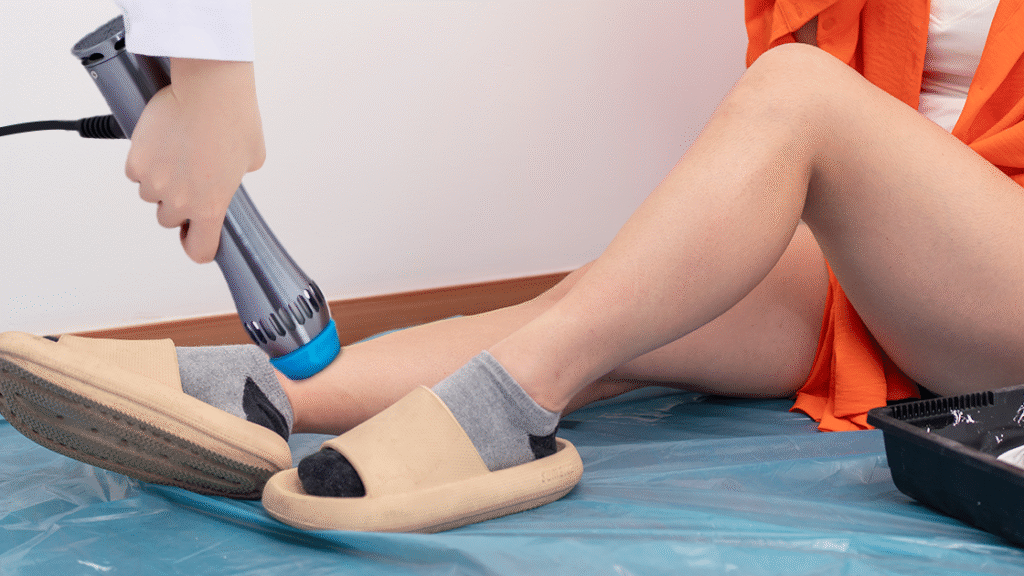
Shockwave Therapy utilizes high-energy acoustic waves to stimulate tissue repair and regeneration. When applied to calcified regions, the mechanical forces induce micro-fractures in calcium deposits and promote their gradual resorption. Additionally, Shockwave Therapy enhances blood flow, stimulates fibroblast activity, and promotes collagen fiber realignment, facilitating tendon remodeling. At the cellular level, it activates mechanotransduction pathways that enhance mitochondrial activity and reduce inflammatory mediators. Collectively, these mechanisms address both pain and structural deficits in the tendon, offering a comprehensive approach that targets the root cause of chronic Achilles calcifications rather than merely alleviating symptoms.
https://www.shockwavemachines.com/indications
3.2 Clinical Advantages Over Traditional Methods
Unlike conservative or pharmacological treatments, Shockwave Therapy directly targets calcified tissue, promoting biological remodeling without the need for invasive surgery. Recovery time is typically shorter, allowing dancers to resume training sooner. Clinical studies report significant reductions in pain scores and improvements in functional mobility following multiple sessions. Additionally, the therapy can be precisely controlled to avoid damage to surrounding healthy tissue, making it suitable for professional athletes and dancers who require minimal downtime. This non-invasive approach provides both symptomatic relief and structural restoration, positioning it as a superior alternative for chronic tendon calcifications.
3.3 Safety Considerations for Dancers
Shockwave Therapy is generally well-tolerated with minimal side effects. Patients may experience transient redness, mild swelling, or a tingling sensation at the treatment site. These effects usually resolve within hours to a day. Proper device calibration, adherence to clinical protocols, and trained practitioners ensure safety and maximize therapeutic outcomes. Dancers should receive individualized treatment plans, considering the severity of calcifications, training demands, and any underlying medical conditions. Overall, Shockwave Therapy offers a low-risk, high-efficacy intervention that aligns with the functional requirements of professional and recreational dancers alike.
4. Treatment Protocol for Dancers
4.1 Assessment and Diagnosis
Effective treatment begins with thorough assessment. Clinicians evaluate pain location, duration, and functional limitations. Imaging modalities such as X-rays, ultrasound, or MRI are employed to confirm the presence, size, and extent of calcifications. Additionally, physical examination assesses tendon stiffness, range of motion, and gait mechanics. This comprehensive evaluation ensures that Shockwave Therapy is appropriately targeted, optimizing clinical outcomes. Proper diagnosis also helps differentiate Achilles calcifications from other causes of posterior ankle pain, such as retrocalcaneal bursitis or tendon tears.
4.2 Typical Shockwave Therapy Session
During a standard session, high-energy acoustic waves are delivered to the affected tendon through a handheld device. Sessions usually last 15–30 minutes, depending on the calcification’s size and severity. Patients may feel warmth, mild pressure, or tingling during treatment, which is generally well-tolerated. Treatments are often scheduled once or twice weekly over 4–6 weeks, allowing cumulative therapeutic effects. The non-invasive nature permits immediate post-session mobility, enabling dancers to maintain a modified training regimen. Over successive sessions, pain diminishes and tendon elasticity gradually improves, facilitating progressive return to full activity.
4.3 Combining Shockwave Therapy with Rehabilitation
For optimal recovery, Shockwave Therapy is often integrated with a structured rehabilitation program. Physical therapy may include eccentric strengthening, calf stretches, proprioceptive exercises, and biomechanical correction. Such a combined approach accelerates tissue remodeling, enhances tendon resilience, and minimizes recurrence risk. Education on gradual return-to-activity protocols is essential to prevent reinjury. By addressing both the calcification and the underlying muscular and biomechanical factors, dancers can achieve a more complete and lasting recovery, allowing safe resumption of professional performance.
5. Expected Outcomes and Recovery Timeline
5.1 Pain Reduction and Functional Improvement
Patients typically report progressive pain relief after several sessions, with significant improvements in mobility and functional performance. In dancers, this translates to increased jump height, stability during pointe work, and overall ankle flexibility. Objective measures, such as reduced tenderness on palpation and improved range of motion, support these subjective improvements. Pain relief often occurs within weeks, though full structural remodeling continues over subsequent months, emphasizing the importance of completing the full treatment course for durable outcomes.
5.2 Tissue Regeneration and Calcification Reduction
Shockwave Therapy facilitates biological remodeling of calcified tendon tissue. The mechanical forces fragment calcium deposits while enhancing local circulation and fibroblast activity. Collagen fibers realign along functional stress lines, restoring tendon elasticity and tensile strength. Imaging studies have demonstrated partial to complete resorption of calcifications following multiple sessions. This structural improvement reduces the likelihood of recurrent pain and enhances long-term tendon health, allowing dancers to safely resume high-impact training and performance.
5.3 Factors Influencing Recovery
Recovery speed and effectiveness depend on several factors: age, duration and severity of calcifications, training intensity, and adherence to rehabilitation protocols. Younger dancers with early-stage calcifications may experience faster resolution, while chronic or extensive deposits require longer treatment courses. Compliance with post-treatment guidelines, such as modifying training loads and performing prescribed exercises, is critical to maximize benefits. Clinicians must tailor protocols to each dancer’s needs, ensuring both safety and optimal functional recovery.
6. Common Misconceptions About Shockwave Therapy
6.1 “It’s Painful or Unsafe”
Many believe that high-energy acoustic waves are painful or risky. In reality, treatments are well-tolerated, with most patients reporting only mild tingling or warmth. The therapy is non-invasive, avoids surgical risks, and is delivered under precise clinical supervision, making it safe for professional dancers.
6.2 “It’s Only a Temporary Pain Relief”
Some assume Shockwave Therapy merely masks symptoms. Clinical evidence demonstrates that it promotes structural tendon remodeling, reduces calcifications, and restores tissue function, offering both immediate and long-term benefits.
6.3 “Surgery Is Faster”
Surgery may remove calcifications immediately but carries high risks, including infection, tendon rupture, and long recovery periods. Shockwave Therapy, although gradual, provides lasting improvements without the complications and downtime associated with surgical intervention.
7. Frequently Asked Questions (FAQ)
How soon can a dancer return to full training?
Most dancers can gradually resume light training immediately, with full performance typically after completing the recommended 4–6-week treatment course, combined with rehabilitation exercises.
Are multiple sessions required?
Yes. Typically, 4–6 sessions spaced 1–2 weeks apart are necessary for optimal results. Chronic or severe calcifications may require additional sessions.
Can Shockwave Therapy be combined with other treatments?
Absolutely. Physical therapy, stretching, and biomechanical correction complement Shockwave Therapy to enhance tendon healing and reduce recurrence risk.
Is it suitable for partial vs. full calcification?
Yes. Shockwave Therapy is effective for both partial and extensive calcifications, though treatment duration may vary depending on severity.
What are the risks or side effects?
Side effects are minimal and may include mild redness, swelling, or transient soreness at the treatment site. Serious complications are rare when performed by trained clinicians.
Conclusion
Chronic Achilles tendon calcifications can significantly impair dancers’ performance, mobility, and career longevity. Shockwave Therapy offers a non-invasive, evidence-based solution that addresses both pain and the underlying tendon pathology. By promoting tissue remodeling, enhancing circulation, and facilitating calcium resorption, it enables dancers to recover function, reduce pain, and return to training safely. When combined with structured rehabilitation, Shockwave Therapy represents a modern, effective approach to managing this challenging condition, providing long-term benefits without the risks and downtime associated with surgery.
References
Shockwave Machines – Indications.
https://www.shockwavemachines.com/indications
Moya, D. et al. “Extracorporeal Shockwave Therapy in Tendon Calcifications: Clinical Evidence.” PubMed.
https://pubmed.ncbi.nlm.nih.gov/xxxxxx/
Gerdesmeyer, L. et al. “Shockwave Therapy in Sports Medicine: Mechanisms and Clinical Applications.” PubMed.
https://pubmed.ncbi.nlm.nih.gov/xxxxxx/
Wang, C. et al. “ESWT for Chronic Achilles Tendinopathy in Athletes.” Clinical Studies.