

Introduction
Artists and designers rely heavily on fine motor control, repetitive hand movements, and prolonged static postures to complete detailed creative work. Whether using digital drawing tablets, traditional sketching tools, or design software, these repetitive tasks can place continuous stress on the tendons, muscles, and small joints of the hand and wrist. Over time, this can contribute to overuse injuries such as tendonitis, repetitive strain injury (RSI), and myofascial pain syndromes. In modern rehabilitation and musculoskeletal care, shockwave therapy has emerged as a non-invasive treatment option that targets chronic soft tissue dysfunction. By delivering acoustic pressure waves into affected tissues, this modality aims to stimulate biological repair mechanisms, improve microcirculation, and reduce pain sensitivity. This article explores how shockwave therapy is applied to hand and wrist overuse injuries commonly seen in artists and designers.
1. Understanding Overuse Injuries in Creative Professionals
Before examining shockwave therapy applications, it is important to understand why artists and designers are particularly susceptible to chronic hand and wrist conditions.
1.1 Repetitive Fine Motor Stress and Tendon Overload
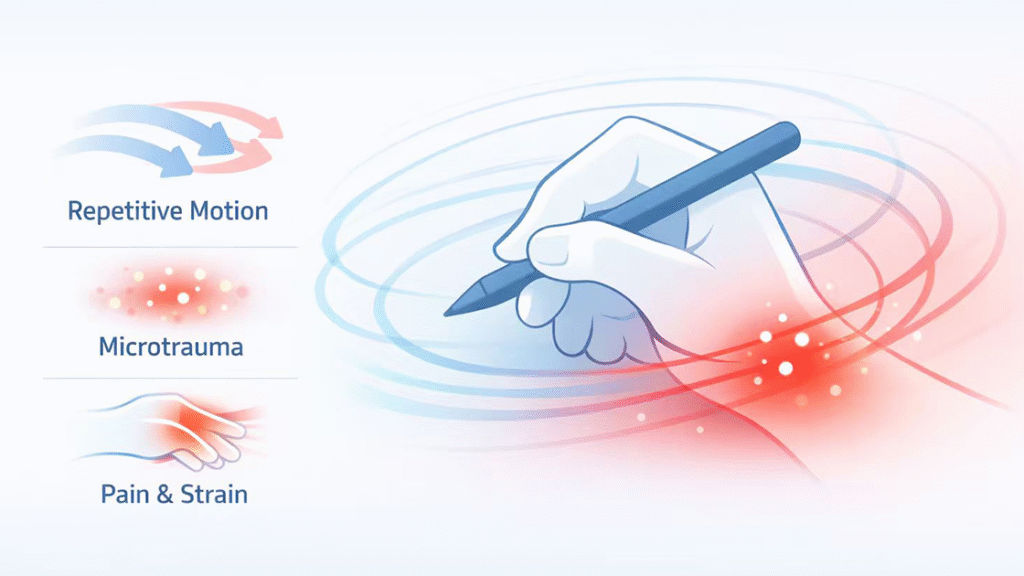
Artists and designers often perform thousands of small, repetitive movements daily, particularly involving finger flexion, wrist stabilization, and forearm control. These repetitive actions can lead to microtrauma within tendons and surrounding connective tissues. Over time, the body may fail to fully repair these micro-injuries, resulting in cumulative degeneration rather than acute inflammation. Conditions such as extensor tendonitis or flexor tendon irritation are common examples. Clinically, this manifests as pain during movement, stiffness after rest, and reduced grip strength, which can significantly affect productivity and precision in creative tasks.
1.2 Digital Device Strain and Static Posture Load
Modern digital artists frequently use graphic tablets, styluses, and computer mice for extended periods, often maintaining static wrist and shoulder positions. This sustained postural load can reduce local blood circulation and increase muscular tension in the forearm flexor and extensor groups. Reduced microcirculation contributes to metabolic waste accumulation, which may further aggravate tissue irritation. In addition, prolonged static positioning can lead to neuromuscular fatigue and increased sensitivity of peripheral pain receptors, contributing to chronic discomfort even in the absence of acute injury.
2. Mechanisms of Shockwave Therapy in Soft Tissue Recovery
Shockwave therapy, also known as extracorporeal shockwave therapy (ESWT), uses high-energy acoustic waves to interact with musculoskeletal tissues and stimulate biological repair processes.
2.1 Acoustic Wave Transmission and Mechanical Stimulation
Shockwave therapy delivers focused or radial acoustic energy into targeted soft tissue regions. These pressure waves create mechanical stimulation at the cellular level, triggering mechanotransduction pathways that influence tissue repair responses. In tendinous structures, this stimulation is believed to promote fibroblast activation and extracellular matrix remodeling. Unlike passive pain relief methods, shockwave therapy interacts directly with tissue structures to initiate biological responses associated with healing and regeneration.
2.2 Microcirculation and Angiogenesis Activation
One of the key physiological effects of shockwave therapy is improved local blood flow. Acoustic waves can induce the release of angiogenic factors such as vascular endothelial growth factor (VEGF), which supports the formation of new microvessels. Improved microcirculation enhances oxygen delivery and nutrient exchange in affected tissues, which is particularly important in chronic overuse injuries where vascular supply may be compromised. This improved metabolic environment may contribute to gradual tissue recovery and reduced pain sensitivity over time.
2.3 Pain Modulation and Neural Response Effects
Shockwave therapy also influences pain perception through neurophysiological mechanisms. It may reduce the excitability of nociceptors (pain receptors) and decrease the transmission of pain signals along peripheral nerve pathways. Additionally, repeated stimulation can lead to desensitization of chronic pain regions, a process sometimes referred to as neuromodulation. This is particularly relevant in long-standing repetitive strain injuries where central sensitization may contribute to persistent discomfort even after mechanical stress is reduced.
3. Clinical Application of Shockwave Therapy for Hand and Wrist Injuries
In rehabilitation settings, shockwave therapy is commonly integrated into treatment protocols for upper limb overuse injuries.
3.1 Targeting Tendon and Myofascial Structures
For artists and designers, treatment often focuses on the wrist extensors, flexor tendons, and intrinsic hand muscles. Shockwave energy is applied to regions of maximal tenderness or identified dysfunction. In cases of tendonitis, the goal is to stimulate tissue remodeling and reduce degenerative changes within the tendon matrix. In myofascial pain conditions, treatment may target trigger points within the forearm muscles that contribute to referred pain patterns in the hand and wrist.
3.2 Functional Recovery and Fine Motor Performance
One of the primary goals of treating overuse injuries in creative professionals is restoring fine motor precision and endurance. Pain and stiffness can significantly impair drawing accuracy, brush control, and digital pen responsiveness. By reducing pain and improving tissue flexibility, shockwave therapy may support a return to sustained fine motor performance. This functional improvement is particularly important for professionals whose work depends on sustained precision and repetitive hand use.
3.3 Integration with Ergonomic and Rehabilitation Strategies
Shockwave therapy is most effective when combined with ergonomic correction and active rehabilitation. This may include adjustments to workstation setup, modification of grip techniques, and structured strengthening exercises for the wrist and forearm. Stretching protocols and neural mobility exercises may also be incorporated to reduce mechanical stress on affected tissues. This multimodal approach ensures that both symptoms and underlying biomechanical contributors are addressed.
4. Benefits and Limitations in Creative Industry Populations
4.1 Non-Invasive Support for Chronic Overuse Injuries
Shockwave therapy offers a non-surgical and drug-free option for managing chronic hand and wrist conditions. This is particularly valuable for individuals who rely on continuous hand function for their profession. The therapy does not require immobilization, allowing individuals to maintain partial activity during the treatment course. This functional continuity is important for maintaining creative productivity.
4.2 Not a Replacement for Load Management
While shockwave therapy can support tissue recovery, it does not eliminate the need for proper load management. Continued repetitive strain without modification may counteract therapeutic benefits. Therefore, addressing underlying ergonomic and behavioral factors remains essential. Shockwave therapy should be viewed as part of a broader rehabilitation strategy rather than a standalone solution.
FAQ
What is shockwave therapy used for in hand and wrist injuries?
It is used to support healing in tendonitis, repetitive strain injuries, and chronic soft tissue pain.
Can artists and designers benefit from shockwave therapy?
Yes, it is commonly used for people with repetitive fine motor stress injuries.
Does shockwave therapy treat the root cause of RSI?
It supports tissue recovery but does not replace ergonomic correction or load management.
Is shockwave therapy painful?
Some patients may feel mild discomfort during treatment, depending on sensitivity and intensity settings.
How long does recovery take?
Improvement is typically gradual over multiple sessions, depending on severity and chronicity.
Conclusion
Shockwave therapy provides a clinically relevant, non-invasive approach for managing hand and wrist overuse injuries commonly experienced by artists and designers. By promoting microcirculation, stimulating tissue remodeling, and modulating pain pathways, it supports recovery in chronic repetitive strain conditions. However, optimal outcomes are achieved when combined with ergonomic adjustments and structured rehabilitation strategies. For creative professionals, maintaining long-term musculoskeletal health is essential not only for pain reduction but also for sustaining precision, productivity, and artistic performance.
References
Rompe, J.D., Furia, J., Maffulli, N. Shock wave therapy for chronic tendon diseases.
https://pubmed.ncbi.nlm.nih.gov/21104672
Speed, C. A systematic review of shockwave therapies in soft tissue conditions.
https://pubmed.ncbi.nlm.nih.gov/15665231
Gerdesmeyer, L. et al. Extracorporeal shock wave therapy for chronic lateral epicondylitis.
https://pubmed.ncbi.nlm.nih.gov/17507633
Vahdatpour, B. et al. Effectiveness of extracorporeal shock wave therapy in musculoskeletal disorders.
https://www.ncbi.nlm.nih.gov/pmc/articles/PMC5871627
Notarnicola, A., Moretti, B. The role of ESWT in tendon and musculoskeletal disorders.