

Introduction
You load the barbell for a heavy set of curls. The first rep feels fine. By the third, a sharp pain shoots through the front of your shoulder and down into your elbow. You ignore it, finish the set, and spend the next two days unable to lift your coffee mug. For weightlifters, bodybuilders, and functional fitness athletes, biceps tendinopathy is a frustrating and stubborn injury. The pain does not stop you from living a normal life, but it definitely stops you from training hard. Cortisone shots offer temporary relief but weaken the tendon over time. Surgery means months away from the gym. Fortunately, extracorporeal shock wave therapy (ESWT) provides a middle path—a non‑invasive, drug‑free treatment that targets the damaged tendon directly and gets weightlifters back to the barbell without an operating room. This article explains how shockwave therapy works for biceps tendinopathy, what the treatment feels like, and how to combine it with smart training modifications for a full recovery.
1. Understanding Biceps Tendinopathy in Weightlifters
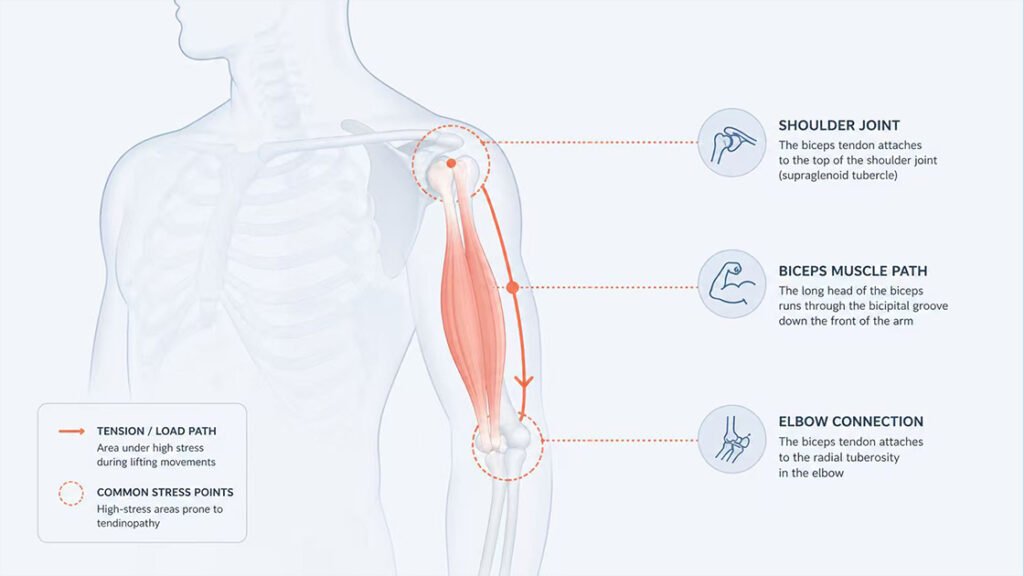
The biceps tendon connects the biceps muscle to the shoulder joint and the elbow. Weightlifters put this tendon under repeated, high‑load stress, which eventually leads to micro‑tears, inflammation, and degeneration.
1.1 What Is Biceps Tendinopathy
Biceps tendinopathy is an overuse injury affecting the long head of the biceps tendon where it passes through the bicipital groove of the humerus. Unlike acute biceps rupture, which happens suddenly with a pop, tendinopathy develops gradually over weeks or months. The tendon becomes thickened, disorganized at the cellular level, and painful with specific movements such as supination (turning the palm up), elbow flexion against resistance, or overhead pressing. Weightlifters often feel the pain deep in the front of the shoulder or down the front of the arm. The condition is not a simple inflammation—it is a failed healing response that leaves the tendon weaker and more vulnerable.
1.2 Why Weightlifters Are at High Risk
Any exercise that places the biceps under tension increases the risk. Barbell curls with a straight bar lock the wrists in supination, placing constant torque on the long head tendon. Pull‑ups, rows, and deadlifts also stress the biceps as a stabilizer. The problem worsens when lifters increase volume too quickly, use poor form (swinging the weight), or train through fatigue without enough rest days. Over time, the repetitive micro‑trauma exceeds the tendon’s ability to repair itself. Unlike muscles, tendons receive limited blood flow, especially the long head of the biceps, which has a relatively avascular zone near its attachment. This poor blood supply explains why the injury tends to become chronic.
1.3 Typical Symptoms and How They Affect Training
The hallmark symptom of biceps tendinopathy is a deep, aching pain over the anterior shoulder that worsens with lifting and improves with rest. Weightlifters often notice pain at the start of a workout that seems to fade during activity only to return with a vengeance hours later. Palpating the biceps tendon in the bicipital groove reproduces the tenderness. Overhead presses, chin‑ups, and supinated curls become almost impossible without sharp pain. Many lifters compensate by using lighter weights, changing their grip, or avoiding certain exercises altogether. This compensation pattern creates muscle imbalances and can lead to secondary shoulder impingement or rotator cuff issues. Ignoring the problem only allows the tendon degeneration to progress.
2. How Shockwave Therapy Targets the Biceps Tendon
Shockwave therapy uses high‑energy acoustic waves to stimulate healing in damaged soft tissues. For the biceps tendon, ESWT addresses the root causes of tendinopathy: poor blood flow, disorganized collagen, and chronic inflammation.
2.1 Focused Versus Radial Shockwave for Tendons
Two types exist. Radial shockwaves spread outward from the applicator, covering a wider but shallower area. Focused shockwaves concentrate energy at a precise depth, making them better for deep structures like the long head of the biceps. For biceps tendinopathy, focused shockwave is the preferred choice because the tendon sits under the deltoid and pectoralis muscles. Radial waves may not reach the target with enough energy. A provider will adjust the energy flux density and frequency based on the chronicity of the injury. Acute flare‑ups need lower energy, while chronic, degenerative tendinopathy requires higher energy to break down scar tissue and trigger a fresh healing response.
2.2 Mechanical Disruption of Abnormal Tissue
One of the primary mechanisms of ESWT is mechanical. When the acoustic wave hits the degenerated tendon, it creates micro‑cavitation bubbles that expand and collapse. This implosion generates shear forces that disrupt calcific deposits and break apart disorganized collagen fibers. The process essentially “resets” the tendon, removing the pathological tissue that the body could not clear on its own. After this controlled micro‑trauma, the body mounts a fresh inflammatory and healing response. New blood vessels grow into the area, and fibroblasts lay down new collagen in a more organized, functional pattern. The mechanical effect happens during the treatment session itself, but the healing takes weeks to unfold.
2.3 Stimulating Neovascularization and Collagen Repair
Degenerated tendons have poor blood flow, which is why they fail to heal. ESWT directly stimulates angiogenesis—the formation of new microcapillaries. By week two or three after starting shockwave therapy, the treated biceps tendon shows significantly increased vascularity. More blood brings oxygen, nutrients, and immune cells that clear debris and support tissue remodeling. At the same time, shockwave upregulates the expression of growth factors such as TGF‑β and vascular endothelial growth factor (VEGF). These signals recruit tenocytes (tendon cells) and boost collagen type I production, which gives the tendon its tensile strength. Over several weeks, the tendon becomes thicker, more organized, and more resistant to future overload.
2.4 Pain Modulation Without Medication
Beyond tissue repair, ESWT changes how the nervous system perceives pain from the biceps tendon. The high‑energy acoustic pulses overload the small nerve fibers that transmit pain signals, a phenomenon called hyperstimulation analgesia. After a treatment session, many weightlifters notice an immediate but temporary reduction in pain. Over the full course of therapy, the repeated stimulation desensitizes the nerve endings within the tendon, raising the threshold for pain. This means that previously painful movements—like holding a supinated curl at 90 degrees—gradually become tolerable again. Because ESWT does not use any medication, there are no systemic side effects, no stomach issues, and no risk of masking a worsening injury.
3. Practical Application for Weightlifters and Athletes
Shockwave therapy is not a passive fix. Weightlifters need to understand the protocol, the expected timeline, and how to adjust their training to protect the healing tendon.
3.1 What a Typical Treatment Session Looks Like
A focused ESWT session for the biceps tendon takes 10 to 15 minutes. The lifter lies on their back with the shoulder slightly externally rotated. The provider applies ultrasound gel to the front of the shoulder over the bicipital groove. Using a handheld applicator, they deliver 2000 to 3000 shockwaves at a frequency of 5 to 8 Hz. The sensation is a deep, percussive thumping—not pleasant, but tolerable for most athletes. No anesthesia is required. Immediately after the session, the tendon may feel sore or achy for 24 to 48 hours. This post‑treatment soreness is a normal sign that the healing process has been activated.
3.2 Number of Sessions and Timeline
Most clinical protocols for biceps tendinopathy recommend three to five sessions spaced one week apart. Some chronic cases may need up to six sessions. Improvement does not happen overnight. The first two sessions often produce only modest changes. By the third or fourth session, lifters usually notice a clear reduction in pain during daily activities and during warm‑up sets. Full clinical improvement typically appears four to six weeks after the final session, as the new collagen matures and vascularity stabilizes. Many lifters return to their pre‑injury lifting numbers within eight to twelve weeks of starting shockwave therapy, provided they follow proper training modifications.
3.3 Training Modifications During Treatment
Do not train through pain. During the weeks of shockwave therapy, weightlifters must avoid provocative movements. This means no heavy barbell curls, no chin‑ups with a supinated grip, and no overhead presses that cause sharp pain. However, complete rest is also not ideal. Acceptable alternatives include neutral‑grip cable rows, hammer curls (palms facing each other), and lat pull‑downs with a neutral grip. Lower the training volume by 40 to 50 percent. Use pain as a guide: if an exercise produces pain during or after the movement, remove it for now. After completing the full shockwave course, gradually reintroduce supinated curls over three to four weeks, starting at 30% of the previous working weight.
3.4 What to Avoid After Each Session
For 48 hours after a shockwave session, avoid heavy lifting that directly stresses the biceps tendon. Anti‑inflammatory medications like ibuprofen or naproxen should also be avoided, because the therapy relies on a controlled inflammatory response to trigger healing. Ice packs are acceptable for the first 24 hours if post‑treatment soreness feels intense. Some lifters benefit from gentle range‑of‑motion exercises, such as passive shoulder external rotation or pendulum swings, to keep the joint from stiffening. Resume normal daily activities immediately, but hold off on any biceps‑intensive training until the post‑session soreness subsides.
4. Comparing Shockwave to Other Treatments for Biceps Tendinopathy
Weightlifters have multiple options for managing biceps tendinopathy. Understanding how shockwave stacks up against rest, injections, and surgery helps athletes make informed choices.
4.1 Rest and Activity Modification Alone
Resting the tendon for six to eight weeks can reduce pain, but the tendon does not heal structurally. The degenerated collagen remains disorganized, and blood flow stays poor. Once the lifter returns to heavy training, the pain comes back quickly because the underlying pathology never resolved. Rest also leads to muscle atrophy and detraining. Shockwave therapy does not replace rest entirely but complements it by actively stimulating repair. Lifters who choose only rest often find themselves back at the same point months later, having lost strength and gained nothing in tissue quality.
4.2 Corticosteroid Injections
Cortisone shots provide rapid, dramatic pain relief for two to six weeks. However, corticosteroids also weaken collagen synthesis and can accelerate tendon degeneration over time. Repeated injections increase the risk of tendon rupture. For a weightlifter who needs to compete in the short term, a single injection may be acceptable, but it is not a healing strategy. Shockwave therapy takes longer to show benefits, but those benefits involve actual tissue repair. The choice comes down to short‑term relief versus long‑term structural improvement. For lifters who want to keep lifting for years, shockwave is the superior choice.
4.3 Surgery
Surgical options include biceps tenodesis (reattaching the tendon to the humerus) or tenotomy (cutting the tendon). Both require general anesthesia, a recovery period of four to six months, and physical therapy. Many weightlifters who undergo surgery never return to their previous lifting numbers due to altered shoulder biomechanics. Surgery is appropriate for full‑thickness tears or cases that have failed all conservative treatments for over nine months. For the vast majority of biceps tendinopathy—grades 1 and 2—shockwave therapy resolves symptoms well enough to avoid the operating room entirely. It is far less expensive, carries no surgical risks, and does not require weeks off work.
5. Long‑Term Success and Prevention After Shockwave
Once shockwave therapy has healed the biceps tendon, weightlifters need to adopt training strategies that prevent recurrence. The tendon is now stronger, but it is not unbreakable.
5.1 Gradual Return to Full Lifting
After finishing the shockwave course and allowing four to six weeks for tissue remodeling, lifters can slowly ramp up volume and intensity. Start with neutral‑grip pulling movements, then add hammer curls, and finally reintroduce supinated barbell curls. Increase weight by no more than 10% per week. If any movement reproduces the old pain, deload by 20% and stay at that level for two weeks before trying again. Many lifters find that permanently replacing straight‑bar curls with EZ‑bar or dumbbell curls reduces stress on the biceps tendon while still building the biceps effectively.
5.2 Warm‑Up and Mobility Work
A cold, stiff tendon is more vulnerable to injury. Before any upper‑body pulling or curling exercise, perform five minutes of light cardio to increase core temperature. Follow with dynamic stretches: arm circles, cat‑cow stretch with shoulder retraction, and gentle biceps stretches with the elbow straight and palm facing up. Do not stretch a painful, irritable tendon—stretching only makes degenerative tendinopathy worse. Once the tendon is pain‑free, regular light stretching helps maintain flexibility and reminds the nervous system that the end‑range positions are safe.
5.3 Managing Training Volume and Recovery
Biceps tendinopathy often develops when lifters increase volume too fast or train the same movement pattern too frequently. Limit direct biceps work to two sessions per week. Keep the total number of heavy sets for supinated curling movements to six or fewer per week. Incorporate de‑load weeks every fourth week, reducing volume by 50%. Pay attention to sleep, protein intake, and hydration—all of which affect tendon repair. A well‑rested tendon recovers faster and adapts to higher loads. Many lifters find that adding a maintenance shockwave session once every three to six months keeps their biceps tendon feeling resilient, especially if they are pushing heavy numbers.
Frequently Asked Questions (FAQ)
Q1: Does shockwave therapy hurt?
Most weightlifters describe the sensation as a deep, rhythmic thumping. It is uncomfortable but usually tolerable. After the session, the tendon may feel sore for 24 to 48 hours, similar to a good workout soreness.
Q2: How soon can I lift heavy again?
You can continue light training during the shockwave course, avoiding provocative movements. Return to heavy supinated curls four to six weeks after the final session, allowing the tendon time to remodel.
Q3: Can shockwave make my biceps tendon worse?
When delivered by a trained provider using proper energy levels, shockwave therapy is very safe. Transient soreness is normal, but permanent worsening is extremely rare.
Q4: Do I need to stop all arm training during shockwave?
No. Avoid movements that cause sharp pain. Neutral‑grip rows, hammer curls, and pulling with straps are usually fine. Complete rest is not necessary and may delay recovery.
Q5: How do I know if shockwave worked for me?
You will know when you can perform a heavy set of supinated curls without the familiar deep ache. Most lifters notice a clear improvement by the fourth session and full resolution by eight to twelve weeks after starting treatment.
Conclusion
Biceps tendinopathy does not have to end a weightlifter‘s pursuit of strength. The old options—rest, injections, or surgery—each carried significant drawbacks. Rest did not heal the tendon. Injections weakened it. Surgery meant months away from the barbell. Extracorporeal shock wave therapy offers a different path. By delivering focused acoustic energy directly to the damaged tendon, ESWT breaks down pathological tissue, stimulates new blood vessel growth, and reorganizes collagen fibers. The treatment requires no drugs, no needles, no incisions, and no time off work. With a typical course of three to five weekly sessions, most weightlifters return to full training within three months—not just pain‑free, but with a stronger, more resilient tendon. The barbell will still be there. With shockwave therapy, so will you.
References
Shockwave Machines. Indications for Biceps Tendinopathy.
https://www.shockwavemachines.com/indications
International Society for Medical Shockwave Treatment. Biceps Tendinopathy Guidelines.
https://www.shockwavetherapy.org/biceps-tendinopathy
Romeo P, et al. Extracorporeal shock wave therapy in musculoskeletal disorders: a review. Med Princ Pract. 2022;31(3):201-210.
Notarnicola A, Moretti B. The biological effects of extracorporeal shock wave therapy on tendons. Muscles Ligaments Tendons J. 2019;9(1):29-36.
Wu YT, et al. Comparative effectiveness of shockwave therapy for chronic tendinopathy: a systematic review. J Clin Med. 2023;12(4):1423.