

Introduction
Hiking can be an enjoyable way to stay active, explore nature, and build lower-body strength. Yet repeated climbs, steep descents, and uneven trails can place considerable stress on the calves. For recreational hikers, calf discomfort may first appear after a long weekend on the trail. Over time, repeated irritation can turn occasional soreness into a recurring problem. Chronic calf pain can affect more than the next hiking trip. It may make stairs uncomfortable, reduce walking tolerance, or create stiffness after sitting. Shockwave Therapy may have a role in a broader recovery plan for selected soft-tissue conditions. Understanding the possible causes of calf pain and how shockwave treatment fits into rehabilitation can help hikers make more informed recovery decisions.
1. Why Hiking Can Lead to Persistent Calf Pain
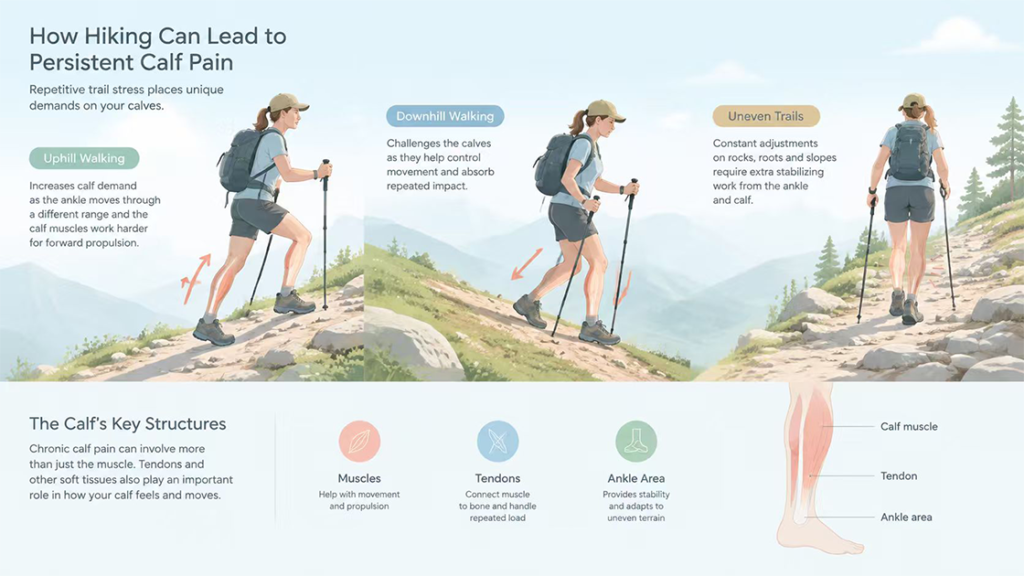
Before considering any treatment approach, it is important to understand why hiking places unique demands on the lower legs. Trail walking does not load the calves in the same way as ordinary walking on flat ground.
1.1 Uphill Walking Increases Calf Demand
Walking uphill changes the mechanics of each step. The ankle needs to move through a different range, while the calf muscles contribute more to forward propulsion.
Long climbs can therefore create substantial repetitive loading. A hiker may feel fine during the first part of a trail but notice increasing tightness as the elevation continues to rise.
This pattern can become more noticeable when someone increases hiking distance or elevation too quickly.
1.2 Descents Create Another Type of Stress
Going downhill may feel easier from a cardiovascular perspective, but it can still challenge the lower legs.
The calf muscles help control movement as the body moves downward. Repeated downhill steps can create a different form of muscular and tendon loading.
A long descent may therefore leave the calves feeling stiff or sore even when the climb itself felt manageable.
1.3 Uneven Trails Change the Way the Calf Works
Natural trails rarely provide a perfectly predictable walking surface. Rocks, roots, slopes, and uneven ground require constant adjustments.
The ankle and calf must respond to these changes from one step to the next. Smaller stabilizing movements can accumulate over several hours.
For recreational hikers who only train occasionally, this sudden increase in workload may be particularly noticeable.
2. Understanding Chronic Calf Pain in Hikers
Not every sore calf represents an injury. Normal post-exercise soreness usually improves with adequate recovery. Persistent or recurring pain deserves a closer look.
2.1 Normal Soreness Versus Recurrent Pain
Delayed muscle soreness can occur after unfamiliar or demanding physical activity. It often develops within the hours following exercise and gradually improves.
Chronic calf pain follows a different pattern. It may return during similar activities or remain present between hiking sessions.
A hiker might notice discomfort every time a trail becomes steep. Another person may feel pain after several miles rather than at the beginning of the walk.
These patterns can provide useful information when discussing symptoms with a healthcare professional.
2.2 Calf Pain Can Involve More Than Muscle
The calf contains several muscles and tendons that work together during walking and climbing. Pain can come from different structures, including muscle tissue, tendons, or areas around the ankle.
This distinction matters because treatment should match the underlying problem.
For example, chronic tendon-related pain may require a different rehabilitation strategy from simple muscular fatigue. A professional assessment can help determine what structure is involved and whether additional imaging or evaluation is appropriate.
3. Where Shockwave Therapy May Fit Into Calf Recovery
Once a persistent calf problem has been assessed, Shockwave Therapy may become one component of a broader treatment plan. It should not replace diagnosis, exercise, or appropriate load management.
3.1 How Shockwave Therapy Works
Shockwave Therapy uses acoustic waves to deliver mechanical energy to targeted areas of the body.
These waves interact with tissues and may influence local biological responses. Research has explored potential effects on pain, tissue remodeling, blood flow, and other processes involved in musculoskeletal recovery.
The exact response depends on the type of shockwave, treatment parameters, tissue involved, and clinical condition.
This is why treatment should be individualized rather than based on a single protocol for every type of calf pain.
3.2 Why Chronic Soft-Tissue Problems May Be Considered
Shockwave Therapy has received attention in the management of several chronic musculoskeletal conditions, particularly problems involving tendons and other soft tissues.
One possible reason is its ability to deliver mechanical stimulation to a localized treatment area. This may help create a biological environment that supports tissue remodeling and rehabilitation.
However, the evidence varies across conditions. A therapy that may benefit one tendon disorder cannot automatically be assumed to work in the same way for every calf problem.
The diagnosis and recovery stage should remain central to treatment planning.
3.3 Shockwave Therapy Is Not a Substitute for Progressive Loading
Calf recovery requires more than passive treatment.
The calf muscles need to regain strength and the ability to tolerate the demands of hiking. Progressive loading can help prepare the tissue for walking uphill, descending trails, and handling uneven surfaces.
Shockwave Therapy may be used alongside exercises rather than instead of them.
This combination can create a more complete approach. One part focuses on the affected tissue, while another gradually rebuilds strength and functional capacity.
4. Building a Better Recovery Strategy for Hikers
Treating chronic calf pain is only one part of the process. Recreational hikers also need to consider how their training habits contribute to repeated symptoms.
4.1 Increase Hiking Load Gradually
A common problem occurs when hiking frequency or distance increases faster than the body can adapt.
Someone who normally walks on flat roads may suddenly attempt a steep mountain trail. The cardiovascular system may handle the challenge reasonably well, while the calves struggle with the unfamiliar workload.
Gradual progression gives muscles and tendons more time to adapt.
Increasing distance, elevation, or hiking frequency one step at a time can be more practical than making a large jump in training volume.
4.2 Strengthen the Calves Between Hiking Trips
Strong calves do more than improve hiking performance. They also help the lower leg tolerate repeated loading.
Calf raises and other progressive strengthening exercises can help build capacity. The specific exercise selection should depend on the individual’s symptoms and physical condition.
For someone with persistent pain, working with a physical therapist or other qualified professional can help determine the appropriate level of loading.
4.3 Do Not Ignore Recovery Between Trails
Recovery does not begin when the next hike starts. It begins after the previous one ends.
Sleep, nutrition, appropriate activity levels, and recovery days can all influence how the body responds to repeated physical stress.
A hiker who repeatedly pushes through unresolved calf pain may gradually reduce their tolerance for longer trails.
This creates a cycle where every hike produces symptoms before the tissue has fully adapted.
5. When Chronic Calf Pain May Need Professional Attention
Not every calf problem can be managed as ordinary hiking soreness. Certain patterns deserve professional evaluation.
5.1 Pain That Returns on Every Hike
If calf pain repeatedly appears after similar distances or elevation changes, the pattern should not be ignored.
Recurring symptoms may indicate that the tissue has not adapted to the current workload or that an underlying condition needs attention.
A professional can assess strength, movement patterns, training load, and the affected tissues.
5.2 Pain That Persists Between Hiking Sessions
Occasional post-hike soreness should generally improve with recovery. Pain that remains during ordinary walking or continues for an extended period may require further assessment.
This is especially important if symptoms gradually become more frequent or interfere with daily activities.
Shockwave Therapy should only be considered after determining whether the underlying condition is appropriate for this type of treatment.
5.3 Sudden or Severe Calf Symptoms Require Caution
Not all calf pain comes from overuse.
Sudden severe pain, significant swelling, warmth, redness, unexplained tenderness, or difficulty walking can have causes that require prompt medical attention.
Hikers should not assume that persistent calf discomfort is simply a sports injury. A professional evaluation is particularly important when symptoms appear suddenly or do not match the usual pattern of exercise-related soreness.
FAQ
Can Shockwave Therapy help chronic calf pain?
It may support recovery for selected chronic soft-tissue conditions, but its effectiveness depends on the underlying diagnosis. It should form part of an individualized treatment plan.
Is Shockwave Therapy suitable for hikers?
It may be considered when a hiker has a diagnosed musculoskeletal condition that may respond to shockwave treatment. A professional should determine whether the therapy fits the specific problem.
Can hiking cause chronic calf pain?
Repeated uphill walking, downhill loading, uneven terrain, and sudden increases in hiking volume can place substantial stress on the calves. Persistent pain may indicate that the tissue needs further assessment.
Should I stop hiking if my calf hurts?
The answer depends on the severity and cause of the pain. Continuing normal activity through significant or worsening pain may not be appropriate. A professional can help determine a safe activity level.
Can Shockwave Therapy replace calf strengthening?
No. Strength and load tolerance remain important parts of long-term recovery. Shockwave Therapy may complement progressive exercise rather than replace it.
When should calf pain be evaluated?
Persistent, recurring, worsening, or unexplained calf pain deserves professional attention. Sudden severe symptoms or significant swelling require prompt medical evaluation.
Conclusion
Recreational hiking places unique demands on the calves. Long climbs increase propulsion demands, while steep descents require repeated control of body movement. Uneven trails add another layer of stress. When hiking volume increases too quickly, these demands may contribute to recurring calf discomfort.
Shockwave Therapy may provide a supportive option for selected chronic soft-tissue conditions. Its potential role becomes more meaningful when combined with proper assessment, progressive strengthening, sensible hiking progression, and adequate recovery. For recreational hikers, the goal should not simply be to reduce pain before the next trail. It should be to build enough strength and tissue tolerance to handle future hikes with greater confidence and consistency.
References
Shockwave Therapy for Musculoskeletal Disorders: A Review of the Literature
https://pubmed.ncbi.nlm.nih.gov/27676410/
Extracorporeal Shock Wave Therapy for Musculoskeletal Disorders: Effectiveness and Mechanisms
https://pubmed.ncbi.nlm.nih.gov/23811435/
Clinical Application of Extracorporeal Shock Wave Therapy in Musculoskeletal Disorders
https://pmc.ncbi.nlm.nih.gov/articles/PMC4105117/
Extracorporeal Shockwave Therapy in Tendinopathy: A Review of the Literature
https://pubmed.ncbi.nlm.nih.gov/25672770/
Physical Activity Guidelines for Americans, 2nd Edition
https://health.gov/sites/default/files/2019-09/Physical_Activity_Guidelines_2nd_edition.pdf