

Introduction
Content creation has evolved into a full-time profession for video editors, photographers, graphic designers, social media managers, streamers, and digital marketers. While creative work offers flexibility and innovation, it often requires long hours of computer use, repetitive hand movements, and prolonged sitting. Over time, these demands can contribute to discomfort in the neck, shoulders, and wrists. As awareness of occupational musculoskeletal health continues to grow, Shockwave Therapy has gained attention as a non-invasive technology used to support soft tissue function, promote tissue remodeling, and address chronic stress within muscles, tendons, and connective tissues. For content creators who spend countless hours editing, designing, and producing digital content, understanding the role of Shockwave Therapy provides valuable insight into modern recovery and tissue care strategies.
1. Why Content Creators Commonly Experience Neck, Shoulder, and Wrist Pain
1.1 The Physical Demands of Long Editing Sessions
Content creation may appear physically effortless, but the body experiences significant strain during extended editing sessions. Editors often maintain static postures while focusing on screens for several hours at a time. Small repetitive movements involving keyboards, mice, editing consoles, and touchpads can place continuous stress on muscles and tendons. Over time, these repetitive demands may contribute to tissue overload, reduced mobility, and localized discomfort. The neck, shoulders, and wrists are particularly vulnerable because they remain engaged throughout most digital production tasks.
1.2 Repetitive Motion and Cumulative Tissue Stress
Unlike acute injuries, occupational discomfort among content creators often develops gradually. Repetitive wrist movements, prolonged shoulder elevation, and forward head posture can create cumulative stress within soft tissues. These patterns may influence muscle flexibility, tendon function, and fascial mobility. As tissues adapt to repeated mechanical loads, they can become less resilient, leading to persistent tightness and movement restrictions that affect daily comfort and productivity.
2. Understanding Shockwave Therapy Technology
2.1 What Is Shockwave Therapy?
Shockwave Therapy is a non-invasive treatment modality that utilizes acoustic waves to interact with targeted tissues. Originally developed for medical applications involving calcified structures, the technology has expanded into musculoskeletal rehabilitation and soft tissue management. Modern shockwave devices deliver controlled acoustic energy that penetrates tissues and stimulates biological responses at the cellular level. This technology is widely used in rehabilitation settings to support tissue regeneration, circulation, and structural remodeling.
2.2 How Acoustic Waves Interact with Soft Tissue
When shockwave energy enters the body, it creates mechanical stimulation within muscles, tendons, fascia, and connective tissue structures. These acoustic pulses generate controlled micro-mechanical effects that influence tissue metabolism and cellular communication. Unlike therapies focused solely on surface-level treatment, Shockwave Therapy reaches deeper anatomical layers where chronic tissue stress and movement restrictions often develop. This makes it particularly relevant for individuals who experience long-term occupational strain.
3. Shockwave Therapy and Occupational Strain in Content Creators
3.1 Addressing Neck Muscle Tension from Screen-Based Work
The forward-head posture commonly observed during editing sessions places continuous demand on cervical muscles and surrounding soft tissues. As this posture becomes habitual, mechanical stress accumulates in the neck region. Shockwave Therapy interacts with affected tissues through acoustic stimulation, promoting localized biological activity within the treatment area. By targeting structures involved in postural strain, the technology supports tissue mobility and physiological function in regions frequently affected by prolonged screen use.
3.2 Supporting Shoulder Function During Repetitive Creative Tasks
Video editing, graphic design, and content production often require sustained arm positioning and repetitive upper extremity movements. These activities can contribute to increased stress on shoulder muscles, tendons, and connective tissues. Shockwave Therapy delivers acoustic energy into these structures, stimulating cellular processes associated with tissue adaptation and remodeling. As a result, it has become a commonly discussed technology in rehabilitation environments focused on occupational musculoskeletal health.
3.3 Managing Wrist and Forearm Overuse
Wrist discomfort is a frequent concern among content creators who rely heavily on precision hand movements. Continuous clicking, scrolling, and keyboard use place repetitive demands on forearm tendons and surrounding tissues. Shockwave Therapy targets these areas by generating mechanical stimulation that influences tissue activity beneath the skin surface. This approach supports the management of chronic overuse patterns commonly associated with digital work environments.
4. Biological Mechanisms Behind Shockwave Therapy
4.1 Promoting Microcirculation in Stressed Tissues
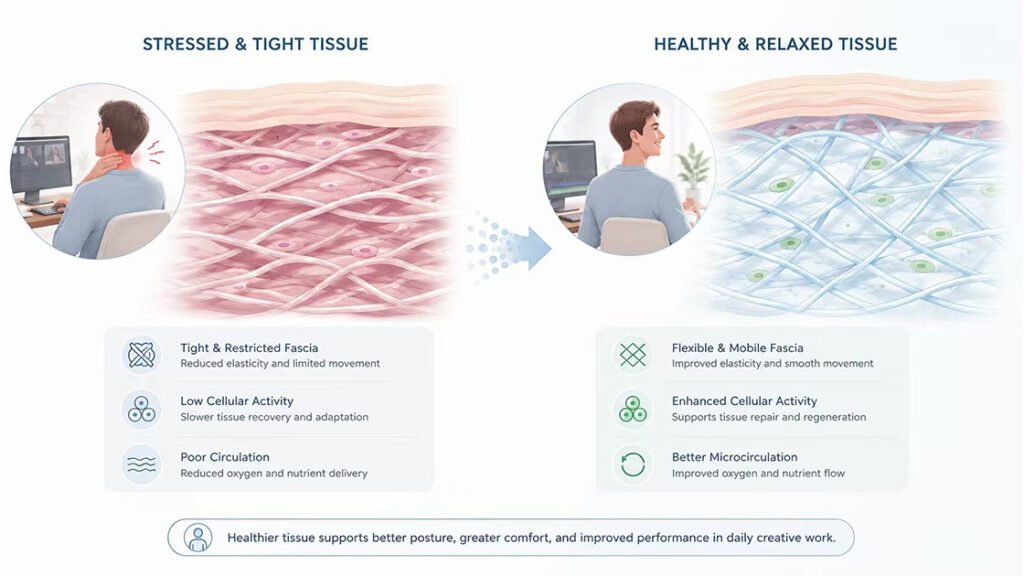
One of the most recognized effects of Shockwave Therapy is its influence on local microcirculation. Acoustic waves interact with vascular structures, encouraging physiological responses that support blood flow within targeted regions. Improved circulation contributes to oxygen and nutrient transport, which are essential for maintaining tissue health. For content creators who spend long periods in static positions, supporting microvascular activity is an important aspect of overall tissue maintenance.
4.2 Stimulating Cellular Activity and Tissue Remodeling
Shockwave Therapy is associated with biological responses that affect fibroblasts, connective tissue cells, and extracellular matrix structures. These interactions contribute to tissue remodeling processes that help maintain structural integrity. In occupational settings where repetitive strain is common, supporting normal tissue turnover and adaptation can be an important component of long-term musculoskeletal care.
4.3 Supporting Fascial Mobility and Soft Tissue Flexibility
Fascia forms an interconnected network throughout the body and plays a critical role in movement efficiency. Repetitive work patterns may contribute to fascial tightness and reduced mobility. Shockwave Therapy produces mechanical stimulation that interacts with fascial tissues and surrounding structures. This process supports tissue elasticity and movement quality, particularly in areas affected by prolonged postural demands.
5. The Growing Role of Shockwave Therapy in Modern Workplace Wellness
5.1 A Non-Invasive Option for Digital Professionals
As digital professions continue to expand, workplace wellness strategies increasingly focus on non-invasive technologies that support musculoskeletal health. Shockwave Therapy aligns with this trend by offering a technology-driven approach that addresses soft tissue function without surgical intervention. For content creators who depend on physical comfort to maintain productivity, understanding available recovery technologies has become increasingly important.
5.2 Integrating Shockwave Therapy into Recovery-Oriented Work Habits
Modern workplace wellness extends beyond ergonomics and movement breaks. Recovery-focused strategies now include technologies designed to support tissue health and functional mobility. Shockwave Therapy fits within this broader framework by interacting with tissues exposed to repetitive occupational stress. As awareness grows regarding the physical demands of digital work, acoustic wave technology continues to attract attention as part of comprehensive musculoskeletal support programs.
FAQ
Q1: What is Shockwave Therapy?
Shockwave Therapy is a non-invasive technology that uses acoustic waves to stimulate biological activity within soft tissues.
Q2: Why do content creators often experience neck and shoulder discomfort?
Long editing sessions, repetitive movements, and prolonged screen use can create cumulative stress in these areas.
Q3: Can Shockwave Therapy reach deep tissues?
Yes. Acoustic waves can penetrate beyond the skin surface and interact with muscles, tendons, and connective tissues.
Q4: How does Shockwave Therapy support tissue function?
It promotes biological responses related to circulation, cellular activity, and tissue remodeling.
Q5: Is Shockwave Therapy only used for athletes?
No. It is increasingly used in occupational wellness and rehabilitation settings for individuals experiencing repetitive strain and soft tissue stress.
Conclusion
Shockwave Therapy represents an advanced application of acoustic wave technology designed to support musculoskeletal health in modern work environments. For content creators who spend long hours editing, designing, and managing digital projects, repetitive stress on the neck, shoulders, and wrists can contribute to ongoing tissue strain. Through mechanical stimulation of soft tissues, improved microcirculation, and support for cellular remodeling processes, Shockwave Therapy has become an important non-invasive option in contemporary rehabilitation and occupational wellness. As digital professions continue to grow, technologies that address the physical demands of content creation are likely to play an increasingly significant role in maintaining long-term tissue function and movement quality.
References
Extracorporeal Shock Wave Therapy in Musculoskeletal Disorders
https://www.ncbi.nlm.nih.gov/pmc/articles/PMC6029898
Shockwave Therapy and Soft Tissue Regeneration
https://www.ncbi.nlm.nih.gov/pmc/articles/PMC7732168
Mechanisms of Extracorporeal Shockwave Therapy
https://www.ncbi.nlm.nih.gov/pmc/articles/PMC8244104
Acoustic Wave Therapy in Rehabilitation Medicine
https://www.ncbi.nlm.nih.gov/pmc/articles/PMC6997463
Shockwave Therapy for Tendon and Connective Tissue Disorders