

Introduction
Dental professionals perform highly precise procedures that require long periods of concentration, repetitive hand movements, and fixed working positions. Over time, these occupational demands may place continuous stress on areas such as the neck, shoulders, upper back, wrists, and hands. Modern dental practices are increasingly focusing on ergonomic improvements and professional wellness strategies to support long-term career sustainability. Shockwave Therapy, also known as Extracorporeal Shock Wave Therapy (ESWT), uses acoustic wave energy to create mechanical stimulation within targeted tissues and has become an advanced technology explored in various musculoskeletal care settings. By combining professional assessment, ergonomic habits, exercise programs, and supportive technologies, shockwave therapy provides another option for dental professionals who want to maintain physical comfort during demanding clinical work.
1. Understanding Occupational Physical Challenges Among Dental Professionals
Dentistry requires precision, stability, and controlled movements. While these skills are essential for clinical performance, the physical demands of dental procedures can create unique challenges for practitioners who spend many hours maintaining similar positions.
1.1 How Dental Work Creates Repetitive Physical Stress
Dental professionals often perform procedures while maintaining forward head posture, leaning positions, and limited movement for extended periods. These working conditions can increase physical stress on the neck, shoulders, back, and upper extremities.
Dentists, dental hygienists, and dental assistants frequently rely on repeated hand movements and fine motor control when using clinical instruments. Over time, these repetitive tasks may influence muscle comfort and movement patterns, making occupational wellness an important consideration in dental environments.
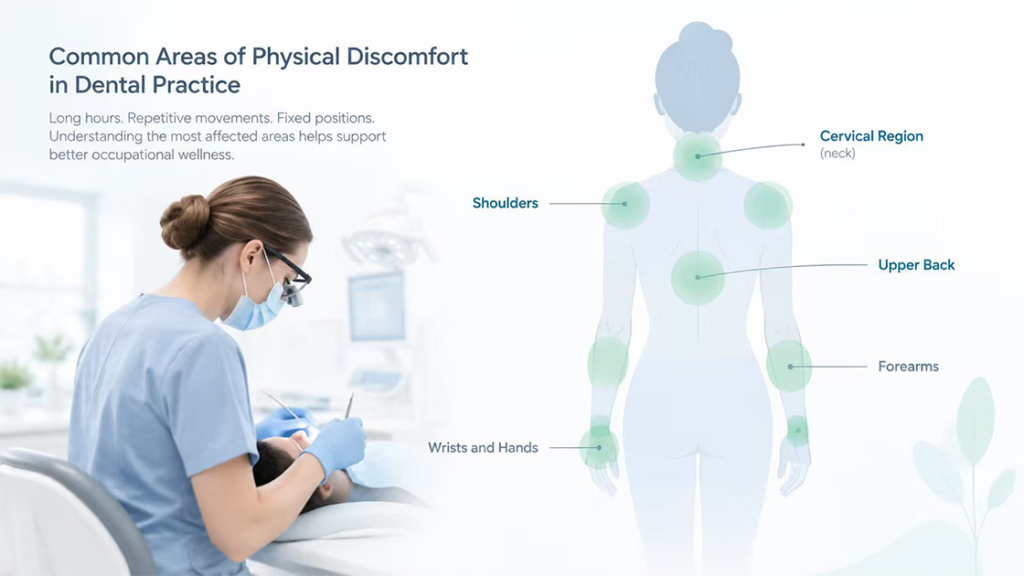
1.2 Common Areas of Physical Discomfort in Dental Practice
The areas most commonly involved in dental occupational stress include the cervical region, shoulders, lower back, wrists, and forearms.
Long procedures may require practitioners to maintain static postures while focusing on small treatment areas. This combination of visual concentration and limited body movement can contribute to muscle fatigue and reduced physical comfort during daily work.
Understanding these occupational challenges helps dental professionals explore different supportive approaches that fit their working environment.
1.3 Why Dental Ergonomics and Recovery Strategies Matter
Ergonomics plays an important role in modern dental practice. Proper equipment positioning, posture awareness, movement breaks, and physical conditioning are commonly discussed strategies for supporting professional health.
In addition to ergonomic methods, some dental professionals are exploring technology-based approaches that focus on tissue support and recovery management.
Shockwave Therapy represents one of the technologies used in musculoskeletal care environments, providing an additional option alongside traditional wellness strategies.
2. The Role of Shockwave Therapy in Musculoskeletal Support
Shockwave Therapy uses acoustic waves delivered through specialized applicators to create mechanical stimulation within targeted areas. Different systems may include focused shockwave and radial pressure wave technologies, each designed with different energy delivery characteristics.
2.1 Understanding Acoustic Wave Technology
Shockwave Therapy is based on the application of high-energy acoustic waves that interact with tissues through mechanical stimulation.
These waves can create physical responses within treated areas and are commonly discussed in relation to soft tissue support, circulation responses, and musculoskeletal care applications.
For dental professionals experiencing occupational physical demands, this technology provides another approach that can be considered within a broader recovery and wellness plan.
2.2 Focused Shockwave and Radial Pressure Wave Differences
Modern shockwave systems generally include focused shockwave technology and radial pressure wave technology.
Focused shockwave delivers energy toward a specific depth, while radial pressure wave technology distributes energy outward from the applicator point.
The selection of technology depends on professional evaluation, application goals, and targeted areas. Both approaches are used in different musculoskeletal environments where controlled mechanical stimulation is required.
2.3 Why Shockwave Technology Fits Professional Recovery Programs
Dental professionals often require recovery solutions that fit into busy schedules and professional lifestyles.
Non-invasive technology options can provide additional support within wellness programs because they do not require complex procedures and can be incorporated alongside exercise, stretching, and ergonomic improvements.
Shockwave Therapy is increasingly discussed as part of modern approaches to musculoskeletal care because of its versatility in professional rehabilitation settings.
3. Applications of Shockwave Therapy for Dental Professionals
Dental professionals may benefit from understanding how advanced recovery technologies are applied in occupational wellness programs. The goal is not to replace healthy movement habits but to provide additional support options.
3.1 Supporting Neck and Shoulder Wellness
Neck and shoulder areas experience significant demands during dental procedures because practitioners often maintain forward-facing positions while performing detailed work.
Shockwave Therapy may be considered as part of a broader approach for professionals focusing on maintaining muscle comfort and mobility in these areas.
Combining targeted technology with posture improvement and mobility exercises can create a more complete occupational wellness strategy.
3.2 Supporting Wrist and Forearm Care
Dental procedures require continuous hand control and precise instrument handling. Repetitive gripping and fine movements can place stress on the wrist and forearm regions.
Shockwave technology is often explored in soft tissue-focused applications because mechanical stimulation can support tissue response in targeted areas.
For dental professionals, maintaining hand and wrist comfort is especially important because these areas directly influence daily clinical performance.
3.3 Supporting Recovery After Long Clinical Sessions
Long clinical procedures can create temporary muscle fatigue due to prolonged concentration and limited movement.
Recovery strategies that include stretching, exercise, proper rest, and supportive technologies can help professionals manage physical demands more effectively.
Shockwave Therapy can be considered as part of a comprehensive approach designed around individual needs and professional requirements.
4. Integrating Shockwave Therapy Into Dental Wellness Programs
As awareness of occupational health continues to grow, dental clinics and healthcare professionals are exploring ways to create healthier working environments.
4.1 Combining Shockwave Therapy With Ergonomic Practices
Technology alone does not replace proper workplace design. Ergonomic adjustments remain a fundamental part of dental wellness.
Examples include improving working posture, adjusting equipment positioning, and creating opportunities for movement throughout the workday.
When combined with ergonomic strategies, Shockwave Therapy may provide additional support within a complete professional wellness plan.
4.2 The Potential Role of Shockwave Therapy in Dental Clinics
Dental clinics increasingly focus not only on patient care but also on supporting the long-term health of their professional teams.
Adding recovery-focused technologies can help clinics develop broader wellness programs for dentists, hygienists, and assistants.
Shockwave systems may become part of multidisciplinary environments where professionals combine physical therapy concepts, exercise guidance, and technology-based support.
4.3 Creating Personalized Recovery Approaches
Every dental professional has different working habits, physical conditions, and occupational demands.
A personalized approach considers factors such as procedure length, working posture, activity level, and individual wellness goals.
Shockwave Therapy allows professionals to develop targeted strategies based on specific areas requiring attention.
5. The Future of Shockwave Therapy in Occupational Wellness
As healthcare industries continue focusing on professional longevity, occupational wellness technologies are becoming increasingly important.
5.1 Growing Interest in Non-Invasive Recovery-Shockwave Therapy
Many professionals are exploring non-invasive technologies that can complement traditional wellness methods.
Shockwave Therapy continues to attract attention because of its applications in musculoskeletal environments and its ability to provide targeted acoustic wave stimulation.
For dental professionals, these technologies represent an additional option within broader strategies focused on maintaining physical comfort throughout their careers.
5.2 Building Sustainable Wellness Programs for Dental Teams
The future of dental wellness may involve a combination of ergonomic education, physical activity, recovery strategies, and advanced technologies.
Creating sustainable professional health programs requires attention to both workplace conditions and individual needs.
Shockwave Therapy can become one component of a comprehensive approach that supports dental professionals in managing the physical demands of modern clinical practice.
FAQ
What is Shockwave Therapy?
Shockwave Therapy uses acoustic wave energy to create mechanical stimulation in targeted areas and is commonly used in musculoskeletal care settings.
Why may dental professionals consider Shockwave Therapy?
Dental professionals often experience physical demands from prolonged postures and repetitive movements, making recovery support an important part of occupational wellness.
Which areas are commonly focused on in dental professional wellness programs?
Common areas include the neck, shoulders, upper back, wrists, and forearms.
Can Shockwave Therapy replace ergonomic improvements?
No. Ergonomics, exercise, and healthy workplace habits remain important parts of professional wellness. Shockwave Therapy is considered a complementary approach.
What types of shockwave technology are available?
Common technologies include focused shockwave and radial pressure wave systems, which differ in how acoustic energy is delivered.
Conclusion
Dental professionals face unique physical demands caused by precise movements, prolonged working positions, and repetitive clinical tasks. As occupational wellness becomes an increasingly important topic in dentistry, technologies such as Shockwave Therapy provide another supportive option within comprehensive recovery programs. By combining acoustic wave technology with ergonomic improvements, exercise habits, and professional guidance, dental teams can explore more complete strategies for maintaining physical comfort and supporting long-term career sustainability.
References
Prevention and Rehabilitation of Musculoskeletal Disorders in Dental Professionals: A Systematic Review
https://pmc.ncbi.nlm.nih.gov/articles/PMC6709589
Shockwave treatment: A new wave for musculoskeletal care
Occupational ergonomics and related musculoskeletal disorders among dentists: A systematic review
https://pubmed.ncbi.nlm.nih.gov/36278379
Prevention of work-related musculoskeletal disorders among dental professionals: A scoping review
https://pubmed.ncbi.nlm.nih.gov/35431203
Ergonomics and Dental Practice: Preventing work-related musculoskeletal problems
https://www.ada.org/resources/ada-library/oral-health-topics/ergonomics-and-dental-practice