

Introduction
American football requires explosive acceleration, rapid changes of direction, powerful blocking, and repeated lower-body movements. These demands place considerable stress on the hip adductor muscles, which help stabilize the pelvis and control leg movement. When groin pain persists, players may struggle with sprinting, cutting, and returning to full training. Shockwave therapy is a non-invasive option that clinicians may consider for selected chronic musculoskeletal conditions. Understanding its potential role, current research, and relationship with active rehabilitation can help football players make informed decisions about managing persistent adductor-related groin pain.
1. Understanding Chronic Groin Pain in Football Players
1.1 How Football Movements Stress the Adductors
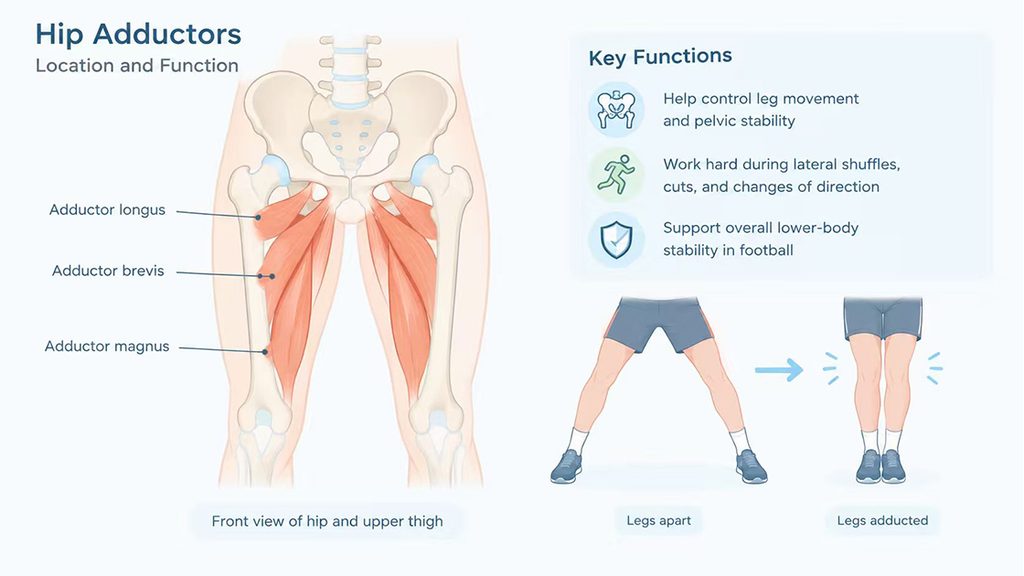
The hip adductors run along the inner thigh and help control leg movement and pelvic stability. During football, these muscles work hard during lateral shuffles, sudden cuts, explosive starts, and changes of direction. Repeated loading, insufficient recovery, or sudden increases in training intensity may contribute to muscle or tendon problems. Some injuries begin with a sudden strain, while others develop gradually as discomfort returns during demanding drills.
1.2 Recognizing Adductor-Related Groin Pain
Adductor-related groin pain commonly affects the inner thigh or the area where the adductor muscles attach near the pelvis. Players may experience discomfort when squeezing their legs together, accelerating, or changing direction. However, groin pain can also arise from hip joint conditions, pubic-related problems, hernias, or bone stress injuries. A clinical assessment helps identify the likely source and determine the most appropriate treatment.
2. How Shockwave Therapy May Support Recovery
2.1 Understanding Extracorporeal Shockwave Therapy
Extracorporeal shockwave therapy (ESWT) delivers acoustic pressure waves through an applicator placed against the skin. Clinicians use this technology for selected musculoskeletal conditions, and researchers continue to investigate its effects on pain and tissue responses. Its effectiveness depends on the condition being treated, the treatment protocol, and the quality of available evidence. Shockwave therapy should therefore be considered as a possible component of care rather than a guaranteed solution for chronic groin pain.
2.2 Radial and Focused Shockwave Technology
Radial and focused shockwave systems deliver acoustic energy in different ways. Radial systems distribute energy outward from the applicator, while focused systems concentrate energy at a selected depth. Professional equipment may offer different treatment options depending on the clinical application and device specifications. The choice should reflect the diagnosed condition, target tissue, and clinician’s expertise rather than the assumption that one technology works best for every groin injury.
2.3 Why Accurate Treatment Targeting Matters
The groin contains closely positioned muscles, tendons, joints, nerves, and blood vessels. Pain in this region does not always come from the adductor muscles, so clinicians should establish the likely diagnosis before selecting a treatment. A chronic tendon problem may require a different approach from an acute muscle tear or a suspected bone injury. Careful assessment and appropriate device settings are particularly important when treating this sensitive anatomical area.
3. What Research Says About Shockwave Therapy for Groin Pain
3.1 Evidence From Athletic Groin Pain Studies
Research has explored shockwave therapy for persistent groin pain in athletes, including some football populations. Findings suggest that it may have a role in selected cases, but the evidence remains limited and does not establish effectiveness for every type of adductor-related condition. Studies involving different sports, diagnoses, and treatment protocols also make it difficult to apply results directly to American football players.
3.2 Understanding the Limits of Current Evidence
Chronic groin pain can involve several structures, and studies do not always examine the same condition. Some combine shockwave therapy with exercise or other treatments, making the individual contribution of shockwave therapy difficult to determine. Athletes should understand that promising findings do not guarantee pain relief or a specific recovery timeline. Treatment decisions should reflect the diagnosis, research evidence, and individual response.
3.3 Why Rehabilitation Remains Essential
Shockwave therapy should not replace progressive exercise, load management, or clinical reassessment. If symptoms persist despite an appropriate rehabilitation plan, clinicians may need to review the diagnosis or consider further investigation. Combining evidence-informed treatment decisions with active rehabilitation provides a more comprehensive approach than relying on a single intervention.
4. Building a Football-Specific Recovery Plan
4.1 Begin With Assessment and Load Management
A clinician will typically review the injury history, aggravating movements, training demands, and physical examination findings. Assessment may include resisted hip adduction, range-of-motion testing, and checks for other possible causes of groin pain. Players may need to reduce activities that repeatedly provoke symptoms while maintaining suitable conditioning. The goal is to manage the load without unnecessarily stopping all physical activity.
4.2 Restore Adductor Strength and Pelvic Control
Rehabilitation often progresses from tolerable muscle contractions to resisted hip adduction, controlled strengthening, and more demanding functional exercises. Training for the trunk and surrounding hip muscles may also help improve movement control. Exercise intensity should increase gradually according to symptoms, strength, and functional progress. Persistent symptom aggravation signals that the rehabilitation plan may need adjustment.
4.3 Integrate Shockwave Therapy With Active Rehabilitation
For selected cases, clinicians may consider shockwave therapy alongside progressive strengthening and movement training. Radial or focused technology may offer different treatment approaches, but the choice depends on the clinical assessment and device guidance. Shockwave sessions alone cannot restore the strength, coordination, and tolerance needed for high-intensity football. Active rehabilitation remains central to recovery.
4.4 Progress Toward a Safe Return to Play
Returning to football should depend on functional progress rather than a fixed number of treatment sessions. Players should gradually rebuild their tolerance for running, acceleration, deceleration, cutting, and position-specific drills. Full training and contact activities should resume when the athlete can perform the required movements with acceptable symptoms and adequate strength, under professional guidance.
5. Safety and Practical Considerations
5.1 When Further Medical Assessment Is Needed
Severe sudden pain, significant bruising, marked weakness, or difficulty bearing weight may indicate an injury that requires prompt evaluation. Persistent or worsening groin pain may also warrant further investigation for hip, bone, or other conditions. A trained clinician should review the diagnosis, medical history, contraindications, and device-specific safety guidance before treatment.
5.2 Setting Realistic Recovery Expectations
Recovery varies with the underlying condition, injury severity, training demands, and response to rehabilitation. Some temporary discomfort may occur after shockwave treatment, but worsening symptoms should be discussed with the treating professional. Regular reassessment helps determine whether pain, strength, movement, and football-specific function are improving.
FAQ
Can shockwave therapy help chronic groin pain?
It may be considered for selected cases, but evidence specific to adductor-related groin pain remains limited. A clinical assessment is essential.
Is focused or radial shockwave therapy better?
Neither is universally better. The appropriate option depends on the diagnosis, target tissue, and clinician’s expertise.
Can players keep training during treatment?
Often, activity can be modified according to symptoms. Sprinting, cutting, and contact drills may need temporary restrictions.
How many sessions are needed?
There is no universal schedule. Treatment frequency depends on the condition, clinical protocol, and individual response.
Can shockwave therapy replace rehabilitation?
No. Progressive strengthening, load management, and football-specific exercise remain essential parts of recovery.
Conclusion
Chronic adductor-related groin pain can interfere with the explosive movements and rapid direction changes required in American football. Shockwave therapy may be an option for selected cases, but current evidence does not support treating it as a guaranteed solution or a replacement for rehabilitation. Accurate diagnosis, appropriate selection of radial or focused technology, progressive strengthening, and a criteria-based return-to-play plan remain central to responsible care. Combining these elements can help players and clinicians make informed decisions about recovery and a safe return to the field.
References
- Doha Agreement Meeting on Terminology and Definitions in Groin Pain in Athletes
https://bjsm.bmj.com/content/49/12/768
- Current Clinical Concepts: Exercise and Load Management of Adductor Strains, Adductor Ruptures, and Long-Standing Adductor-Related Groin Pain
https://pmc.ncbi.nlm.nih.gov/articles/PMC10569248
- Non-surgical Treatment of Pubic Overload and Groin Pain in Amateur Football Players: A Prospective Double-Blinded Randomised Controlled Study
https://pubmed.ncbi.nlm.nih.gov/28093636
- Nonsurgical Interventions for the Management of Long-Standing Groin Pain in Athletes: A Systematic Review of Randomized Controlled Trials
https://pmc.ncbi.nlm.nih.gov/articles/PMC10329515
- Groin Pain and Injuries: Evaluation and Management