

Introduction
Dentistry requires precision, concentration, and long periods of controlled posture. Many dental professionals spend hours leaning forward, maintaining fixed arm positions, and performing detailed procedures in limited working spaces. Over time, these occupational demands may contribute to muscle tension and physical discomfort in areas such as the neck, shoulders, upper back, and arms. As interest in professional wellness and occupational recovery continues to grow, Shockwave Therapy has become a technology explored in rehabilitation and physical care environments. Using acoustic wave energy, shockwave technology provides targeted mechanical stimulation that may support tissue response, circulation, and muscle recovery processes. For dental professionals, this approach represents one possible option within a broader wellness strategy focused on maintaining physical comfort during demanding clinical work.
1. Understanding Physical Challenges Faced by Dental Professionals
Dental professionals perform highly precise tasks that require concentration and controlled body positioning. Unlike many physically active occupations, dental work often involves limited movement combined with repetitive upper-body activity. Understanding these occupational demands helps explain why dentists may pay attention to posture management and professional recovery strategies.
1.1 Why Dental Work Can Create Neck and Shoulder Pressure
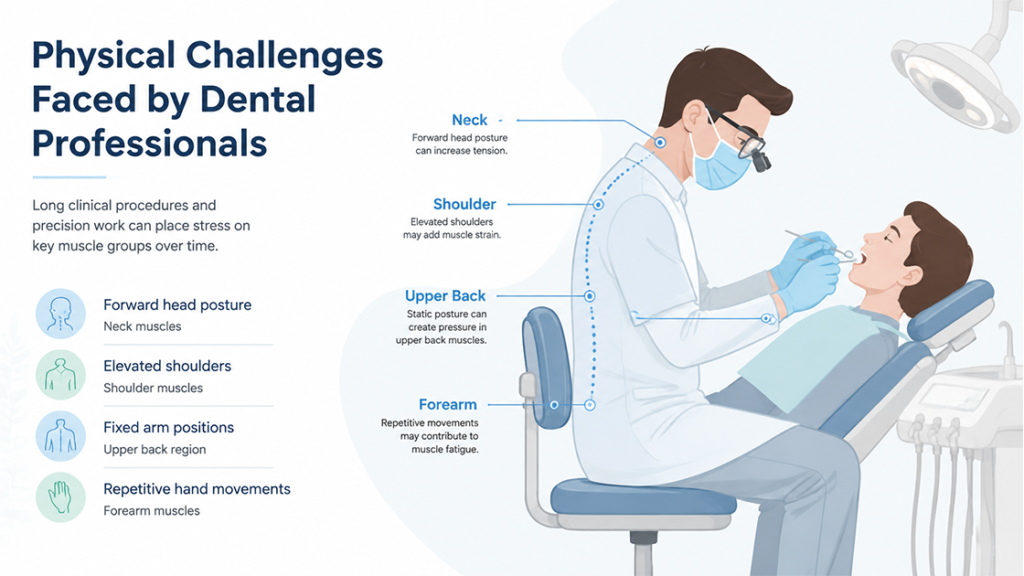
Dentists often maintain forward-leaning positions while working with patients.
Common working patterns include:
- bending the neck downward
- keeping shoulders elevated
- holding arms in fixed positions
- performing repetitive hand movements
These positions allow dentists to complete detailed procedures accurately, but maintaining them for extended periods may place additional demand on certain muscle groups.
Frequently involved areas include:
- neck muscles
- shoulder muscles
- upper back region
- forearms
Developing healthy workplace habits, including posture awareness and regular movement, can help dental professionals better manage the physical requirements of their occupation.
1.2 The Role of Repetitive Movements in Dental Practice
Dental procedures often require repeated movements involving the hands, wrists, and arms.
Examples include:
- instrument handling
- precise hand positioning
- maintaining steady arm control
- repeated clinical motions
Although these movements are usually performed with careful technique, repetition over long working schedules can contribute to muscle fatigue.
Many healthcare professionals now recognize the importance of occupational wellness because maintaining physical comfort can support long-term professional performance.
Shockwave Therapy is one technology used in rehabilitation settings that focuses on delivering mechanical energy to targeted areas as part of professional recovery programs.
1.3 Why Occupational Recovery Matters for Dental Professionals
Dentistry is a career that requires many years of physical precision and concentration.
Supporting physical wellness may involve:
- ergonomic workplace adjustments
- regular stretching routines
- strength and mobility exercises
- professional recovery approaches
A comprehensive wellness strategy helps dental professionals consider both clinical performance and personal physical needs.
Technology-based approaches such as Shockwave Therapy may be incorporated into professional care plans when appropriate, providing additional options for addressing areas affected by repetitive occupational demands.
2. Understanding How Shockwave Therapy Supports Muscle Recovery
Shockwave Therapy is a non-invasive technology that uses acoustic wave energy to create mechanical stimulation in targeted areas. It has been widely explored in musculoskeletal rehabilitation because of its ability to interact with soft tissues and support natural biological responses.
Understanding how this technology works helps explain why it is used in various professional recovery environments.
2.1 The Science Behind Acoustic Wave Technology
Shockwave Therapy uses high-energy acoustic waves that travel through targeted tissues.
Depending on the technology type, shockwave systems may include:
- radial shockwave therapy
- focused shockwave therapy
Radial shockwaves distribute energy outward from the application point, making them commonly used for broader soft tissue areas.
Focused shockwaves deliver energy more precisely at specific depths, allowing professionals to select different approaches based on treatment goals.
The mechanical stimulation created by acoustic waves may influence tissue responses and support circulation-related processes within targeted areas.
2.2 Why Shockwave Therapy May Be Considered for Dental Professionals
Dental professionals often focus on small, precise clinical movements, but the physical effects of their work may involve larger muscle groups.
Areas that may receive attention include:
- cervical muscles
- shoulder muscles
- upper back tissues
- arm-related muscle groups
Shockwave Therapy allows professionals to focus energy on selected areas rather than applying a general approach.
This targeted application makes it a technology considered in various rehabilitation and wellness environments where muscle comfort and physical recovery are important considerations.
2.3 The Difference Between Traditional Recovery and Technology-Assisted Support
Traditional recovery methods often include:
- stretching
- exercise programs
- posture improvement
- manual techniques
These approaches remain important parts of physical wellness.
Technology-assisted options such as Shockwave Therapy provide another method that professionals may combine with existing recovery strategies.
Rather than replacing healthy movement habits, shockwave technology can serve as an additional supportive tool within personalized wellness programs.
For dental professionals with repetitive occupational demands, combining multiple approaches may provide a more complete strategy for maintaining physical comfort.
3. Common Areas Where Dentists May Consider Shockwave Therapy Support
Because dental work involves specific postural demands, certain body regions may experience greater workload during daily clinical activities. Shockwave Therapy allows targeted application, making it suitable for professionals who require focused approaches for particular muscle areas.
3.1 Supporting Neck Muscle Comfort During Clinical Work
The neck plays an important role in maintaining visual focus and precise positioning during dental procedures.
Long periods of forward head posture may increase demand on:
- cervical muscles
- surrounding soft tissues
- upper shoulder areas
Shockwave Therapy may be incorporated into professional wellness programs that focus on supporting muscle comfort in the neck region.
Combined with ergonomic improvements and movement habits, targeted shockwave applications may become part of a broader approach to occupational recovery.
3.2 Supporting Shoulder and Upper Back Wellness
Shoulder and upper back muscles are frequently engaged during dental procedures because professionals often maintain controlled arm positions.
Daily clinical activities may involve:
- reaching toward treatment areas
- holding instruments
- maintaining arm stability
These repeated demands can make shoulder and upper back wellness an important consideration for dental professionals.
Shockwave Therapy uses acoustic wave stimulation to target selected areas and support tissue response, making it a potential option within professional recovery settings.
3.3 Considering Forearm and Hand-Related Muscle Support
Dentistry requires highly precise hand movements and continuous instrument control.
The forearms and hands are essential for:
- maintaining grip
- controlling tools
- performing detailed procedures
While the hands perform the visible work, surrounding muscles in the forearm and upper limb also contribute to movement stability.
Shockwave Therapy may be considered as part of a broader wellness approach focused on maintaining comfort in areas affected by repetitive hand activities.
4. Integrating Shockwave Therapy Into Dental Professional Wellness Programs
Dental professionals often focus on patient care, but maintaining their own physical condition is also an important part of long-term career sustainability. Since dental procedures require repeated precision movements and prolonged postures, many professionals are exploring different approaches to support muscle wellness and occupational recovery. Shockwave Therapy can be included as one supportive technology within a broader professional wellness program.
4.1 Combining Shockwave Therapy With Ergonomic Improvements
Ergonomics plays an important role in reducing physical stress during dental procedures.
Professional ergonomic strategies may include:
- adjusting patient positioning
- improving working posture
- changing hand positioning habits
- incorporating movement breaks
While ergonomic improvements help reduce unnecessary physical stress, some areas may still experience workload due to the nature of dental procedures.
Shockwave Therapy may complement these strategies by providing targeted acoustic wave stimulation to selected muscle and soft tissue areas.
Research on extracorporeal shockwave therapy has explored its applications in various musculoskeletal conditions, including soft tissue and upper extremity-related concerns.
By combining technology-assisted support with proper workplace habits, dental professionals can develop a more comprehensive approach to occupational wellness.
4.2 The Role of Shockwave Therapy in Modern Rehabilitation Settings
Modern rehabilitation continues to incorporate technology-based approaches that focus on supporting tissue response and physical function.
Shockwave Therapy uses mechanical acoustic waves that interact with targeted tissues through a process known as mechanotransduction.
This process involves mechanical stimulation that may influence biological responses within tissues.
Professional rehabilitation settings may use different shockwave approaches depending on application requirements:
- Radial Shockwave Therapy for broader soft tissue areas
- Focused Shockwave Therapy for more concentrated energy delivery
The ability to adjust energy delivery methods allows professionals to consider different application needs when creating personalized recovery programs.
4.3 Supporting Long-Term Career Wellness for Dental Professionals
Dentistry is a profession that often requires years of repetitive precision work.
Maintaining physical wellness may involve:
- regular mobility exercises
- strength training
- posture awareness
- professional recovery support
Shockwave Therapy represents one possible option within a larger wellness strategy.
Rather than focusing only on short-term comfort, long-term occupational wellness encourages professionals to consider how daily work patterns affect physical condition over time.
A balanced approach that combines healthy habits and appropriate professional support may help dental professionals better manage the physical demands of their careers.
5. The Future of Shockwave Therapy Applications in Occupational Health
As awareness of workplace-related physical challenges continues to increase, more industries are exploring professional recovery solutions. Shockwave Therapy, traditionally associated with musculoskeletal rehabilitation, is gaining attention as a potential supportive technology for different occupational groups.
5.1 Why Shockwave Therapy Is Becoming More Relevant for Workplace Wellness
Many occupations involve repetitive movements, fixed postures, or physically demanding tasks.
Examples include:
- healthcare professionals
- skilled technicians
- manual workers
- service industry professionals
These jobs often require continuous use of specific muscle groups.
Shockwave Therapy provides a targeted approach through acoustic wave technology, allowing professionals to focus on specific areas involved in occupational stress.
Its applications in musculoskeletal care have been widely discussed, particularly for tendon, soft tissue, and movement-related conditions.
For dental professionals, this technology represents one potential addition to broader workplace wellness strategies.
5.2 The Growing Importance of Personalized Recovery Solutions
Every dental professional has different working habits, clinical environments, and physical needs.
Future occupational wellness programs may focus more on personalized approaches that consider:
- individual posture patterns
- daily workload
- specific muscle demands
- professional lifestyle
Technology-based solutions such as Shockwave Therapy may continue developing alongside traditional rehabilitation methods.
By combining personalized care plans with modern therapeutic technologies, professionals can explore more flexible approaches to maintaining physical wellness throughout their careers.
FAQ
What is Shockwave Therapy?
Shockwave Therapy is a non-invasive technology that uses acoustic wave energy to provide mechanical stimulation to targeted tissue areas.
Why might dentists consider Shockwave Therapy?
Dentists may explore Shockwave Therapy as part of a wellness routine because their work often involves repetitive movements and prolonged clinical postures.
Which areas may dentists focus on?
Common areas include the neck, shoulders, upper back, arms, and forearm muscle regions.
What is the difference between radial and focused shockwave therapy?
Radial shockwaves distribute energy across broader areas, while focused shockwaves deliver energy more precisely at selected depths.
Can Shockwave Therapy replace ergonomic improvements?
No. Ergonomics, exercise, and healthy work habits remain important parts of occupational wellness.
Is Shockwave Therapy only used for dental professionals?
No. Shockwave Therapy is also used in various rehabilitation and musculoskeletal care environments.
Conclusion
Dental professionals face unique physical demands due to prolonged clinical postures, repetitive hand movements, and the need for continuous precision. These occupational factors make physical wellness an important consideration throughout their careers. Shockwave Therapy provides a technology-based approach using acoustic wave energy to support targeted tissue stimulation and recovery-focused programs. When combined with ergonomic improvements, movement habits, and professional guidance, Shockwave Therapy can become part of a comprehensive wellness strategy designed around the specific needs of dental professionals.
References
Effect of Shockwave Treatment for Management of Upper and Lower Extremity Musculoskeletal Conditions: A Narrative Review
https://pubmed.ncbi.nlm.nih.gov/29775801
Extracorporeal Shock Wave Therapy in Musculoskeletal Disorders: A Review
https://pmc.ncbi.nlm.nih.gov/articles/PMC5586835
Focused Extracorporeal Shockwave Therapy in Physical Medicine and Rehabilitation
https://doi.org/10.1007/s40141-020-00306-z
Extracorporeal Shock Wave Therapy for the Treatment of Musculoskeletal Pain: A Narrative Review
https://pubmed.ncbi.nlm.nih.gov/37957975
The Effects of Shockwave Therapy on Musculoskeletal Conditions Based on Changes in Imaging: A Systematic Review and Meta-Analysis