

Introduction
Gymnastics coaches play an important role in athlete development, but their professional responsibilities often involve more than instruction and supervision. Many coaches regularly demonstrate movements, assist athletes during training, repeat technical drills, and maintain physically demanding positions throughout long practice sessions. These activities may contribute to muscle fatigue, soft tissue stress, and reduced mobility over time. Shockwave Therapy, also known as Extracorporeal Shock Wave Therapy (ESWT), has gained attention as a non-invasive technology that uses acoustic wave energy to support soft tissue recovery and physical comfort. By delivering controlled mechanical stimulation to targeted areas, shockwave technology may support circulation, tissue response, and mobility improvement as part of a broader recovery strategy for physically active professionals.
1. Understanding the Physical Demands Faced by Gymnastics Coaches
Gymnastics coaching requires a unique combination of technical knowledge, physical involvement, and continuous movement. Unlike many coaching roles that focus mainly on observation, gymnastics coaches often participate directly in training demonstrations and physical assistance.
1.1 Repetitive Movement Patterns in Gymnastics Coaching
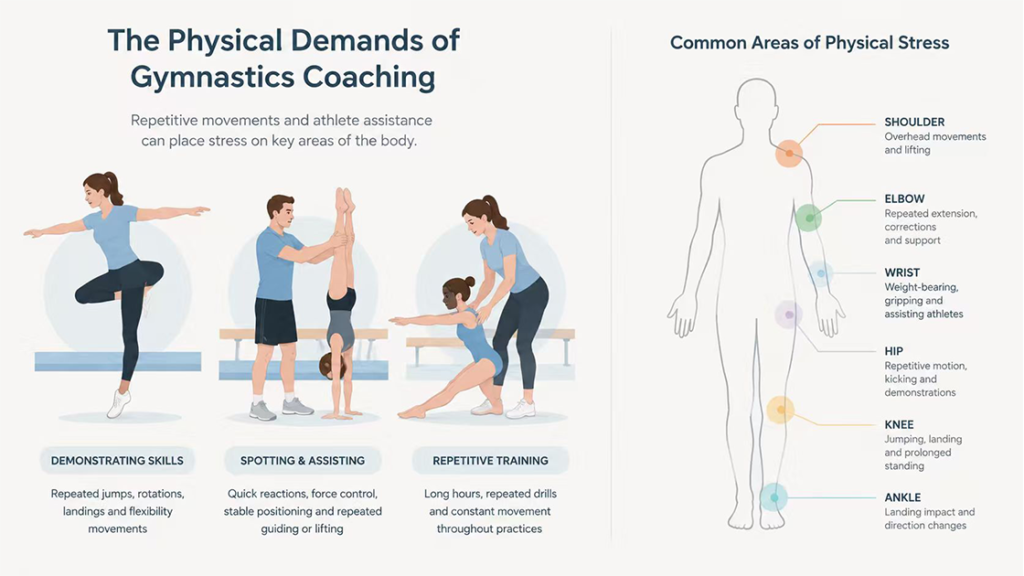
Gymnastics coaches frequently repeat the same movements they teach athletes. Demonstrating skills such as jumps, rotations, landings, flexibility exercises, and body positioning requires repeated use of muscles and joints.
Over time, repetitive activities may place stress on areas including the shoulders, wrists, elbows, hips, knees, and ankles. Coaches may experience physical discomfort not only from personal training but also from frequently assisting athletes with corrections and demonstrations.
Unlike professional gymnasts, coaches often continue these physical activities over many years while also managing teaching responsibilities. This combination of repetitive movement and long-term workload makes recovery and mobility support an important part of maintaining professional performance.
1.2 Physical Stress From Spotting and Athlete Assistance
One of the unique responsibilities of gymnastics coaches is athlete spotting. Coaches often provide physical support during skills involving rotation, balance, and aerial movement.
Spotting requires:
- quick reaction movements
- sudden force control
- stable body positioning
- repeated lifting or guiding actions
These demands can place additional pressure on muscles and connective tissues, particularly around the shoulders, upper back, wrists, and lower limbs.
Shockwave Therapy has become a technology of interest in rehabilitation environments because it focuses on mechanical stimulation of targeted tissues. This approach may complement professional recovery programs designed around mobility, flexibility, and physical conditioning.
1.3 Common Areas of Physical Discomfort Among Gymnastics Coaches
Because gymnastics involves full-body movement, coaches may experience discomfort in multiple areas depending on their responsibilities and training style.
The shoulder region is frequently involved due to repeated arm positioning and demonstration of overhead movements. Wrist and elbow areas may also experience stress from weight-bearing activities, especially when coaches demonstrate floor exercises or support athletes during training.
Lower-body areas such as knees, ankles, and hips may be affected by repeated jumping, landing demonstrations, and standing for extended periods.
Understanding these physical demands helps explain why recovery technologies such as shockwave therapy are increasingly considered within sports and rehabilitation settings.
2. How Shockwave Therapy Supports Recovery Strategies for Gymnastics Coaches
Shockwave Therapy uses acoustic energy to interact with targeted tissues. Unlike traditional massage-based approaches, shockwave technology delivers controlled mechanical waves that can reach specific treatment areas.
This technology is commonly discussed in sports medicine and rehabilitation environments because of its potential role in supporting tissue response, circulation, and mobility.
2.1 The Role of Shockwave Therapy in Soft Tissue Support
Extracorporeal Shock Wave Therapy uses high-energy acoustic waves that travel through tissues. These mechanical waves create controlled stimulation, which may influence local biological responses.
In professional settings, shockwave devices are often designed with adjustable intensity levels and application modes to address different tissue conditions.
For gymnastics coaches, this technology may be considered when supporting areas affected by repetitive physical demands, including:
- shoulder muscles
- elbow tendons
- wrist structures
- lower limb soft tissues
The goal is to support normal tissue function and improve comfort during recovery routines.
2.2 Radial Shockwave Therapy and Mobility Support
Radial Shockwave Therapy is one of the commonly used forms of ESWT. It delivers pressure waves from the applicator into targeted body areas.
This type of shockwave technology is often used in sports rehabilitation because it allows professionals to focus on larger soft tissue regions.
For gymnastics coaches who frequently perform demonstrations or assist athletes, radial shockwave applications may support:
- muscle relaxation
- tissue flexibility
- movement comfort
When combined with stretching programs, strength training, and professional guidance, shockwave therapy can become part of a comprehensive physical recovery approach.
2.3 Supporting Tendon and Muscle Health in High-Demand Professions
Tendons and muscles play essential roles in movement control and physical performance. Gymnastics coaches rely on these structures every day when demonstrating skills and assisting athletes.
Repeated loading may influence tissue condition over time. Supporting tendon and muscle health is therefore important for professionals who maintain active careers.
Shockwave Therapy focuses on mechanical stimulation that may encourage natural tissue responses and support a healthier movement environment.
It does not replace professional evaluation or individualized rehabilitation planning, but it can serve as an additional option within a broader approach to physical wellness.
3. Why Shockwave Therapy Is Becoming Relevant for Gymnastics Coaching Professionals
As sports and rehabilitation technology continue to develop, more professionals are exploring supportive tools that can fit into active lifestyles. Gymnastics coaches often maintain physically demanding careers for many years, making long-term mobility and tissue care important considerations.
Shockwave Therapy provides a non-invasive approach that focuses on mechanical stimulation of targeted tissues. It is commonly discussed in sports medicine environments because of its applications in supporting soft tissue function and movement quality.
3.1 Supporting Shoulder Function in Gymnastics Coaching
The shoulder plays a critical role in gymnastics-related movements. Coaches frequently demonstrate handstands, cartwheels, support positions, and upper-body techniques that require shoulder stability and mobility.
Repeated overhead movements may place continuous demands on:
- rotator cuff muscles
- shoulder tendons
- surrounding connective tissues
Shockwave Therapy may be incorporated into professional recovery programs to support tissue flexibility and movement comfort.
By applying acoustic wave energy to targeted areas, this technology may encourage local tissue responses and support a healthier environment for active professionals.
For gymnastics coaches, maintaining shoulder mobility is important because their daily responsibilities often require both demonstration ability and physical assistance during training.
3.2 Supporting Wrist and Elbow Areas During Demonstration Activities
Gymnastics involves significant weight-bearing through the hands. Although coaches may not train at the same intensity as athletes, repeated demonstrations and athlete assistance can still place stress on the wrists and elbows.
Common professional activities include:
- demonstrating floor movements
- supporting athletes during skill learning
- adjusting body positions
These movements require coordinated use of tendons, muscles, and joints.
Shockwave Therapy is often considered within rehabilitation settings because it can deliver focused mechanical stimulation to specific areas. The technology may support soft tissue comfort and mobility as part of a structured recovery approach.
3.3 Lower Limb Recovery Support for Active Coaches
Gymnastics coaches also rely heavily on their lower limbs. Jumping demonstrations, landing techniques, and extended periods of standing during practice sessions can increase physical demands on the hips, knees, ankles, and feet.
Lower limb areas commonly involved in gymnastics activities include:
- Achilles tendon region
- calf muscles
- knee supporting structures
- hip muscles
Shockwave technology may help professionals address areas affected by repetitive loading and maintain movement quality.
Rather than focusing only on short-term discomfort, many active professionals consider recovery strategies that support long-term physical performance.
4. Integrating Shockwave Therapy Into Sports Rehabilitation Environments
Shockwave Therapy is often used alongside other professional approaches, including exercise programs, mobility training, and physical conditioning. For gymnastics coaches, the most effective recovery strategy usually involves understanding personal movement patterns and workload demands.
4.1 The Role of Shockwave Technology in Sports Clinics
Sports rehabilitation clinics often work with individuals who have high physical demands, including athletes, coaches, and fitness professionals.
Shockwave devices typically allow professionals to adjust treatment parameters according to different application areas. Depending on the equipment design, practitioners may select different pressure levels, frequencies, and applicators for specific tissue needs.
This flexibility allows shockwave technology to be incorporated into personalized recovery programs.
For gymnastics coaches, sports clinics may consider shockwave applications for areas affected by repetitive movement, physical demonstrations, and long-term training involvement.
4.2 Combining Shockwave Therapy With Mobility and Strength Programs
Recovery does not depend on a single approach. Gymnastics coaches often benefit from combining different strategies that address flexibility, strength, movement control, and workload management.
Shockwave Therapy may complement:
- stretching routines
- mobility exercises
- strength conditioning
- professional rehabilitation guidance
By combining different methods, professionals can focus on maintaining balanced movement patterns and supporting physical readiness.
The purpose of integrating shockwave technology is not to replace exercise or rehabilitation but to provide an additional supportive option.
4.3 The Importance of Individualized Assessment
Every gymnastics coach has different physical demands based on coaching style, experience level, and daily responsibilities.
A coach who frequently demonstrates floor routines may have different needs compared with someone who mainly provides spotting support or manages training sessions.
Professional assessment helps identify:
- areas of physical stress
- movement limitations
- recovery goals
Individualized planning allows shockwave technology to be applied in a more targeted and appropriate way.
5. The Future of Shockwave Therapy in Supporting Sports Professionals
As more sports professionals recognize the importance of long-term physical wellness, technologies that support recovery and mobility continue to attract attention.
Gymnastics coaches represent an interesting group because they combine athletic movement with teaching responsibilities. Their physical health directly influences their ability to guide athletes effectively.
5.1 Expanding Applications of ESWT in Sports Medicine
Extracorporeal Shock Wave Therapy has become an important technology within sports medicine and rehabilitation fields. It uses acoustic wave energy to create mechanical stimulation in targeted tissues.
The technology has been explored in different musculoskeletal applications, including tendon-related conditions and sports-related recovery programs.
Within gymnastics-related environments, shockwave applications have also been discussed in connection with specific athletic conditions involving overuse and physical stress.
As understanding of tissue response continues to develop, more professionals may explore how shockwave technology fits into comprehensive sports recovery strategies.
5.2 Supporting Longevity for Gymnastics Professionals
Many gymnastics coaches build careers that last decades. Unlike athletes whose competitive years may be limited, coaches often continue physical demonstrations and training involvement throughout their professional lives.
Maintaining mobility and physical comfort can help coaches continue participating in the sport they teach.
Shockwave Therapy represents one potential supportive tool within a broader approach that includes:
- proper movement habits
- strength maintenance
- flexibility training
- professional recovery strategies
Long-term career sustainability depends on consistent attention to physical health.
5.3 Understanding Realistic Expectations of Shockwave Therapy
Shockwave Therapy should be viewed as part of a comprehensive wellness and rehabilitation approach.
It focuses on mechanical stimulation and tissue support rather than replacing professional evaluation or individualized care planning.
For gymnastics coaches, the value of shockwave technology comes from its ability to complement existing recovery methods and support active lifestyles.
Understanding realistic expectations helps professionals make informed decisions about whether this technology fits their personal recovery goals.
FAQ
What is Shockwave Therapy?
Shockwave Therapy is a non-invasive technology that uses acoustic wave energy to support soft tissue recovery and mobility.
Why might gymnastics coaches consider Shockwave Therapy?
Gymnastics coaches often perform repetitive movements and demonstrations that may create physical stress on muscles and soft tissues.
Which areas may benefit from shockwave support?
Common areas include shoulders, elbows, wrists, hips, knees, and lower limb tissues.
Can Shockwave Therapy replace physical training?
No. It is generally considered a supportive technology that can complement exercise and rehabilitation programs.
Is Shockwave Therapy only for athletes?
No. It may also be considered by physically active professionals, including coaches and fitness-related workers.
Conclusion
Gymnastics coaches experience unique physical demands because their roles combine teaching, movement demonstration, and athlete assistance. Repetitive activities involving the shoulders, wrists, elbows, hips, and lower limbs may influence long-term physical comfort and mobility. Shockwave Therapy offers a non-invasive approach that uses acoustic wave technology to support tissue response and recovery strategies. When combined with professional assessment, mobility training, and personalized wellness planning, shockwave technology may become a valuable supportive option for gymnastics professionals who want to maintain an active and sustainable career.
References
Focused Extracorporeal Shock Wave Therapy for Ischial Apophysitis in Young High-Level Gymnasts
https://pubmed.ncbi.nlm.nih.gov/36730937
Extracorporeal Shock Wave Therapy and the Handstand-Position Radiography for Proximal Humeral Epiphysiolysis in Elite Gymnasts
https://pmc.ncbi.nlm.nih.gov/articles/PMC11179844
Shockwave Treatment: A New Wave for Musculoskeletal Care
How Shockwave Therapy Helps Heal Sports and Overuse Injuries
https://utswmed.org/medblog/sports-injuries-shockwave-therapy
Use of Extracorporeal Shockwave Therapies for Athletes and Physically Active Individuals: A Systematic Review