

Introduction
Non-healing wounds remain a complex challenge in modern healthcare because the recovery process depends on multiple factors, including tissue condition, circulation, cellular activity, and the body’s natural repair response. Traditional wound management often focuses on maintaining a suitable healing environment, while emerging technologies continue to explore additional ways to support tissue recovery. Shockwave Therapy, also known as Extracorporeal Shock Wave Therapy (ESWT), has gained attention in rehabilitation and regenerative medicine because it delivers controlled acoustic waves into targeted tissues. Through mechanical stimulation, Shockwave Therapy may support biological processes associated with microcirculation, tissue remodeling, and soft tissue recovery. Different forms of shockwave technology, including radial and focused shockwave systems, allow professionals to select suitable approaches based on tissue depth and recovery goals. As interest grows in advanced rehabilitation technologies, Shockwave Therapy continues to be explored as a supportive option within comprehensive wound and tissue management strategies.
1. Understanding Non-Healing Wounds and Tissue Recovery Challenges
Wound recovery is a complex biological process involving several stages, including inflammation, tissue formation, and remodeling. When this process becomes delayed, tissues may require additional support to restore normal function and maintain a healthy recovery environment.
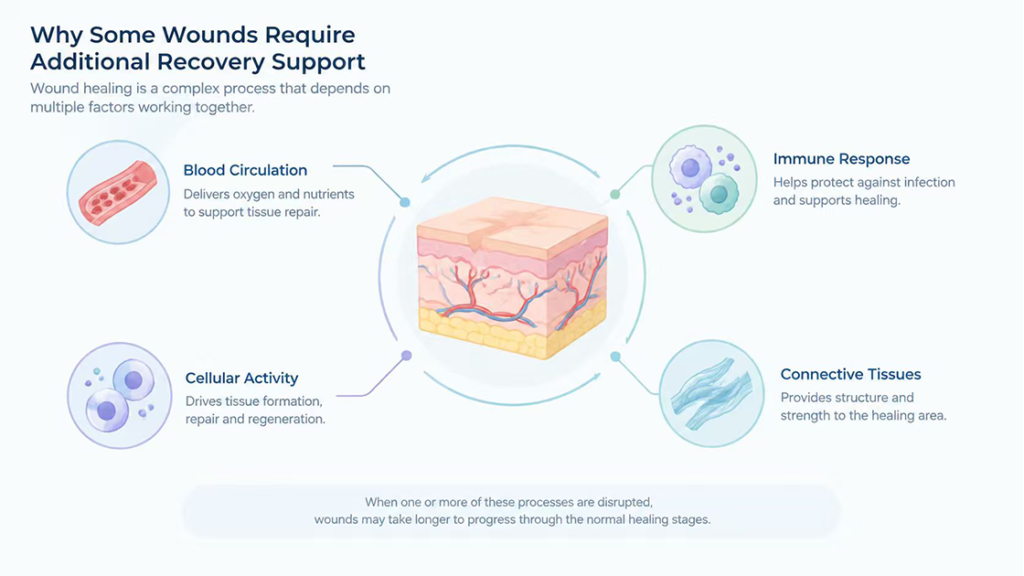
1.1 Why Some Wounds Require Additional Recovery Support
Normal wound recovery depends on coordinated interactions between blood vessels, immune responses, connective tissues, and cellular activity. When one or more of these processes become disrupted, wounds may take longer to progress through different recovery stages.
Factors such as reduced circulation, repeated pressure, tissue stress, and underlying health conditions can influence the ability of tissues to recover efficiently. Because wound recovery involves multiple biological systems, modern approaches often focus on supporting the overall tissue environment rather than only addressing surface conditions.
Shockwave Therapy has been explored as a technology that may influence local tissue responses through mechanical energy. By delivering acoustic waves into targeted areas, it provides a non-invasive method that focuses on supporting natural biological activities related to tissue recovery.
1.2 Common Types of Non-Healing Wounds
Non-healing wounds can appear in different forms depending on their causes and location. Common categories include chronic soft tissue wounds, pressure-related wounds, diabetic foot wounds, and wounds caused by physical trauma.
Each type of wound presents different recovery considerations. For example, some wounds may involve reduced circulation, while others may experience delayed tissue regeneration or prolonged inflammatory responses.
Because wound conditions vary significantly, professionals usually consider multiple factors, including tissue depth, wound characteristics, surrounding skin condition, and overall health status, when developing recovery strategies.
Shockwave Therapy has been studied in different wound-related applications because of its potential role in supporting tissue responses and improving the local environment around damaged areas. Research has explored its use as a supportive technology alongside conventional wound management approaches.
1.3 The Importance of Tissue Environment During Recovery
The condition of the surrounding tissue plays an important role in wound recovery. Healthy tissue requires sufficient oxygen delivery, nutrient exchange, and cellular communication to maintain normal repair activities.
Microcirculation is especially important because small blood vessels help deliver essential resources to tissues. When circulation support is limited, the recovery environment may become more challenging.
Shockwave Therapy is associated with mechanical stimulation that may influence local biological responses. The process known as mechanotransduction describes how mechanical signals can be converted into cellular responses, which may affect activities related to tissue remodeling and regeneration.
Understanding these mechanisms helps explain why shockwave technology has become an area of interest in modern rehabilitation and tissue recovery research.
2. How Shockwave Therapy Supports Tissue Recovery Processes
Shockwave Therapy uses acoustic pressure waves to deliver controlled mechanical energy into targeted tissues. Depending on the technology type, radial or focused shockwaves can be selected to address different tissue depths and application goals.
2.1 Understanding Extracorporeal Shock Wave Therapy (ESWT)
Extracorporeal Shock Wave Therapy (ESWT) was originally developed in medical applications involving high-energy acoustic waves and has since expanded into rehabilitation and soft tissue management.
During treatment, shockwaves travel through tissues and create mechanical stimulation. This stimulation may interact with cells and surrounding structures, supporting biological processes involved in tissue response.
Modern shockwave systems commonly include radial shockwave technology and focused shockwave technology. Radial systems generally distribute energy over broader superficial areas, while focused systems can concentrate energy at deeper targeted points.
The selection between different shockwave approaches depends on professional assessment, tissue characteristics, and recovery objectives.
2.2 The Role of Mechanotransduction in Tissue Response
Mechanotransduction describes the way cells respond to mechanical signals. When tissues receive controlled mechanical stimulation, cells may activate pathways associated with biological adaptation and tissue remodeling.
Shockwave Therapy applies mechanical energy through acoustic waves, creating a controlled stimulus within targeted tissues. This process has been studied in relation to factors such as cellular activity, growth factor expression, and vascular responses.
The interaction between mechanical stimulation and biological response is one reason why shockwave technology continues to attract attention in regenerative medicine and rehabilitation fields.
2.3 Supporting Microcirculation and Angiogenesis
Blood supply is an essential component of tissue recovery. Angiogenesis, the formation of new blood vessels, plays an important role in improving circulation and supporting tissue regeneration.
Research has explored how ESWT may influence vascular responses and tissue recovery processes. Some studies have discussed possible relationships between shockwave stimulation, angiogenesis-related factors, and improved tissue environments.
By supporting circulation-related processes, Shockwave Therapy may serve as a complementary technology within broader wound management programs.
3. Applications of Shockwave Therapy in Advanced Wound Recovery Management
As healthcare technology continues to develop, wound management is moving toward more comprehensive approaches that consider circulation, tissue quality, cellular activity, and the surrounding recovery environment. Shockwave Therapy is being explored as a supportive technology that may complement traditional wound care strategies by focusing on deeper tissue responses.
3.1 Supporting Chronic Wound Recovery Through Acoustic Wave Technology
Chronic wounds often remain in a prolonged recovery stage because the normal sequence of tissue repair becomes interrupted. In these situations, the local tissue environment may require additional support to encourage healthy recovery processes.
Shockwave Therapy uses acoustic waves to create controlled mechanical stimulation within targeted areas. This stimulation may influence cellular responses, circulation-related activities, and tissue remodeling pathways.
Some research has explored the relationship between ESWT and chronic wound recovery, including possible effects on angiogenesis, inflammatory regulation, and tissue regeneration processes. These findings have contributed to growing interest in shockwave technology as part of advanced wound management approaches.
3.2 The Role of Shockwave Therapy in Diabetic Foot Wound Support
Diabetic foot wounds represent one of the more complex areas within wound management because they may involve multiple factors, including circulation challenges, tissue stress, and changes in normal healing responses.
Shockwave Therapy has been investigated in relation to diabetic wound recovery because mechanical stimulation may influence vascular responses and tissue conditions. Some studies have explored how ESWT may interact with angiogenesis-related factors and cellular activities involved in tissue repair.
Within professional healthcare settings, Shockwave Therapy is generally considered as part of a broader wound management strategy rather than a standalone approach. Proper assessment of wound condition, tissue status, and overall health factors remains important when considering any advanced recovery technology.
3.3 Supporting Soft Tissue Regeneration and Tissue Remodeling
Soft tissue regeneration involves multiple biological processes, including collagen production, cellular communication, and structural remodeling. Maintaining a supportive tissue environment is important for normal recovery progression.
Shockwave Therapy may contribute mechanical signals that influence tissue responses through mechanisms such as mechanotransduction. This process describes how physical stimulation can create cellular reactions that affect biological activities.
By supporting tissue remodeling processes, shockwave technology has become an area of interest in rehabilitation and regenerative medicine. Its applications continue to expand beyond traditional musculoskeletal care into broader tissue recovery fields.
4. Understanding Different Shockwave Technologies for Tissue Recovery
Modern Shockwave Therapy systems include different energy delivery methods designed for various application needs. Understanding the differences between technologies helps professionals select suitable approaches based on tissue depth, treatment goals, and recovery requirements.
4.1 Radial Shockwave Therapy and Tissue Recovery Applications
Radial Shockwave Therapy delivers acoustic waves that spread outward from the application point, making it suitable for broader treatment areas and superficial soft tissue applications.
This type of shockwave technology is commonly associated with soft tissue stimulation and muscle-related recovery programs. The mechanical energy created by radial waves may support local tissue responses and circulation-related activities.
For wound and soft tissue applications, professionals consider factors such as tissue condition, treatment area, and appropriate energy settings when planning applications.
4.2 Focused Shockwave Therapy for Deeper Tissue Areas
Focused Shockwave Therapy concentrates acoustic energy at a specific depth, allowing professionals to target deeper tissue structures.
Because different wounds and tissue conditions involve different layers of the body, focused technology provides another option for situations where deeper tissue interaction may be considered.
The choice between radial and focused shockwave approaches depends on professional evaluation and the specific recovery objectives. Both technologies represent different methods of delivering mechanical energy to biological tissues.
4.3 The Importance of Personalized Shockwave Therapy Parameters
Effective use of Shockwave Therapy requires careful consideration of multiple parameters, including energy intensity, frequency, treatment area, and tissue characteristics.
Every wound recovery situation is different. Factors such as wound location, surrounding tissue condition, and overall recovery status may influence how professionals design a suitable approach.
Personalized parameter selection allows shockwave technology to be integrated more effectively into comprehensive rehabilitation and tissue management programs.
5. The Future of Shockwave Therapy in Tissue Recovery and Rehabilitation
The development of Shockwave Therapy continues to expand as researchers and healthcare professionals explore its potential applications in different recovery fields. From musculoskeletal rehabilitation to advanced tissue management, acoustic wave technology continues to attract attention because of its unique mechanical stimulation properties.
5.1 Combining Shockwave Therapy With Comprehensive Wound Management
Wound recovery requires a multi-dimensional approach that considers tissue condition, circulation, infection control, lifestyle factors, and professional care.
Shockwave Therapy is generally viewed as a supportive technology that may be integrated with established wound management methods. Combining different approaches allows professionals to address various aspects of tissue recovery.
A comprehensive strategy focuses not only on the wound surface but also on the surrounding biological environment that influences recovery.
5.2 Why Non-Invasive Recovery Technologies Are Gaining Attention
Modern healthcare continues to explore technologies that provide supportive options without requiring invasive procedures. Non-invasive approaches are becoming increasingly important in rehabilitation and recovery environments.
Shockwave Therapy offers a technology-based method that uses acoustic energy to interact with tissues. Its applications in tissue stimulation, circulation support, and recovery management have encouraged continued exploration.
As healthcare continues to focus on personalized recovery strategies, technologies like Shockwave Therapy may become part of broader rehabilitation solutions.
5.3 Future Development of Shockwave Therapy in Regenerative Medicine
The future development of Shockwave Therapy may focus on improving treatment precision, understanding biological mechanisms, and expanding professional applications.
Current discussions around shockwave technology include areas such as angiogenesis, tissue regeneration, cellular response, and rehabilitation science. Continued research may provide further insights into how mechanical stimulation influences different tissue environments.
With advances in technology and clinical knowledge, Shockwave Therapy continues to represent an important area of innovation within modern recovery and rehabilitation fields.
FAQ
What is Shockwave Therapy?
It is a non-invasive technology that uses acoustic waves to create controlled mechanical stimulation within targeted tissues.
Can Shockwave Therapy support non-healing wound recovery?
It may support tissue recovery processes as part of a comprehensive wound management approach.
What is the difference between radial and focused shockwave therapy?
Radial shockwave therapy distributes energy across a broader area, while focused shockwave therapy concentrates energy at a deeper target point.
How does Shockwave Therapy affect tissue?
Shockwave Therapy creates mechanical stimulation that may influence cellular responses, circulation support, and tissue remodeling processes.
Is Shockwave Therapy suitable for every wound condition?
Suitability depends on individual wound characteristics, overall health condition, and professional evaluation.
Can Shockwave Therapy replace traditional wound care?
No. Shockwave Therapy is generally considered a supportive technology used alongside appropriate wound management strategies.
Conclusion
Non-healing wounds require careful attention to tissue condition, circulation, cellular activity, and the overall recovery environment. Shockwave Therapy, including radial and focused shockwave technologies, provides a modern approach that uses acoustic wave energy to support tissue stimulation and recovery management. Through mechanisms related to mechanotransduction, microcirculation, and tissue remodeling, shockwave technology continues to be explored in rehabilitation and advanced wound care fields. When combined with professional assessment and comprehensive recovery strategies, Shockwave Therapy represents an evolving technology that may contribute to the future development of modern tissue recovery solutions.
References
Extracorporeal Shock Wave Therapy for Wound Healing: Technology, Mechanisms, and Clinical Efficacy
https://pubmed.ncbi.nlm.nih.gov/22642362
Low Intensity Shockwave Treatment Modulates Macrophage Functions Beneficial to Healing Chronic Wounds
https://pubmed.ncbi.nlm.nih.gov/34360610
Extracorporeal Shockwave Therapy Compared With Standard Care for Diabetic Foot Ulcer Healing: An Updated Systematic Review
https://pmc.ncbi.nlm.nih.gov/articles/PMC10332991
Shock Wave Therapy for Wound Healing and Scar Treatment
https://www.ncbi.nlm.nih.gov/books/NBK586112
Extracorporeal Shockwave Therapy for the Healing and Management of Venous Leg Ulcers