

Introduction
Swimming requires precise coordination, continuous muscle activation, and repetitive upper-body movement patterns. Competitive swimmers and regular aquatic athletes often complete thousands of strokes during training sessions, placing repeated demands on the shoulders, rotator cuff muscles, upper back, and surrounding soft tissues. Movements such as freestyle, butterfly, and backstroke require frequent overhead motion and shoulder rotation, which makes recovery management an important part of a swimmer’s training routine. Shockwave Therapy has become an increasingly discussed technology in sports rehabilitation because of its ability to deliver mechanical energy to targeted areas through extracorporeal shockwave therapy principles. By supporting soft tissue response, circulation, and musculoskeletal recovery processes, shockwave technology provides swimmers with an additional approach for maintaining physical comfort and supporting long-term performance routines.
1. Understanding Shoulder Demands in Swimming
1.1 Why Repetitive Swimming Strokes Create Shoulder Stress
Swimming is a unique endurance sport because the upper body performs repeated movements while maintaining speed and technical efficiency. Unlike many land-based sports, swimmers rely heavily on continuous shoulder rotation and overhead arm movements.
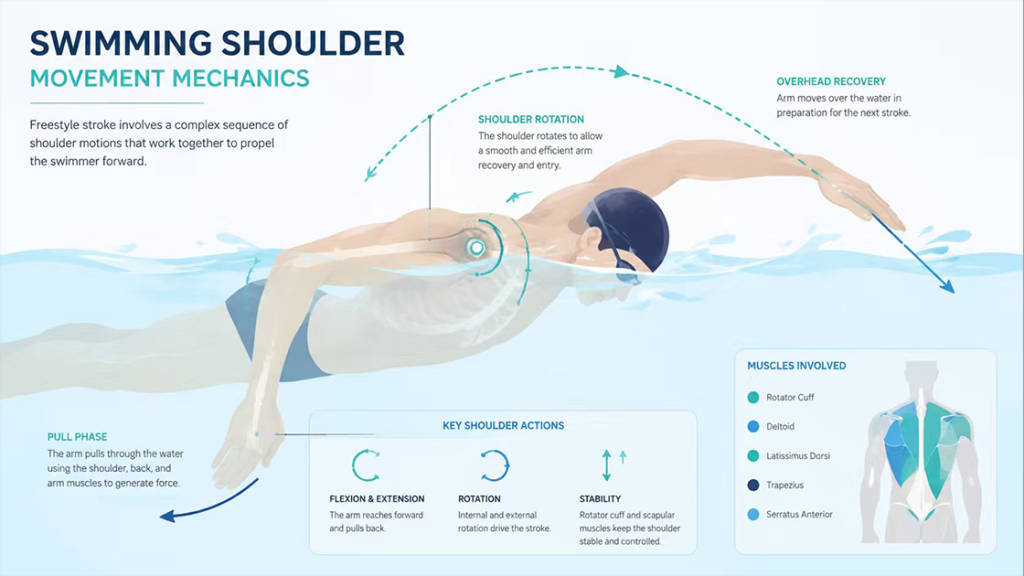
During a single training session, swimmers may perform hundreds or thousands of strokes. Each stroke requires coordinated movement between the shoulder joint, rotator cuff muscles, scapular stabilizers, and upper back muscles.
The shoulder complex provides a wide range of motion, allowing swimmers to generate propulsion in the water. However, repeated movement patterns can create continuous physical demands on muscles and tendon tissues involved in swimming mechanics.
Freestyle and butterfly strokes require frequent overhead positioning, while backstroke involves repeated shoulder rotation behind the body. These technical movements make shoulder mobility and soft tissue condition important considerations for swimmers.
Shockwave Therapy uses controlled acoustic energy to support targeted areas involved in repetitive movement activities. Through mechanical stimulation, this technology may assist soft tissue recovery processes and become part of a swimmer’s overall recovery strategy.
1.2 The Connection Between Swimming Technique and Rotator Cuff Function
The rotator cuff plays an important role in shoulder stability and movement control. It consists of several muscles and tendons that help maintain proper shoulder mechanics during arm movement.
Swimming requires continuous activation of the rotator cuff because swimmers repeatedly lift, rotate, and extend their arms through different stroke patterns.
Proper technique helps swimmers maintain efficient movement, but training volume, stroke frequency, and individual biomechanics can influence how much stress certain shoulder structures experience.
The relationship between the shoulder blade, upper back muscles, and rotator cuff is essential for balanced swimming movements. When these areas work together effectively, swimmers can maintain better movement coordination during training.
Shockwave Therapy focuses on supporting areas affected by repeated physical activity. Depending on professional assessment, shockwave applications may be considered as part of a broader approach for supporting tendon tissue and soft tissue recovery.
1.3 Common Shoulder Areas Swimmers Focus on During Recovery
Swimmers often pay attention to several areas that contribute to stroke efficiency and upper-body movement.
Commonly focused areas include:
- Rotator cuff muscles
- Shoulder tendons
- Upper back muscles
- Scapular stabilizing muscles
- Upper arm soft tissues
Each area contributes to maintaining swimming technique and shoulder movement control.
Because swimming involves repetitive strokes rather than isolated movements, recovery strategies often consider the entire shoulder movement system instead of focusing on only one area.
Shockwave Therapy provides a targeted technology option that can be incorporated into professional recovery programs to support areas experiencing repeated training demands.
2. How Shockwave Therapy Supports Swimmer Recovery
2.1 Understanding Extracorporeal Shockwave Therapy in Sports Recovery
Extracorporeal Shockwave Therapy (ESWT) is a technology that uses acoustic waves to deliver mechanical energy into specific body areas. In sports rehabilitation settings, shockwave therapy is commonly discussed for its applications involving tendons, muscles, and soft tissue structures.
There are different types of shockwave technologies, including radial shockwave therapy and focused shockwave therapy. Each approach delivers energy differently depending on the targeted area and professional application goals.
For swimmers, shockwave technology provides a non-invasive support option that focuses on areas exposed to repetitive movement patterns.
The technology is commonly considered alongside other recovery strategies, including mobility training, strength conditioning, and appropriate rest periods.
2.2 Supporting Rotator Cuff and Tendon Tissue Recovery
The shoulder contains multiple tendons and muscles that work together during swimming movements. The rotator cuff requires continuous coordination during strokes, turns, and starts.
Shockwave Therapy delivers mechanical stimulation to selected areas, which may support circulation and tissue response processes.
For swimmers, this approach may be considered when developing recovery plans focused on maintaining shoulder function and supporting soft tissue condition.
The goal of shockwave technology is not to replace proper training techniques but to complement comprehensive recovery management.
By combining professional guidance, swimming technique adjustments, and recovery technologies, athletes can create a more balanced approach to managing repetitive shoulder demands.
2.3 Radial and Focused Shockwave Therapy Applications for Swimmers
Different swimming-related concerns may involve different tissue depths and movement patterns. This is why shockwave systems often include different energy delivery methods.
Radial Shockwave Therapy distributes mechanical waves across a broader treatment area, making it suitable for larger soft tissue regions.
Focused Shockwave Therapy delivers energy more precisely to targeted areas where deeper tissue support may be required.
For swimmers, professional evaluation helps determine the appropriate approach based on training habits, physical condition, and recovery goals.
Both technologies are designed around the principle of controlled mechanical stimulation to support musculoskeletal recovery processes.
3. Swimming-Related Areas That Often Require Recovery Support
3.1 Supporting the Rotator Cuff After Repetitive Overhead Movements
The rotator cuff is one of the most important functional structures involved in swimming because it helps control shoulder movement during repeated arm rotation. Freestyle, butterfly, and backstroke all require frequent overhead movements, which place continuous demands on the muscles and tendons around the shoulder joint.
Swimmers often focus on maintaining shoulder stability because efficient strokes depend on coordinated movement between the rotator cuff, shoulder blade, and upper back muscles. When training volume increases, the repeated nature of swimming can create additional physical demands on these areas.
Shockwave Therapy may support recovery-focused routines by delivering acoustic energy to selected soft tissue areas. Through mechanical stimulation, shockwave technology is commonly used in sports rehabilitation settings to support tendon and soft tissue management.
For swimmers, incorporating shockwave technology into a comprehensive recovery plan may help address areas exposed to repetitive training demands while working alongside proper technique, strength conditioning, and mobility exercises.
3.2 Supporting Shoulder Tendons During Intensive Swimming Training
Swimming requires continuous tendon involvement because every stroke depends on controlled force transmission between muscles and joints. The shoulder tendons help transfer movement from the muscles to the arm, allowing swimmers to maintain speed and technical efficiency.
High-volume training schedules may increase attention toward tendon condition, especially for athletes who practice multiple sessions per week. Factors such as stroke technique, training intensity, recovery time, and individual biomechanics can all influence how swimmers manage shoulder workload.
Shockwave Therapy focuses on using controlled mechanical waves to support targeted tissue areas. Depending on professional evaluation, radial shockwave therapy or focused shockwave therapy may be considered for different recovery goals.
By supporting soft tissue response and circulation around selected areas, shockwave technology can become part of a broader approach to maintaining shoulder function during demanding swimming routines.
3.3 Supporting Upper Back and Scapular Muscle Function in Swimmers
Although swimming movements mainly involve the shoulders and arms, the upper back plays an essential role in maintaining efficient stroke mechanics. Muscles surrounding the scapula help control shoulder blade movement and provide stability during repetitive arm actions.
During swimming, the connection between the shoulder joint, scapular muscles, and upper back structures allows athletes to maintain proper posture and movement coordination.
Recovery programs often consider the entire upper-body movement system instead of focusing only on the shoulder. This approach helps swimmers address the relationship between different muscle groups involved in performance.
Shockwave Therapy may provide additional support for soft tissue areas involved in repeated movement patterns. When combined with mobility training and strengthening exercises, it can contribute to a complete musculoskeletal recovery strategy.
4. The Role of Shockwave Therapy in Modern Swimming Recovery
4.1 Why Swimmers Are Exploring Advanced Recovery Technologies
Competitive swimming requires a careful balance between training intensity and recovery management. Unlike sports with short bursts of movement, swimming often involves repetitive technical motions performed over long training periods.
Many swimmers use recovery strategies to support muscle condition, flexibility, and physical readiness. Traditional approaches may include stretching, strength training, rest periods, and professional rehabilitation guidance.
As sports technology develops, Shockwave Therapy has become an option discussed in many rehabilitation environments. Extracorporeal Shockwave Therapy (ESWT) uses acoustic waves to create mechanical stimulation in targeted areas, supporting recovery-focused applications for muscles, tendons, and soft tissues.
For swimmers, advanced recovery technology can complement training programs by addressing the physical demands created by repetitive strokes and high-volume practice sessions.
4.2 The Difference Between Radial and Focused Shockwave Therapy for Swimmers
Shockwave Therapy systems may use different energy delivery methods depending on the application area and professional goals.
Radial Shockwave Therapy distributes energy across a broader surface area and is often considered for larger soft tissue regions. This approach may be suitable when swimmers focus on wider muscle groups around the shoulder, upper back, or surrounding areas.
Focused Shockwave Therapy delivers energy more precisely and may be considered when attention is directed toward specific deeper tissue areas.
For swimmers, selecting an appropriate shockwave approach depends on individual training patterns, physical condition, and professional assessment.
Understanding the differences between these technologies allows rehabilitation professionals to create more personalized recovery strategies for aquatic athletes.
4.3 Integrating Shockwave Therapy With Swimming Training Plans
Recovery technology works most effectively when combined with proper training management. Swimming performance depends not only on endurance but also on movement efficiency, strength balance, and injury prevention strategies.
A complete swimming recovery plan may include:
- Proper stroke technique
- Shoulder mobility exercises
- Strength conditioning
- Adequate recovery periods
- Professional guidance
Shockwave Therapy can serve as a supportive tool within this framework by focusing on areas exposed to repeated mechanical stress.
Rather than replacing fundamental training principles, shockwave technology works alongside established recovery methods to help swimmers maintain better physical management throughout their training cycles.
5. Building a Long-Term Recovery Strategy for Swimmers
5.1 Supporting Consistent Performance Through Recovery Management
Long-term swimming success requires more than intense training. Athletes also need effective recovery strategies that consider the physical demands created by repetitive movement patterns.
Because swimming relies heavily on shoulder rotation and upper-body coordination, maintaining soft tissue condition is an important part of many swimmers’ wellness routines.
Shockwave Therapy provides another option for supporting musculoskeletal recovery by using acoustic energy to target specific areas involved in training.
When combined with proper swimming techniques, conditioning programs, and recovery habits, shockwave technology can help athletes develop a more complete approach to managing training demands.
5.2 Choosing the Right Shockwave Therapy Approach for Swimming Applications
Every swimmer has unique training requirements. A competitive swimmer completing daily practices may have different recovery needs compared with a recreational swimmer who trains several times per week.
Factors that may influence a suitable shockwave therapy approach include:
- Swimming frequency
- Stroke type
- Training intensity
- Target recovery areas
- Individual physical condition
Professional assessment helps determine how shockwave technology fits into an overall recovery plan.
For swimmers looking for advanced support options, Shockwave Therapy offers a modern approach based on mechanical stimulation, soft tissue support, and sports rehabilitation principles.
FAQ
Why do swimmers often focus on shoulder recovery?
Swimming requires repetitive overhead movements and continuous shoulder rotation, which place frequent demands on the shoulder complex.
Can Shockwave Therapy support swimmers?
Shockwave Therapy can be used as part of a recovery-focused plan to support soft tissue and musculoskeletal recovery processes.
What areas are commonly considered for swimmers?
Common areas include the rotator cuff, shoulder tendons, upper back muscles, and scapular stabilizing muscles.
Is Shockwave Therapy only for professional swimmers?
No. Recreational swimmers and athletes with regular training routines may also consider recovery technologies.
What is the difference between radial and focused shockwave therapy?
Radial shockwave therapy generally covers broader areas, while focused shockwave therapy delivers energy more precisely to targeted regions.
Conclusion
Swimming requires thousands of repeated movements that place continuous demands on the shoulders, rotator cuff, and upper-body muscles. Stroke repetition, overhead arm motion, and intensive training schedules make recovery management an important consideration for aquatic athletes. Shockwave Therapy uses mechanical acoustic energy to support targeted soft tissue areas and provides an additional option within modern sports rehabilitation approaches. By combining shockwave technology with proper swimming technique, strength training, mobility exercises, and balanced recovery habits, swimmers can create a more complete strategy for maintaining physical comfort and supporting long-term participation in the sport.
References
Extracorporeal Shockwave Therapy for the Treatment of Noncalcific Rotator Cuff Tendinopathy: A Systematic Review and Meta-analysis
https://pubmed.ncbi.nlm.nih.gov/37903597
Radial Extracorporeal Shockwave Therapy Reduces Pain and Promotes Proximal Tendon Healing After Rotator Cuff Repair: Randomized Clinical Trial
https://pubmed.ncbi.nlm.nih.gov/37027927
Shock Wave Therapy for Rotator Cuff Disease With or Without Calcification
Efficacy of Radial Extracorporeal Shockwave Therapy in Rehabilitation Following Arthroscopic Rotator Cuff Repair
https://pmc.ncbi.nlm.nih.gov/articles/PMC9439771
Swimmer’s Shoulder: Symptoms, Tests, Treatment & Recovery
https://my.clevelandclinic.org/health/diseases/17535-swimmers-shoulder