

Introduction
The pitching motion is one of the most violent and unnatural movements in all of sports. The shoulder externally rotates to extreme angles, the arm accelerates with tremendous velocity, and the entire kinetic chain must fire in perfect sequence to deliver a baseball with accuracy and power. For pitchers, this repetitive cycle places extraordinary demands on the shoulder joint, leading to adaptive changes that can ultimately compromise performance and increase injury risk. Among the most common and concerning of these adaptations is glenohumeral internal rotation deficit, or GIRD. This condition, characterized by a loss of internal rotation range of motion in the throwing shoulder, affects pitchers at every level of the sport and has been linked to an elevated risk of shoulder injury. For pitchers who have tried traditional stretching and rehabilitation without lasting relief, shockwave therapy offers a non-invasive, drug-free approach that may help address the underlying tissue dysfunction and restore proper shoulder mechanics.
1. Understanding GIRD and Its Impact on Pitchers
Glenohumeral internal rotation deficit refers to a measurable loss of internal rotation range of motion in the throwing shoulder compared to the non-throwing shoulder. This deficit typically develops as an adaptive response to the repetitive demands of overhead throwing and can have significant consequences for both performance and long-term shoulder health.
1.1 What GIRD Actually Means
The glenohumeral joint is the ball-and-socket articulation where the head of the humerus fits into the glenoid fossa of the scapula. During the throwing motion, the shoulder undergoes extreme ranges of motion. The external rotation, or cocking phase, can reach angles of up to 170 degrees. This repetitive external rotation stretches the anterior capsule and allows for greater external rotation over time. However, this adaptation comes at a cost. The posterior capsule and rotator cuff muscles become progressively tighter, limiting internal rotation.
The result is a shift in the arc of total rotational motion. The throwing shoulder gains external rotation but loses an almost equal amount of internal rotation, so the total range of motion often remains similar between sides. This balance is important to understand. A small loss of internal rotation may represent a normal adaptive response. A pathological GIRD is defined as a loss of internal rotation in the presence of a loss of total rotational motion. Clinically, an asymmetry exceeding 20 degrees between the throwing and non-throwing shoulder is considered significant.
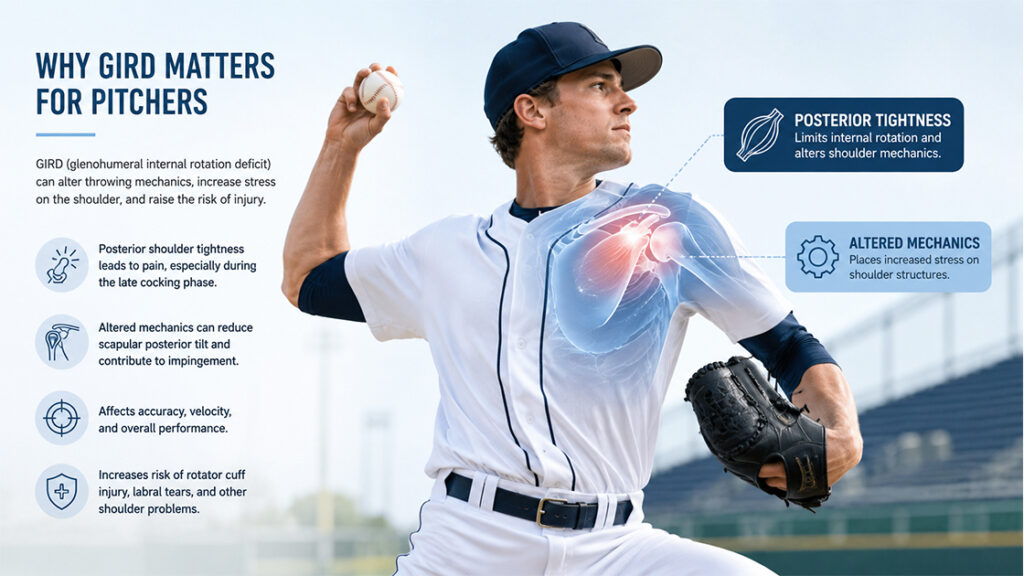
1.2 Why GIRD Matters for Pitchers
The consequences of GIRD extend far beyond a simple range of motion measurement. Pitchers with GIRD often experience new-onset posterior shoulder pain, particularly during the late cocking phase of the throw. The tightness in the posterior shoulder alters the mechanics of the throwing motion, placing increased stress on other structures. Research has shown that pitchers with GIRD exhibit less scapular posterior tilt during pitching, which can contribute to impingement. This altered mechanics can lead to a cascade of shoulder problems, including rotator cuff inflammation, labral tears, and impingement syndromes.
The loss of internal rotation also affects performance. Pitchers with GIRD may compensate by altering their trunk rotation or shoulder mechanics, which can affect ball placement and velocity. The condition can produce a decrease in throwing strength and performance, often accompanied by vague shoulder pain that may be difficult to pinpoint. For a pitcher, these subtle changes can be the difference between an effective outing and an injury that sidelines them for weeks or months.
2. The Biomechanics of Pitching and the Development of GIRD
To understand GIRD, one must first understand the extraordinary forces involved in the pitching motion. The shoulder complex endures tremendous stress with every throw, and the body adapts to this stress in ways that can be both protective and problematic.
2.1 The Throwing Motion and Its Demands
The pitching motion unfolds in several distinct phases. The windup begins the sequence, followed by the cocking phase where the shoulder externally rotates to its maximum. During this phase, the anterior capsule stretches, and the rotator cuff muscles work to maintain humeral head stability. The acceleration phase then generates incredible velocity, placing tremendous eccentric loads on the posterior structures. Finally, the deceleration and follow-through phases absorb the remaining energy.
Each phase imposes unique demands on the shoulder. The repetitive nature of pitching means these demands accumulate over thousands of throws. The posterior capsule and rotator cuff muscles bear the brunt of this repetitive stress, leading to adaptive shortening and fibrosis. This adaptive response, while initially protective, gradually produces the internal rotation deficit that defines GIRD.
2.2 How GIRD Develops Over Time
The development of GIRD occurs gradually over months and years of repetitive throwing. As the posterior capsule tightens, the humeral head shifts position within the glenoid. This shift places increased stress on the anterior structures, including the labrum and biceps tendon. The rotator cuff muscles, particularly the infraspinatus and teres minor, become overworked as they attempt to maintain stability. Over time, these compensatory mechanisms can fail, leading to acute injury.
The process is typically asymptomatic in its early stages. Pitchers may not notice any pain or functional limitation until the deficit becomes significant. The lack of early symptoms often leads to delayed diagnosis and treatment, allowing the condition to progress to the point where it affects both performance and health.
2.3 The Role of Soft Tissue Tightness
The posterior shoulder tightness that drives GIRD involves both the capsule and the rotator cuff muscles. The posterior capsule responds to repetitive stress by increasing its collagen content and becoming stiffer. This capsular tightness limits internal rotation and contributes to the anterior translation of the humeral head during throwing. The rotator cuff muscles also adapt, developing trigger points and increased tone that further restrict motion.
Shockwave therapy addresses this soft tissue tightness directly. The acoustic pulses penetrate the posterior shoulder, reaching the capsule and rotator cuff muscles. This mechanical stimulation can help break down fibrotic tissue, improve tissue elasticity, and support the restoration of normal range of motion.
3. How Shockwave Therapy Addresses Posterior Shoulder Tightness
Shockwave therapy delivers acoustic pressure waves to the posterior shoulder, where the tightness that drives GIRD originates. The mechanical energy from these waves triggers a cascade of biological responses that support tissue healing and remodeling.
3.1 The Cellular Mechanism of Action
When shockwaves reach the posterior capsule and rotator cuff muscles, the mechanical pressure stretches and compresses cells in ways that activate mechanotransduction pathways. Fibroblasts respond by increasing their production of collagenases and matrix metalloproteinases, enzymes that break down fibrotic tissue. This helps remodel the thickened, contracted posterior capsule. The mechanical input also stimulates the release of growth factors that support tissue repair and regeneration.
3.2 Restoring Tissue Elasticity
The primary goal of shockwave therapy for GIRD is to restore the elasticity of the posterior structures. By promoting the breakdown of fibrotic tissue and supporting the synthesis of new, more organized collagen, the therapy helps reduce capsular tightness. This allows for improved internal rotation range of motion, which can positively affect throwing mechanics.
3.3 Pain Modulation and Muscle Relaxation
Shockwave therapy also influences nerve signaling in the treated area. The acoustic pulses can alter the transmission of pain impulses, providing a period of reduced discomfort that allows the pitcher to engage more fully in rehabilitation exercises. The therapy also helps relax hypertonic muscles by reducing nerve activity at the motor end plate, allowing for better muscle coordination and movement control.
4. What a Pitcher Can Expect from Treatment
For pitchers considering shockwave therapy for GIRD, understanding the typical course of treatment helps set realistic expectations.
4.1 The Treatment Experience
A typical shockwave session for the posterior shoulder lasts between five and fifteen minutes. The pitcher lies comfortably while the practitioner positions the applicator over the posterior shoulder, targeting the area where the capsule and rotator cuff muscles attach. Most pitchers describe the sensation as a series of firm taps or a deep percussion. The treatment requires no anesthesia, and pitchers can return to their normal activities immediately afterward.
4.2 Number of Sessions and Timeline
A course of treatment often involves three to five sessions spaced about one week apart. Some pitchers notice improvement after the first session or two, while others benefit from the full series. The full effect of the therapy typically becomes apparent over several weeks, as tissue remodeling and healing take time.
4.3 Integrating with Throwing Rehabilitation
Shockwave therapy works most effectively when combined with a structured rehabilitation program. Pitchers should continue with their prescribed stretching and strengthening exercises. A comprehensive approach that includes manual therapy and a gradual return to throwing can help maintain and enhance the improvements achieved with shockwave therapy.
5. Long-Term Strategies for Pitchers
Preventing GIRD from recurring requires attention to the factors that contribute to its development.
5.1 Stretching and Strengthening
Regular stretching of the posterior shoulder structures and strengthening of the rotator cuff and scapular stabilizers helps maintain proper mechanics and reduce the risk of developing GIRD. Specific exercises should be performed consistently, particularly during the preseason and throughout the competitive season.
5.2 Monitoring Range of Motion
Regular assessment of shoulder range of motion can help detect changes early. Pitchers and their trainers should monitor both internal and external rotation, looking for any significant asymmetry. Early detection allows for intervention before the deficit becomes problematic.
5.3 Managing Throwing Volume
Pitching volume plays a significant role in the development of GIRD. Pitchers should be mindful of their pitch counts, innings pitched, and recovery between appearances. Adequate rest allows the shoulder to recover and reduces the cumulative stress that leads to tissue changes.
FAQ
Q1: Is shockwave therapy painful for GIRD?
Most pitchers describe a tapping or deep percussion sensation that is uncomfortable but brief. The session is short, and any discomfort stops when the handpiece lifts.
Q2: How many sessions does a pitcher typically need?
A common protocol involves three to five sessions spaced about one week apart. Some pitchers notice improvement after two or three sessions, while others benefit from the full series.
Q3: Can I continue throwing during shockwave therapy?
Most pitchers continue throwing during treatment, but they should avoid movements that cause sharp pain. Modifying throwing volume and intensity may be necessary.
Q4: How soon after treatment will I feel less shoulder tightness?
Some pitchers notice a change within a few sessions. The most noticeable improvement often takes several weeks to appear as the tissue remodels.
Q5: Does shockwave therapy work for all types of GIRD?
Shockwave therapy shows the most promise for GIRD associated with posterior capsule tightness. A thorough evaluation helps determine if it is an appropriate option for your specific condition.
Conclusion
Glenohumeral internal rotation deficit represents a significant challenge for pitchers at every level of the sport. The adaptive changes that occur in response to repetitive throwing can compromise performance and increase injury risk. For pitchers who have tried conventional stretching and rehabilitation without lasting relief, shockwave therapy offers a non-invasive, drug-free approach that addresses the underlying tissue dysfunction. By promoting collagen remodeling, reducing capsular tightness, and supporting muscle relaxation, the therapy may help restore proper shoulder mechanics and allow pitchers to continue performing at their best.
References
GIRD in Baseball Pitchers: Pathophysiology and Treatment Options
https://pubmed.ncbi.nlm.nih.gov/31158545
Extracorporeal Shockwave Therapy for Shoulder Conditions
https://pubmed.ncbi.nlm.nih.gov/32678294
Posterior Shoulder Tightness in Throwing Athletes
https://www.ncbi.nlm.nih.gov/books/NBK556028
Shockwave Therapy for Soft Tissue Tightness
https://www.sportsmed.org/shockwave-therapy
Preventing Shoulder Injuries in Pitchers