

Introduction
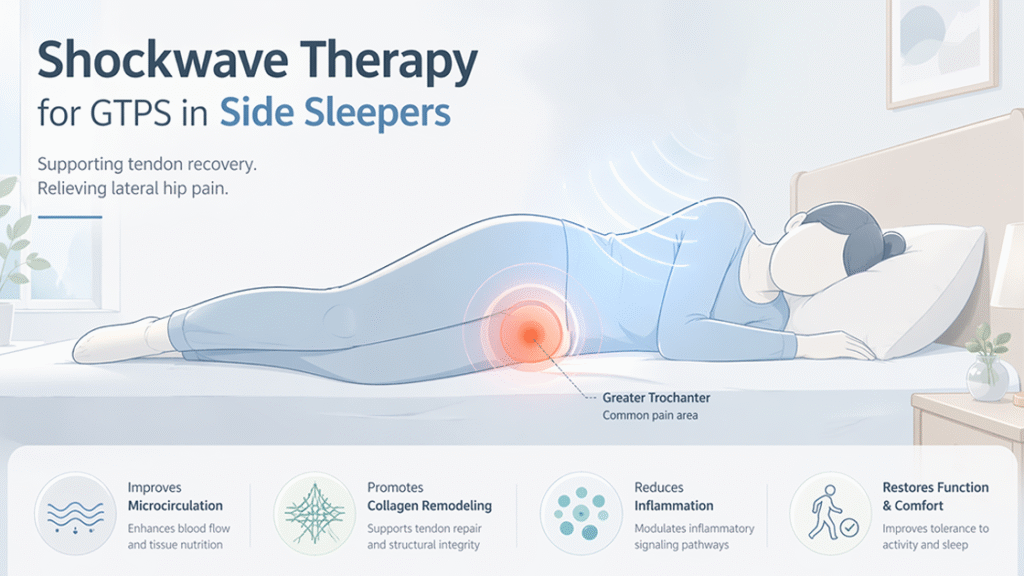
Greater trochanteric pain syndrome (GTPS) represents one of the most common causes of lateral hip pain in adults, yet many individuals remain unaware that their sleeping position may significantly contribute to symptom persistence. Side sleepers often experience repeated compression over the greater trochanter region throughout the night, which can gradually irritate surrounding tendons and bursae. Over time, this mechanical stress contributes to chronic inflammation and degenerative tendon changes rather than acute injury. Extracorporeal shockwave therapy has emerged as a clinically supported non-invasive modality for managing chronic tendon disorders associated with GTPS. By stimulating tissue regeneration, improving microcirculation, and promoting collagen remodeling, shockwave therapy supports recovery in patients whose symptoms persist despite conventional conservative approaches.
1. Understanding Greater Trochanteric Pain Syndrome
Greater trochanteric pain syndrome describes a group of soft-tissue disorders affecting the lateral hip. It commonly involves the gluteus medius tendon, gluteus minimus tendon, and trochanteric bursa.
1.1 Anatomy of the greater trochanter region
The greater trochanter serves as a major attachment site for hip stabilizing muscles, especially the gluteus medius and gluteus minimus. These muscles play essential roles in pelvic stabilization during walking, standing, and side-lying postures. When compression forces persist against this region, tendon loading increases substantially.
Because the lateral hip experiences both tensile and compressive stress during daily movement and rest, the tissues surrounding the greater trochanter are particularly vulnerable to repetitive overload. Over time, this biomechanical strain contributes to localized tendon degeneration and inflammatory responses.
1.2 Difference between GTPS and traditional hip bursitis
GTPS was historically labeled as trochanteric bursitis. However, modern imaging studies demonstrate that tendon pathology plays a larger role than isolated bursal inflammation. Degenerative changes within the gluteal tendons frequently explain persistent lateral hip pain more accurately than bursitis alone.
This distinction is important because treatment strategies that target tendon regeneration, such as shockwave therapy, address the underlying pathology more effectively than approaches focusing solely on inflammation suppression.
1.3 Why GTPS often becomes chronic
Unlike acute injuries that resolve quickly, GTPS often develops gradually through repeated mechanical compression and micro-trauma. These repetitive forces disrupt collagen alignment within tendon fibers and reduce local circulation.
As tissue metabolism declines, healing slows significantly. Without targeted intervention, chronic degenerative changes may persist for months or even years.
2. Why Side Sleeping Contributes to Lateral Hip Pain
Sleeping posture plays a surprisingly important role in musculoskeletal health. Side sleepers place continuous pressure directly over the greater trochanter region during extended nighttime hours.
2.1 Nighttime compression and tendon overload
During side-lying sleep, body weight concentrates over a relatively small contact surface at the lateral hip. This sustained compression restricts blood flow to the gluteal tendons and surrounding soft tissues.
Reduced circulation slows oxygen delivery and metabolic waste removal, creating a microenvironment that favors inflammation persistence. Over time, repetitive nightly compression contributes to tendon sensitization and structural degeneration.
2.2 Reduced overnight circulation and tissue recovery
Sleep normally supports tissue repair through increased parasympathetic activity and growth hormone release. However, when mechanical compression persists during sleep, these recovery mechanisms become less effective in the affected area.
Side sleepers with inadequate mattress support or poor pelvic alignment may experience further reductions in circulation, which prolongs healing timelines and increases symptom recurrence risk.
2.3 Pelvic alignment imbalance during sleep posture
Pelvic tilt commonly occurs when individuals sleep on one side without adequate hip support. This alignment shift increases tension across the gluteal tendons and iliotibial band.
Over weeks and months, asymmetrical loading patterns alter movement mechanics during walking and standing, reinforcing the cycle of lateral hip pain associated with GTPS.
3. Clinical Symptoms of GTPS in Side Sleepers
Patients with side-sleeping-related GTPS often present with characteristic symptom patterns that differ slightly from sports-related hip tendon injuries.
3.1 Localized tenderness over the lateral hip
One of the most recognizable signs of GTPS is tenderness directly over the greater trochanter. Patients frequently report discomfort when pressing on the outer hip or lying on the affected side.
This localized sensitivity reflects irritation within gluteal tendon insertion sites and surrounding soft tissue structures. Because compression worsens symptoms, nighttime discomfort often becomes a primary complaint.
3.2 Pain during prolonged standing or walking
The gluteus medius muscle stabilizes the pelvis during single-leg stance phases of walking. When tendon degeneration develops, this stabilizing function becomes compromised.
As a result, individuals may notice increasing discomfort during longer walking distances or while standing for extended periods. Symptoms often intensify gradually rather than appearing suddenly.
3.3 Sleep disturbance due to hip pressure sensitivity
Many patients first recognize GTPS when nighttime discomfort interrupts sleep. The inability to lie comfortably on one side forces repeated position changes throughout the night.
Sleep disruption further delays tissue recovery by interfering with normal hormonal repair cycles, creating a feedback loop between pain and impaired healing.
4. Mechanisms of Shockwave Therapy in GTPS Treatment
Extracorporeal shockwave therapy supports recovery in chronic tendon conditions by stimulating biological repair mechanisms rather than simply masking symptoms.
4.1 Stimulation of neovascularization in tendon tissue
Shockwave therapy promotes the formation of new microvascular networks within damaged tendon regions. Increased vascular supply enhances oxygen delivery and nutrient transport.
Improved circulation accelerates removal of inflammatory metabolites that accumulate in chronically compressed tissues. This vascular response represents one of the key regenerative mechanisms supporting recovery in GTPS patients.
4.2 Activation of collagen remodeling processes
Healthy tendon function depends on well-organized collagen fiber alignment. Chronic compression disrupts this structure and weakens tissue resilience.
Shockwave stimulation encourages fibroblast activation and collagen synthesis, helping restore tendon structural integrity. Over time, this remodeling process supports improved load tolerance during both movement and sleep-related compression.
4.3 Modulation of chronic inflammatory signaling pathways
Shockwave therapy influences cellular signaling pathways involved in inflammation regulation. It reduces concentrations of pro-inflammatory mediators while supporting tissue repair responses.
This dual action helps transition tissue from a chronic inflammatory state toward a regenerative healing phase.
5. Clinical Advantages of Shockwave Therapy for Side-Sleeping GTPS Patients
Shockwave therapy offers several important advantages for individuals whose symptoms persist despite rest or standard physical therapy approaches.
5.1 Non-invasive support for chronic tendon disorders
Because shockwave therapy does not require injections or surgery, it represents a suitable option for patients seeking conservative treatment strategies.
Its ability to stimulate biological repair without disrupting surrounding structures makes it especially useful for chronic compression-related tendon conditions.
5.2 Improved tolerance to nighttime compression forces
As tendon resilience improves through collagen remodeling and vascular enhancement, tissues become more capable of tolerating mechanical pressure during side sleeping.
Patients often report gradual improvement in nighttime comfort as tissue sensitivity decreases.
5.3 Compatibility with multidisciplinary rehabilitation programs
Shockwave therapy integrates effectively with physiotherapy, posture correction strategies, and sleep ergonomics adjustments.
This combined approach supports long-term symptom reduction and helps prevent recurrence of lateral hip pain.
FAQ
Is GTPS caused only by sleeping position?
No. Side sleeping contributes to compression stress, but tendon degeneration usually develops through multiple mechanical factors.
How does shockwave therapy help tendon recovery?
It stimulates circulation, collagen production, and regenerative signaling within damaged tissue.
Is shockwave therapy appropriate for chronic hip pain?
It is commonly used when symptoms persist despite conservative treatment approaches.
Can GTPS improve without surgery?
Many patients improve through non-invasive rehabilitation strategies including shockwave therapy.
Conclusion
Greater trochanteric pain syndrome in side sleepers illustrates how everyday habits can contribute to chronic tendon disorders through repetitive nighttime compression and altered pelvic alignment. Because GTPS often reflects degenerative changes rather than isolated inflammation, treatment strategies that support tissue regeneration play an important role in recovery. Extracorporeal shockwave therapy promotes neovascularization, collagen remodeling, and inflammatory modulation within affected gluteal tendons, helping restore tissue resilience and reduce pain sensitivity. As awareness grows regarding the relationship between sleep posture and lateral hip pain, shockwave therapy continues to gain recognition as an effective non-invasive option for managing compression-related tendon dysfunction.
References
Speed CA.
Extracorporeal shock-wave therapy in the management of chronic soft-tissue conditions
https://pubmed.ncbi.nlm.nih.gov/15232346
Rompe JD et al.
Shock wave therapy for greater trochanteric pain syndrome
https://pubmed.ncbi.nlm.nih.gov/21443954
Furia JP
High-energy extracorporeal shock wave therapy as a treatment for greater trochanteric pain syndrome
https://pubmed.ncbi.nlm.nih.gov/17307892
Schmitz C et al.
Efficacy and safety of extracorporeal shock wave therapy for orthopedic conditions
https://pubmed.ncbi.nlm.nih.gov/28575835
Del Buono A et al.
Management of greater trochanteric pain syndrome