

Introduction
A hamstring injury may appear to heal once the initial pain and swelling have subsided. However, some athletes continue to notice tightness, reduced flexibility, localized discomfort, or weakness long after returning to regular activities. In some cases, changes within the injured muscle may contribute to these lingering symptoms. Scar tissue can form as part of the body’s normal response to muscle injury. While tissue remodeling is a natural part of recovery, persistent fibrotic changes may sometimes affect how the surrounding tissues move and tolerate load. Shockwave Therapy has attracted interest as a non-invasive modality that may be incorporated into rehabilitation for selected chronic soft-tissue problems.
1. Why Can an Old Hamstring Injury Still Feel Tight?
1.1 How Scar Tissue Can Develop After Muscle Injury
Hamstring injuries commonly occur when the muscles are exposed to high forces, particularly during activities involving sprinting, acceleration, rapid changes in speed, or eccentric loading. Following an injury, the body begins a repair process that involves inflammation, tissue formation, and remodeling.
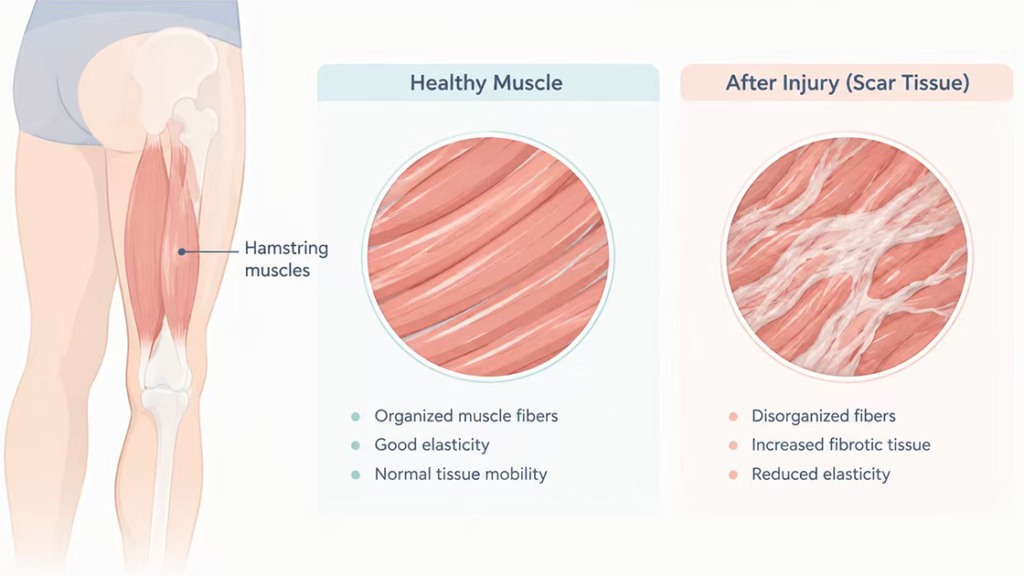
As healing progresses, collagen and other structural components help restore the injured area. The resulting tissue may not have exactly the same mechanical characteristics as the original muscle tissue, particularly after a more significant injury or when recovery is complicated by repeated strain.
1.2 When Healed Does Not Always Mean Fully Recovered
An athlete may be able to return to everyday activities while still experiencing stiffness or discomfort during higher-demand movements. Sprinting, kicking, jumping, or rapid changes of direction can place considerably greater demands on the hamstring than normal walking.
This difference between basic recovery and full functional recovery is important. Persistent tightness does not automatically mean that an injury is still actively damaged, but it may indicate that strength, tissue tolerance, mobility, or movement patterns still require attention.
2. What Role Can Scar Tissue Play in Hamstring Recovery?
2.1 Understanding Fibrotic Changes in Injured Muscle
Scar formation is part of normal tissue repair, but excessive or persistent fibrosis can alter the organization and mechanical behavior of soft tissue. Research on muscle injuries has identified scar tissue as one possible complication that may influence the recovery process.
These changes may contribute to localized stiffness or differences in tissue mobility. However, symptoms after a hamstring injury are not caused by scar tissue alone. Muscle weakness, altered loading, neural sensitivity, reduced conditioning, and movement strategies may also contribute.
2.2 Why Tissue Mobility Matters for Athletes
The hamstrings need to lengthen and contract repeatedly during running and other athletic movements. If the surrounding tissues do not tolerate these demands well, an athlete may experience discomfort or limitations when returning to higher-intensity activities.
For this reason, rehabilitation usually involves more than addressing the site of previous injury. Progressive strengthening, mobility work, neuromuscular control, and gradual exposure to sport-specific movements can help restore the capacity required for athletic performance.
3. How Does Shockwave Therapy Relate to Chronic Hamstring Scar Tissue?
3.1 Mechanical Stimulation and Soft-Tissue Response with Shockwave therapy
Shockwave Therapy delivers acoustic waves into targeted tissues. Rather than acting like a conventional massage or stretching technique, these mechanical waves create a controlled physical stimulus within the treatment area.
Research has explored several biological responses associated with shockwave therapy, including mechanotransduction, changes in local tissue signaling, circulation, and remodeling-related processes. These findings provide a basis for investigating shockwave therapy in chronic soft-tissue conditions, although the exact response can vary according to the tissue and treatment protocol.
3.2 What the Research Says About Muscle Injuries
A systematic review of extracorporeal shockwave therapy for muscle injuries found that ESWT has been investigated for different types of muscle injury, including conditions involving the hamstrings and other lower-extremity muscles. The review also noted potential effects involving microcirculation and tissue regeneration, while emphasizing that the available evidence remains heterogeneous.
This means Shockwave Therapy should not be presented as a guaranteed method for removing scar tissue. Instead, it may be considered an adjunctive modality within an individualized rehabilitation program when persistent soft-tissue symptoms are appropriate for this type of intervention.
4. When Might Shockwave Therapy Be Considered After a Hamstring Injury?
4.1 Persistent Tightness or Localized Discomfort
An athlete who continues to experience localized hamstring tightness or discomfort after the initial injury has healed may benefit from a more detailed assessment. The location, timing, movement pattern, strength, and response to loading can all provide useful information.
If symptoms appear to be associated with chronic soft-tissue changes, Shockwave Therapy may be considered as one part of conservative care. The decision should be based on the individual’s condition rather than simply the presence of a previous hamstring injury.
4.2 When Returning to Sport Requires More Than Pain Relief
Returning to sport involves more than reaching a point where everyday activities are comfortable. High-speed running, acceleration, deceleration, jumping, and sport-specific movements can place substantially greater demands on the hamstring.
A rehabilitation plan therefore needs to progressively rebuild strength and load tolerance. Shockwave Therapy may support the overall process, but it should not replace progressive exercise or sport-specific conditioning.
5. How Can Shockwave Therapy Fit Into a Broader Rehabilitation Plan?
5.1 Combining Shockwave Therapy With Progressive Loading
Exercise-based rehabilitation remains an important part of managing hamstring injuries. Progressive loading can help the muscle and tendon system gradually adapt to the forces required for running and athletic activity.
Research on proximal hamstring conditions suggests that multimodal approaches combining exercise and shockwave therapy may have a role in conservative management. The evidence is not strong enough to establish one universal protocol, but it supports considering shockwave therapy within a broader rehabilitation strategy rather than using it in isolation.
5.2 Addressing Strength, Mobility, and Movement Quality
Persistent symptoms after a hamstring injury may involve several factors at the same time. A rehabilitation program may therefore assess eccentric strength, hip and pelvic control, flexibility, running mechanics, and the athlete’s gradual return to higher-speed activities.
Shockwave Therapy can be positioned as an adjunct rather than the central component of recovery. The overall goal is to improve the tissue’s ability to tolerate normal and sport-specific loading while reducing factors that may contribute to recurrent symptoms.
5.3 Choosing Appropriate Shockwave therapy Parameters
Shockwave Therapy is not a single standardized treatment. Different devices and protocols can vary in terms of wave type, energy level, treatment frequency, number of sessions, and treatment location.
For chronic hamstring symptoms, treatment should be individualized according to the clinical assessment and the specific tissue involved. Applying higher intensity does not automatically mean better results, and treatment parameters should be selected by a qualified professional.
FAQ
Can Shockwave Therapy remove hamstring scar tissue?
Shockwave Therapy should not be described as simply “removing” scar tissue. Research suggests that mechanical stimulation from shockwaves may influence tissue signaling and remodeling processes, but the clinical response can vary.
For this reason, it is more appropriate to describe Shockwave Therapy as a potential supportive modality for selected chronic soft-tissue problems rather than a guaranteed method of eliminating fibrosis.
Can old hamstring injuries cause long-term tightness?
They can be associated with persistent tightness or discomfort, particularly when strength, tissue tolerance, mobility, or movement patterns have not fully recovered.
However, ongoing symptoms do not necessarily mean that scar tissue is the only cause. A professional assessment can help determine whether the symptoms are related to the previous injury or another underlying issue.
Is Shockwave Therapy enough to return an athlete to sports?
Usually, rehabilitation should involve more than a passive treatment modality. Returning to sport requires adequate strength, movement control, flexibility, and tolerance to progressively higher loads.
Shockwave Therapy may be incorporated as an adjunct, but progressive exercise and sport-specific conditioning remain important parts of a complete return-to-activity plan.
How long after a hamstring injury can Shockwave Therapy be considered?
There is no single timeline that applies to every injury. The appropriate timing depends on the type and severity of the original injury, the current tissue status, symptoms, and rehabilitation stage.
A qualified healthcare professional should determine whether shockwave therapy is appropriate at a particular point in recovery.
Conclusion
A hamstring injury can leave more than a memory of the original pain. Even after an athlete returns to normal activities, persistent tightness, localized discomfort, or reduced load tolerance may remain and affect higher-demand movements.
Scar tissue and fibrotic changes may be one factor, but they are only part of the larger recovery picture. Strength, mobility, neuromuscular control, and gradual exposure to sport-specific loading all remain important.
Shockwave Therapy may provide an additional non-invasive option for selected chronic soft-tissue problems. When appropriately assessed and combined with progressive rehabilitation, it may support a more comprehensive approach to managing persistent symptoms after a hamstring injury.
References
The Role of Extracorporeal Shock Wave Therapy in the Treatment of Muscle Injuries: A Systematic Review
https://pubmed.ncbi.nlm.nih.gov/37767244/
The Role of Extracorporeal Shock Wave Therapy in the Treatment of Muscle Injuries: A Systematic Review — Full Text
https://pmc.ncbi.nlm.nih.gov/articles/PMC10521343/
Proximal Hamstring Tendinopathy: A Systematic Review of Interventions
https://pubmed.ncbi.nlm.nih.gov/33842025/
Comparison of Conservative Interventions for Proximal Hamstring Tendinopathy: A Systematic Review and Recommendations for Rehabilitation
https://pubmed.ncbi.nlm.nih.gov/36976939/
Systematic Review on Working Mechanisms of Signaling Pathways in Fibrosis During Shockwave Therapy
https://pubmed.ncbi.nlm.nih.gov/39519292/