

Introduction
Hip pain when getting out of a car is a common problem that can make everyday activities surprisingly uncomfortable. Turning the body, moving the legs out of a low seat, and standing up all place demands on the hip joint, surrounding muscles, and tendons. The source of the discomfort may be related to the gluteal tendons, the soft tissues around the outer hip, or the hip joint itself. Understanding these differences helps explain why certain movements trigger pain and how targeted treatment approaches may help. For selected soft-tissue conditions, shockwave therapy offers a non-invasive option that can be incorporated into professional musculoskeletal treatment and rehabilitation programs.
1. Why Does Hip Pain Occur When Getting Out of a Car?
1.1 The Hip Is Under Pressure During the Exit Movement
Getting out of a car involves several coordinated movements rather than simply standing up. The hip remains flexed while sitting, and the body must rotate, move the legs, stabilize the pelvis, and transfer weight onto the feet during the exit. These movements engage the gluteal muscles, hip flexors, tendons, and other supporting structures.
When these tissues are irritated or the hip joint has limited mobility, the transition from sitting to standing may become uncomfortable. Low car seats, prolonged driving, and repeated twisting movements can make the problem more noticeable, particularly in people who already have hip stiffness or soft-tissue sensitivity.
1.2 Pain Location Can Offer Important Clues
The location of the pain can help identify the structures that may be involved.
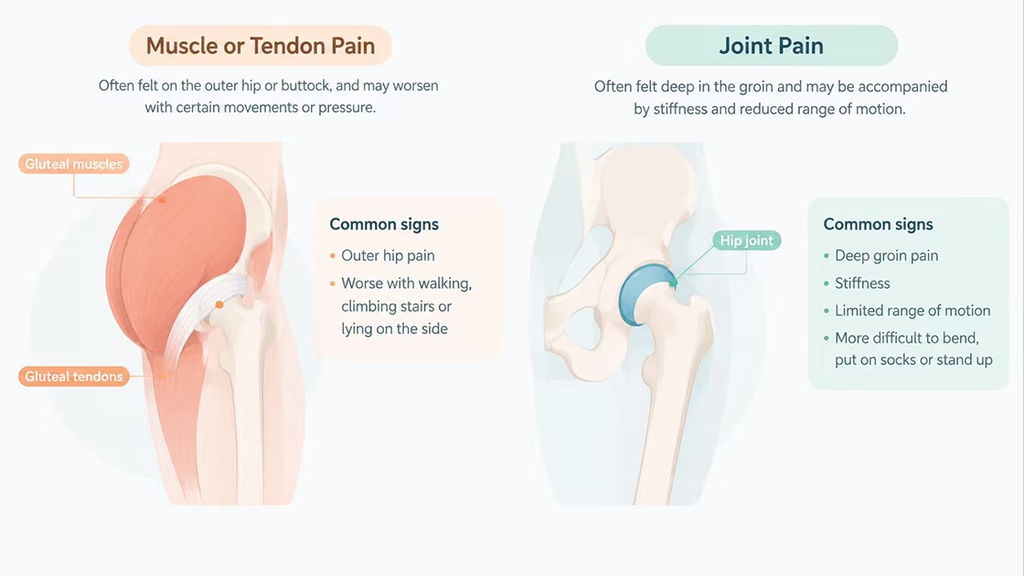
Pain on the outside of the hip may be associated with the gluteal tendons or greater trochanteric pain syndrome (GTPS). Discomfort deep in the groin is more commonly associated with the hip joint, including conditions such as osteoarthritis. Pain in the buttock may also involve surrounding muscles or structures in the lower back.
These patterns are useful starting points for understanding hip discomfort. A clinical assessment can help distinguish between overlapping causes and identify the tissues that should be addressed during treatment.
2. Muscle Pain vs. Hip Joint Pain: What Is the Difference?
2.1 Signs of Muscle and Tendon-Related Hip Pain
Muscle and tendon problems often cause localized discomfort that becomes more noticeable during specific movements or when pressure is applied to the affected area.
For example, gluteal tendinopathy can cause pain over the outer hip, especially when climbing stairs, standing on one leg, walking for extended periods, or lying on the affected side. Moving the leg out of a car may also place additional demand on the gluteal muscles and tendons, triggering discomfort.
Greater trochanteric pain syndrome is a common cause of lateral hip pain. It frequently involves the gluteus medius or gluteus minimus tendons and surrounding tissues near the greater trochanter. Identifying this pattern is particularly relevant when considering targeted soft-tissue treatment approaches.
2.2 Signs of Hip Joint Problems
Hip joint conditions, including osteoarthritis, may produce deep groin pain, stiffness, and reduced range of motion. People may notice difficulty putting on socks, bending to reach their feet, rotating the hip, or standing up from a low seat.
Unlike some localized tendon problems, joint-related discomfort may affect several everyday movements and gradually limit overall mobility. Symptoms can be especially noticeable after sitting for a prolonged period.
Because muscle, tendon, and joint conditions can produce similar symptoms, the location of the pain alone does not establish a diagnosis. Understanding the underlying condition helps guide the selection of appropriate treatment methods.
2.3 Why the Difference Matters for Treatment
The tissues involved in hip pain influence the treatment approach. Tendon-related conditions may require targeted loading exercises, soft-tissue rehabilitation, and strategies to improve hip stability. Joint conditions may require a broader approach focused on mobility, strength, and symptom management.
For healthcare professionals, distinguishing between these conditions also helps determine whether a treatment designed for musculoskeletal soft tissues is appropriate for the clinical presentation.
3. How Can Shockwave Therapy Help with Hip Soft-Tissue Pain?
3.1 Understanding Extracorporeal Shockwave Therapy
Extracorporeal shockwave therapy (ESWT) delivers acoustic energy to targeted tissues through an external applicator. It is used in musculoskeletal care for selected conditions involving tendons and other soft tissues.
The treatment is designed to deliver energy to a specific area without requiring an incision. Depending on the technology used, the acoustic energy can be distributed across a broader treatment region or concentrated within a more defined target area.
For hip-related applications, the treatment area may include the soft tissues around the greater trochanter or the gluteal tendon region when the clinical findings support this approach.
3.2 Targeting the Soft Tissues Around the Outer Hip with Shockwave Therapy
When pain during car exits is associated with gluteal tendinopathy or greater trochanteric pain syndrome, treatment may focus on the structures surrounding the outer hip.
Shockwave therapy delivers mechanical acoustic energy to the selected treatment area. This approach is intended to support the management of persistent soft-tissue pain and can be incorporated into a broader rehabilitation plan that includes progressive strengthening and movement retraining.
The location of the treatment is important. The outer hip contains several structures, including tendons and bony landmarks, so practitioners need to identify the relevant anatomical region before selecting the treatment area and device settings.
3.3 The Role of Professional Shockwave Therapy Equipment
Professional shockwave therapy equipment allows practitioners to deliver acoustic energy using defined treatment parameters. Adjustable settings can help clinicians tailor the treatment protocol to the target area, the condition being addressed, and the patient’s response.
Depending on the system, features may include adjustable energy output, selectable treatment frequencies, and applicators designed for different treatment areas. These capabilities support a more structured treatment process for musculoskeletal applications.
For clinics treating selected soft-tissue conditions around the hip, shockwave equipment can be incorporated into treatment programs alongside exercise-based rehabilitation and other appropriate interventions.
4. Radial vs. Focused Shockwave Therapy for Hip Applications
4.1 Radial Shockwave Therapy
Radial shockwave systems distribute acoustic energy outward from the applicator, creating a broader treatment pattern near the application site. This delivery approach may be useful when working with accessible soft-tissue regions, depending on the condition and treatment protocol.
For lateral hip applications, practitioners may consider radial systems when addressing suitable superficial soft-tissue areas around the gluteal region. Applicator selection, treatment technique, and energy settings influence how the treatment is delivered.
4.2 Focused Shockwave Therapy
Focused shockwave systems concentrate acoustic energy within a defined target region. This technology allows practitioners to direct energy toward selected tissue depths according to the device’s characteristics and treatment protocol.
In musculoskeletal practice, focused systems may be considered when a more localized treatment target is required. The appropriate depth and treatment parameters depend on the anatomical structures involved and the clinical objective.
4.3 Choosing the Right Shockwave Therapy for the Treatment Goal
Radial and focused shockwave systems differ in how they distribute acoustic energy. They should therefore be understood as distinct technologies rather than interchangeable versions of the same treatment method.
For professional clinics, selecting a system involves considering the intended applications, treatment areas, available applicators, parameter controls, and practitioner training. A clear understanding of the target anatomy helps connect the device’s technical capabilities with the needs of a specific treatment program.
5. Key Features of Shockwave Therapy Devices for Hip Treatment
5.1 Adjustable Energy Settings
Energy adjustment is an important feature of professional shockwave therapy equipment. Different anatomical regions and treatment goals may require different settings, making controlled parameter adjustment useful during clinical practice.
For hip-related soft-tissue applications, practitioners can select settings according to the device instructions, the targeted tissue, and patient tolerance. Appropriate adjustment helps support a consistent treatment protocol rather than relying on a single setting for every case.
5.2 Applicator Design and Treatment Accessibility
The applicator is the point of contact between the shockwave system and the treatment area. Its design can influence handling, positioning, and the delivery of acoustic energy.
Around the hip, treatment may involve areas with different contours and levels of soft-tissue coverage. An applicator that can be positioned accurately helps practitioners work with the intended treatment region and maintain a consistent technique.
5.3 Consistent Operation and Professional Training
A well-structured treatment process depends on more than the device’s technical specifications. Practitioners need to understand the system’s operating principles, parameter settings, applicator use, and maintenance requirements.
Professional training also helps ensure that treatment is delivered according to the intended protocol. For clinics integrating shockwave therapy into musculoskeletal services, equipment operation and clinical workflow should be considered together.
6. Combining Shockwave Therapy with Hip Rehabilitation
6.1 Supporting Gluteal Muscle Strength
The gluteal muscles play an important role in pelvic stability and hip movement. When tendon-related pain interferes with daily activities, rehabilitation programs often include progressive exercises to improve muscle strength and load tolerance.
Depending on the individual’s condition, exercises may include controlled hip abduction, supported single-leg activities, and other movements selected by a rehabilitation professional. Exercise intensity should progress according to functional ability and symptom response.
6.2 Improving Movement During Everyday Activities
Rehabilitation can also focus on the movements that trigger discomfort, including standing from a chair, climbing stairs, and getting out of a car.
For example, a person may benefit from practicing a controlled transition from sitting to standing, improving pelvic stability, and avoiding sudden twisting while the leg is still positioned inside the vehicle. These strategies can help reduce unnecessary strain during everyday movements.
6.3 Integrating Device-Based Treatment into a Structured Program
Shockwave therapy may be included as one component of a treatment program for selected tendon-related conditions. Its role is to complement the broader management strategy rather than replace exercise, movement modification, or other indicated care.
For healthcare providers, combining targeted device-based treatment with progressive rehabilitation offers a structured way to address soft-tissue symptoms while monitoring functional changes over time.
7. Practical Tips for Reducing Hip Discomfort When Getting Out of a Car
7.1 Adjust the Sitting Position
A low seat can increase the amount of hip movement required to stand up. When possible, adjusting the seat position before exiting may make the transition more comfortable.
Moving the body toward the edge of the seat and avoiding sudden twisting can also help reduce unnecessary stress on the hip and surrounding tissues.
7.2 Move Slowly and Avoid Sudden Rotation
Instead of quickly turning the pelvis while the legs remain inside the vehicle, try moving the legs and torso in a controlled sequence. Using the hands for support, when safe and practical, may also make standing easier.
If a particular movement consistently triggers pain, modifying that movement temporarily can help reduce irritation while the underlying condition is being addressed.
7.3 Maintain Appropriate Physical Activity
Avoiding all movement for extended periods may contribute to reduced strength and mobility. For many musculoskeletal conditions, maintaining appropriate activity and gradually rebuilding strength are important parts of rehabilitation.
The activity level should match the individual’s condition and tolerance. Persistent or worsening pain, substantial difficulty bearing weight, or severe symptoms after an injury warrant prompt medical assessment.
Frequently Asked Questions
Q1: Why does my hip hurt when I get out of a car?
Hip pain may result from gluteal tendon problems, soft-tissue irritation, or hip joint conditions. Pain location and movement patterns can help identify the cause.
Q2: Can shockwave therapy help with outer hip pain?
Shockwave therapy is used for selected conditions such as greater trochanteric pain syndrome and gluteal tendinopathy. Treatment depends on the diagnosis and clinical needs.
Q3: What is the difference between radial and focused shockwave therapy?
Radial shockwaves spread outward from the applicator, while focused shockwaves concentrate energy within a defined target area. Each has different treatment characteristics.
Q4: Can shockwave therapy replace hip strengthening exercises?
No. Strengthening exercises and activity management remain important parts of rehabilitation for many tendon-related conditions.
Q5: What should clinics consider when choosing a shockwave therapy device?
Key factors include the shockwave technology, adjustable settings, applicator options, intended applications, and staff training.
Conclusion
Hip pain when getting out of a car can originate from the gluteal tendons, the soft tissues around the outer hip, or the hip joint itself. Recognizing the differences between these sources helps practitioners identify the appropriate treatment direction. For selected soft-tissue conditions, shockwave therapy offers a non-invasive treatment approach that can be integrated into professional musculoskeletal care. With adjustable treatment parameters, application-specific technology, and appropriate rehabilitation strategies, shockwave therapy equipment can support structured treatment programs aimed at managing hip soft-tissue pain and improving everyday movement.
References
- National Health Service (NHS). Osteoarthritis: Symptoms.
https://www.nhs.uk/conditions/osteoarthritis/symptoms/ - Harding D, Cameron L, Monga A, Winter S. Is shockwave therapy effective in the management of greater trochanteric pain syndrome? A systematic review and meta-analysis. Musculoskeletal Care. 2024.
https://doi.org/10.1002/msc.1892 - Extracorporeal Shockwave Therapy for Greater Trochanteric Pain Syndrome: A Systematic Review with Meta-Analysis of Randomized Clinical Trials. The Journal of Bone and Joint Surgery Reviews.
https://doi.org/10.2106/JBJS.RVW.24.00091 - Rau C, et al. Extracorporeal Shockwave Therapy for Hip and Pelvic Tendinopathies: A Systematic Review.
https://doi.org/10.1177/15563316251332189 - National Institute for Health and Care Excellence (NICE). Extracorporeal shockwave therapy for refractory greater trochanteric pain syndrome.
https://www.nice.org.uk/guidance/htg248