

Introduction
Chronic lameness is one of the most persistent mobility challenges affecting horses across disciplines, from performance athletes to aging companion animals. Unlike acute injuries that respond quickly to rest, long-term lameness often develops gradually due to tendon strain, ligament stress, joint degeneration, or biomechanical imbalance. These conditions can reduce stride symmetry, limit athletic ability, and affect overall comfort. Extracorporeal shockwave therapy (ESWT) has become an increasingly valuable non-invasive veterinary treatment that supports tissue repair, improves circulation, and reduces inflammation in affected structures. Today, shockwave therapy plays an important role in modern equine rehabilitation programs designed to improve mobility and maintain long-term musculoskeletal health.
1. Understanding Chronic Lameness in Horses
Chronic lameness refers to persistent or recurring irregular movement caused by discomfort within the musculoskeletal system. It can affect horses of all ages and activity levels and often develops slowly over time rather than appearing suddenly.
1.1 What Defines Chronic Equine Lameness
Veterinarians typically classify lameness as chronic when movement abnormalities continue beyond several weeks or return repeatedly after initial improvement. These conditions may involve incomplete healing of connective tissues, long-term inflammation inside joints, or repetitive mechanical stress from training routines.
Because symptoms may appear subtle at first, early detection depends on careful gait evaluation and diagnostic assessment. Horses experiencing chronic lameness may show shortened stride length, uneven weight distribution, reduced willingness to move forward, or decreased flexibility during exercise.
1.2 Common Causes of Long-Term Lameness
Several musculoskeletal structures contribute to chronic lameness when exposed to repeated strain. Tendons and ligaments frequently develop micro-injuries that accumulate over time, especially in performance horses undergoing regular training.
Degenerative joint conditions also represent a major cause of persistent discomfort. As cartilage gradually changes with age or workload, surrounding soft tissues must compensate, increasing strain across the limb. Hoof imbalance and spinal tension may further alter movement patterns and contribute to secondary lameness issues.
1.3 Why Early Supportive Therapy Improves Outcomes
When lameness persists without intervention, horses often redistribute weight away from the affected limb. This compensation increases stress on surrounding structures and may lead to additional injuries.
Supportive therapies such as extracorporeal shockwave treatment help stimulate circulation and tissue repair before long-term biomechanical adaptations develop. Early therapeutic support improves comfort while encouraging healthier movement patterns during recovery.
2. How Shockwave Therapy Works in Equine Rehabilitation
Extracorporeal shockwave therapy delivers controlled acoustic pressure waves into targeted tissues, triggering biological responses that promote healing in damaged musculoskeletal structures.
2.1 The Science Behind Acoustic Wave Stimulation
Shockwave therapy works by transmitting mechanical pulses through soft tissue layers toward deeper connective structures. These pulses activate cellular responses that increase metabolic activity and stimulate repair processes inside injured areas.
One of the most important responses involves activation of fibroblasts responsible for collagen production. Because collagen forms the structural foundation of tendons and ligaments, improving collagen synthesis supports restoration of tissue strength and elasticity in horses affected by chronic lameness.
2.2 Improving Circulation in Damaged Tissues
Chronic injuries often involve reduced blood flow, which slows healing and prolongs discomfort. Shockwave therapy stimulates microcirculation and promotes formation of new blood vessels in treated regions.
Improved circulation enhances oxygen delivery and nutrient transport, allowing tissues to recover more efficiently while reducing the persistence of inflammatory processes that contribute to long-term lameness.
2.3 Supporting Neuromuscular Comfort During Recovery
Shockwave therapy also influences nerve signaling pathways associated with discomfort perception. By temporarily reducing sensitivity in treated areas, the therapy allows horses to move more comfortably while healing continues.
Improved movement comfort helps prevent compensatory posture changes that might otherwise place additional strain on surrounding joints and muscles.
3. Conditions Commonly Associated with Chronic Lameness in Horses
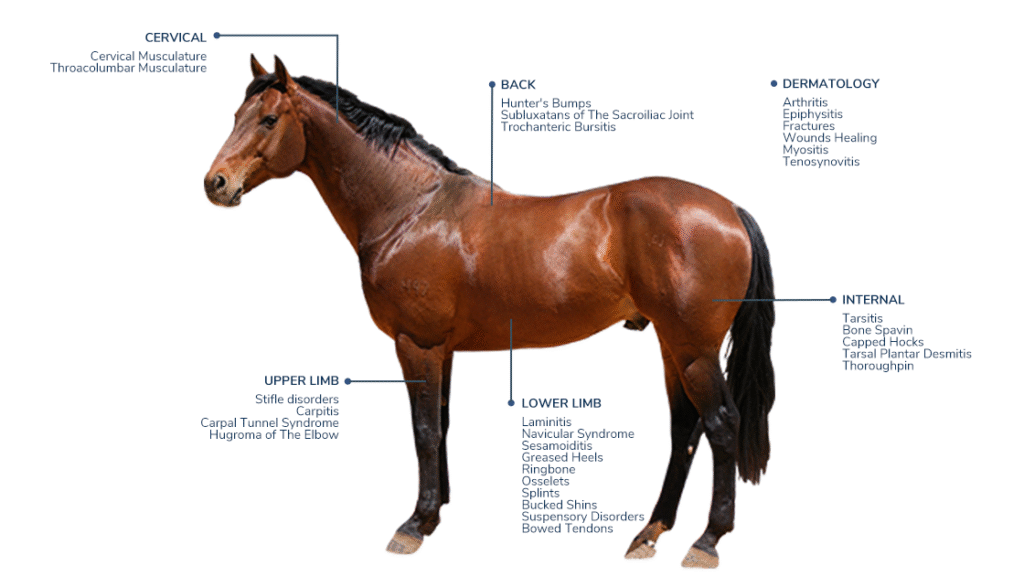
Shockwave therapy is widely used to support recovery across several musculoskeletal conditions frequently responsible for persistent lameness.
3.1 Tendon and Ligament Injuries
Suspensory ligament strain and flexor tendon injuries represent some of the most common causes of long-term mobility issues in performance horses. These structures carry substantial mechanical load during locomotion and are particularly vulnerable to repetitive stress.
Shockwave therapy stimulates collagen remodeling within these tissues and improves circulation around injured fibers, supporting gradual structural recovery.
3.2 Degenerative Joint Conditions
Conditions such as hock arthritis and coffin joint inflammation often contribute to reduced stride efficiency and stiffness. Degenerative joint changes can gradually alter limb biomechanics and lead to recurring movement irregularities.
Shockwave therapy helps reduce inflammatory activity surrounding joints while supporting soft-tissue adaptation that improves functional movement.
3.3 Navicular-Related Heel Pain
Navicular syndrome remains one of the most recognized causes of chronic forelimb lameness. Because this condition affects deep hoof structures responsible for weight distribution, treatment approaches must support circulation inside the hoof capsule.
Shockwave therapy enhances vascular activity in affected regions, supporting tissue recovery alongside corrective farriery programs.
3.4 Thoracolumbar and Pelvic Discomfort
Back-related discomfort can alter posture and influence movement symmetry across the entire body. Reduced spinal flexibility often leads to secondary limb loading patterns that appear as lameness.
Shockwave therapy improves circulation within paraspinal muscles and helps restore functional mobility along the thoracolumbar region.
4. Benefits of Shockwave Therapy for Long-Term Equine Mobility
Shockwave therapy provides several advantages that make it particularly effective in managing chronic equine lameness.
4.1 A Non-Invasive Treatment Option
Unlike surgical procedures, shockwave therapy supports healing without requiring incisions or extended recovery periods. Treatments are performed quickly under veterinary supervision and can be repeated as needed within structured rehabilitation programs.
This makes shockwave therapy especially valuable for managing conditions requiring ongoing support.
4.2 Targeted Tissue Stimulation
Shockwave therapy delivers focused mechanical energy directly to affected tissues. This localized stimulation promotes healing where it is needed most without influencing unrelated areas of the body.
Targeted therapy improves treatment efficiency and supports predictable rehabilitation progress.
4.3 Enhancement of Tissue Oxygenation
Improved microvascular circulation remains one of the most important therapeutic effects of shockwave treatment. Increased oxygen availability supports cellular metabolism and encourages repair of connective tissues under chronic stress.
This process contributes to improved resilience within tendons, ligaments, and surrounding muscular structures.
4.4 Supporting Performance Longevity
Maintaining musculoskeletal health plays a critical role in preserving athletic performance across training cycles. Shockwave therapy helps reduce long-term strain accumulation while supporting natural recovery processes inside heavily loaded structures.
As a result, horses may maintain mobility comfort for longer periods throughout their working careers.
5. Integrating Shockwave Therapy into Equine Rehabilitation Programs
Shockwave therapy delivers the greatest benefits when incorporated into a structured veterinary rehabilitation strategy tailored to each horse’s condition.
5.1 Veterinary Evaluation Before Treatment
A complete musculoskeletal assessment helps determine the origin of lameness and confirm whether shockwave therapy is appropriate. Diagnostic imaging tools such as ultrasound and radiography often guide treatment planning.
Personalized protocols improve both safety and effectiveness.
5.2 Monitoring Progress Throughout Treatment
Shockwave therapy sessions are typically spaced over several weeks depending on the severity and location of the condition. Veterinarians monitor gait symmetry and movement comfort to evaluate treatment response.
Gradual improvement in stride consistency often indicates successful rehabilitation progress.
5.3 Combining Shockwave Therapy with Supportive Management Strategies
Shockwave therapy works most effectively alongside corrective trimming, conditioning adjustments, physiotherapy exercises, and controlled turnout programs.
Coordinated care between veterinarians, trainers, and farriers supports long-term musculoskeletal balance and helps maintain mobility improvements after treatment.
FAQ
Q1: Is shockwave therapy commonly used for chronic lameness in horses?
Yes. It is widely included in veterinary rehabilitation programs supporting tendon, ligament, joint, and back-related conditions.
Q2: How quickly can horses respond to treatment?
Comfort improvements may appear within days, while structural tissue recovery develops gradually across multiple sessions.
Q3: Can performance horses receive shockwave therapy?
Yes. It is frequently used to support mobility in horses involved in regular training activities.
Q4: Does shockwave therapy replace corrective hoof care?
No. It works best alongside professional farriery programs.
Q5: Can older horses benefit from shockwave therapy?
Yes. Aging horses often respond positively due to improved circulation and reduced inflammatory stress.
Conclusion
Chronic lameness represents a complex challenge in equine health management, especially when connective tissue strain, joint degeneration, or biomechanical imbalance persists over time. Shockwave therapy provides a modern, non-invasive approach that stimulates tissue repair, improves circulation, and supports movement comfort across a wide range of musculoskeletal conditions. When integrated into comprehensive veterinary rehabilitation programs, this therapy contributes to improved stride quality, enhanced structural resilience, and long-term mobility support for horses at every stage of activity.
References
1. McClure SR, Van Sickle D, White MR.
Effects of extracorporeal shock wave therapy on the limb of horses.
American Journal of Veterinary Research.
https://pubmed.ncbi.nlm.nih.gov/14672463/
2. Imboden I, Waldern NM, Wiestner T, et al.
Short-term analgesic effects of extracorporeal shock wave therapy in horses with proximal suspensory ligament pain.
The Veterinary Journal.
https://pubmed.ncbi.nlm.nih.gov/18069025/
3. Seabaugh KA, Thoresen M, Giguère S.
Extracorporeal shockwave therapy increases growth factor release from equine platelet-rich plasma in vitro.
Frontiers in Veterinary Science.
https://www.frontiersin.org/articles/10.3389/fvets.2017.00205/full
4. Khairoun A, Hawkins JF, Moore GE, et al.
Electrohydraulic shockwave therapy for superficial digital flexor tendinitis and proximal suspensory desmitis in horses.
Journal of Equine Veterinary Science.
https://pubmed.ncbi.nlm.nih.gov/37120117/
5. MacKay AV, McOnie RC, Riddell LP, Robinson KA.
Characterization of the use of shock wave therapy among equine veterinarians.
Canadian Veterinary Journal.
https://www.ncbi.nlm.nih.gov/pmc/articles/PMC7424940/