

Introduction
Rock climbing places repeated demands on the forearm muscles, tendons, and elbow joint. Frequent gripping, pulling, and holding body weight on small handholds can increase stress on the inner elbow, sometimes contributing to medial epicondylitis, commonly known as golfer’s elbow. Persistent discomfort may affect grip strength, training consistency, and everyday activities. Understanding the anatomy of the common flexor tendon, the factors associated with ongoing pain, and the differences between available physical modalities can help climbers better understand this condition. Extracorporeal shockwave therapy (ESWT) and laser therapy are used in some musculoskeletal care settings to help manage selected pain conditions, although their effectiveness varies by diagnosis and individual circumstances.
1. Understanding Medial Epicondylitis in Rock Climbers
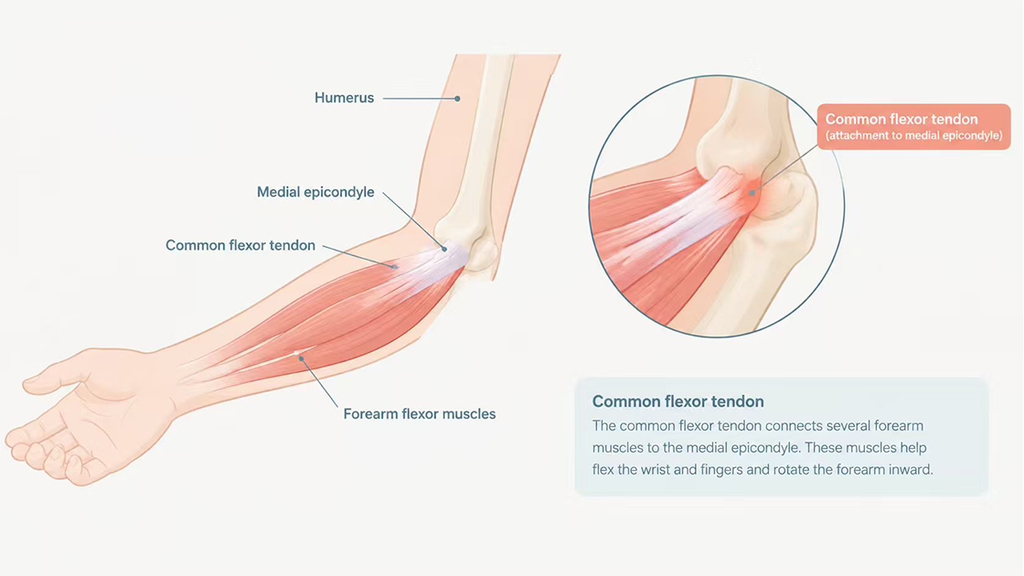
Medial epicondylitis affects the tendons attached to the medial epicondyle, the bony prominence on the inner side of the elbow. Repeated gripping and forearm muscle activation during climbing can increase stress on this area, particularly when training demands exceed the tissue’s ability to adapt.
1.1 What Is the Common Flexor Tendon?
The common flexor tendon connects several forearm muscles to the medial epicondyle of the humerus. These muscles help flex the wrist and fingers and rotate the forearm inward. During climbing, they contribute to grip control and wrist stability. Repetitive loading can lead to tendon-related pain and changes in collagen organization. Although the condition is often called golfer’s elbow, it can also affect people whose activities involve frequent or forceful gripping.
1.2 How Climbing Mechanics Affect the Elbow
Crimp grips, sustained holds, steep routes, and repeated pulling movements can increase forearm muscle activity and tendon loading. High training volume and limited recovery may add to this demand. However, no single climbing technique automatically causes medial epicondylitis. Individual strength, movement patterns, training history, and tissue capacity all influence how the elbow responds to repeated stress.
1.3 Why Symptoms May Persist
Elbow discomfort may continue when repeated loading exceeds the tendon’s current capacity. Returning to demanding climbs before the area can tolerate the required forces may also contribute to recurring symptoms. Other factors, such as reduced forearm strength, changes in wrist movement, or an incorrect initial diagnosis, may complicate recovery. Persistent pain therefore deserves a broader assessment rather than an assumption that the tendon simply needs more rest.
2. Recognizing the Signs of Golfer’s Elbow
Recognizing common symptoms can help climbers understand when the inner elbow may be involved. However, symptoms alone cannot confirm medial epicondylitis because several musculoskeletal and nerve conditions can produce similar discomfort.
2.1 Common Symptoms
Typical symptoms include tenderness near the inner elbow, pain during forceful gripping, and discomfort when bending the wrist against resistance. Some climbers also notice reduced grip tolerance or soreness after training. Symptoms may develop gradually and become more noticeable during lifting, carrying, or other activities that require forearm effort.
2.2 Conditions That Can Cause Similar Pain
Ulnar neuropathy may cause tingling or numbness in the ring and little fingers, while ulnar collateral ligament injuries can produce pain during particular loading movements. Joint irritation, muscle strain, and referred pain from the neck may also resemble medial epicondylitis. A clinical assessment can help distinguish these conditions and determine whether further investigation is necessary.
2.3 When to Seek Professional Assessment
Persistent or worsening pain, reduced hand function, ongoing numbness, or significant weakness warrants professional evaluation. Sudden severe pain, substantial swelling, or symptoms following a major injury also require prompt attention. Accurate diagnosis is important because treatment intended for tendon-related pain may not address nerve irritation, ligament injury, or another underlying condition.
3. How Shockwave Therapy Relates to Medial Elbow Pain
Extracorporeal shockwave therapy is a non-invasive modality used in some musculoskeletal settings, including selected cases of chronic tendinopathy. Its potential role in medial epicondylitis depends on the diagnosis, symptom duration, and available clinical evidence.
3.1 What Is Extracorporeal Shockwave Therapy?
ESWT delivers acoustic pressure waves through an applicator to a targeted area. Researchers have explored how these stimuli may influence pain signaling and local tissue responses. However, proposed biological mechanisms do not guarantee symptom improvement or tendon repair. Clinicians consider shockwave therapy as one possible component of care rather than a stand-alone solution for every case of persistent elbow pain.
3.2 What Does the Research Say?
Research specifically addressing shockwave therapy for medial epicondylitis remains limited, especially for rock climbers. A study by Lee and colleagues examined treatment in newly diagnosed lateral and medial epicondylitis, while systematic reviews of lateral elbow tendinopathy have reported mixed findings. Because the affected tendons and loading patterns differ, results from tennis elbow cannot automatically establish effectiveness for golfer’s elbow. Shockwave therapy may help some individuals manage symptoms, but outcomes vary.
3.3 Focused Shockwave Therapy vs. Radial Pressure Wave Therapy
Focused shockwave therapy concentrates acoustic energy within a selected region, whereas radial pressure wave therapy distributes pressure from the applicator into surrounding tissue. These differences may influence clinical selection, but neither modality is universally superior for medial epicondylitis. The appropriate option depends on the clinical assessment, the suspected tissue involved, the available equipment, and practitioner expertise.
4. Laser Therapy and Other Considerations for Persistent Elbow Pain
Shockwave therapy is not the only physical modality used in musculoskeletal care. Laser therapy and other conservative approaches have also attracted attention, but each has distinct characteristics and limitations.
4.1 Understanding Laser Therapy
Laser therapy delivers light energy to tissue, unlike the acoustic pressure waves used in shockwave therapy. Low-level laser therapy, also called photobiomodulation, aims to influence cellular signaling through specific wavelengths and energy doses. High-intensity laser therapy uses different output levels and protocols. Research findings vary by condition and treatment parameters, so evidence for lateral epicondylitis should not automatically be applied to medial epicondylitis in climbers.
4.2 How Shockwave and Laser Therapy Differ
Shockwave therapy uses acoustic energy, while laser therapy uses light energy. Their physical properties, proposed mechanisms, and treatment protocols differ, so they are not interchangeable. Neither approach guarantees relief or resolves every cause of tendon pain. A qualified healthcare professional can assess whether either modality is appropriate based on the diagnosis, symptoms, and overall clinical picture.
4.3 Why Functional Progress Matters
Pain reduction does not necessarily mean that a tendon has regained its previous capacity to tolerate force. Clinicians may also consider grip tolerance, wrist strength, movement, and the effect of symptoms on daily activities. Looking at these factors over time provides a broader understanding of progress than relying solely on how the elbow feels immediately after a treatment session.
5. Understanding Long-Term Elbow Health in Climbers
Persistent elbow pain can interfere with climbing, but symptom intensity alone does not explain the condition’s full impact. Considering function, activity demands, and the individual’s clinical findings can provide a more complete picture.
5.1 Pain Relief Does Not Always Mean Full Recovery
A climber may experience less discomfort while still having difficulty with sustained gripping or repeated high-force movements. Conversely, mild residual pain does not always indicate that function has failed to improve. Clinicians may therefore assess symptoms alongside strength, movement tolerance, and everyday function when evaluating changes over time.
5.2 The Value of an Individualized Assessment
Climbers differ in training history, physical capacity, and the factors contributing to elbow pain. A clinical assessment helps identify the likely source of symptoms and determine whether shockwave therapy, laser therapy, or another approach may be appropriate. This individualized perspective also helps avoid treating nerve, ligament, or joint conditions as though they were uncomplicated tendon problems.
Frequently Asked Questions
Can shockwave therapy help medial epicondylitis in climbers?
It may help manage symptoms in selected cases, but evidence specific to climbers remains limited, and results vary.
Is medial epicondylitis the same as tennis elbow?
No. Medial epicondylitis affects the inner elbow, while tennis elbow generally affects tendons on the outer side.
Is shockwave therapy the same as laser therapy?
No. Shockwave therapy uses acoustic pressure waves, while laser therapy uses light energy.
Does persistent inner elbow pain always indicate tendon damage?
No. Nerve irritation, ligament injury, and joint conditions can cause similar symptoms. A clinical assessment can help identify the likely cause.
Does reduced pain mean the tendon has fully recovered?
Not necessarily. Clinicians may also assess strength, function, and tolerance of relevant activities.
Conclusion
Medial epicondylitis can cause persistent inner elbow pain in rock climbers because gripping and forearm stabilization place repeated demands on the common flexor tendon. Understanding the condition and distinguishing it from other causes of elbow pain are important steps toward appropriate care. Shockwave therapy and laser therapy may help manage symptoms in selected circumstances, but evidence for medial epicondylitis in climbers remains limited, and neither modality guarantees tendon healing or a complete return to climbing. An individualized clinical assessment and attention to functional changes can help determine the most appropriate approach to ongoing discomfort.
References
- Lee et al. “Effectiveness of Initial Extracorporeal Shock Wave Therapy on the Newly Diagnosed Lateral or Medial Epicondylitis.” Annals of Rehabilitation Medicine (2012).https://doi.org/10.5535/arm.2012.36.5.681
- StatPearls. “Medial Epicondylitis (Golfer’s Elbow).”https://www.ncbi.nlm.nih.gov/books/NBK519000/
- Karanasios et al. “Clinical Effectiveness of Shockwave Therapy in Lateral Elbow Tendinopathy: Systematic Review and Meta-analysis.” Clinical Rehabilitation (2021).https://doi.org/10.1177/02692155211006860
- Bisset and colleagues / OPTIMa Collaboration. “Are Passive Physical Modalities Effective for the Management of Common Soft Tissue Injuries of the Elbow? A Systematic Review.”https://pubmed.ncbi.nlm.nih.gov/27022675/
- Shockwave Therapy Systems and Equipment.https://www.shockwavemachines.com/