

Introduction
Running is one of the most popular forms of exercise in the U.S., providing cardiovascular benefits, stronger bones, and improved mental health. However, repetitive impact and high training volumes often lead to overuse injuries, which can impair performance, limit daily activities, and in severe cases, require medical intervention. Traditional treatments such as rest, NSAIDs, ice, and physical therapy may relieve symptoms but often fail to repair underlying soft tissue or tendon damage. Extracorporeal shockwave therapy (ESWT) offers a non-invasive, evidence-based solution that stimulates tissue repair, reduces inflammation, and helps athletes return to training safely and efficiently.
1. Common Overuse Injuries in Runners
Runners are prone to overuse injuries due to repetitive mechanical stress on muscles, tendons, and bones. Understanding these conditions is essential for effective treatment selection.
1.1 Achilles Tendon Pain
Achilles tendinopathy is characterized by pain, swelling, and impaired function in the posterior lower leg. It commonly results from repetitive loading during running, especially in high-mileage training or rapid intensity increases. Microtears and disorganized collagen within the tendon contribute to chronic pain, limited dorsiflexion, and reduced propulsion during running. Untreated, Achilles tendon injuries may progress to partial or complete rupture, severely impacting athletic performance. Effective management requires targeted interventions that promote tendon healing at the cellular level.
1.2 Plantar Heel Overload
Plantar fasciopathy, often called plantar fasciitis, is another frequent overuse injury among runners. Chronic stress on the plantar fascia can lead to inflammation at its insertion on the calcaneus, resulting in heel pain, stiffness, and discomfort upon first steps in the morning. High-impact training and inappropriate footwear increase susceptibility. Shockwave therapy has been shown to reduce fascia thickness, stimulate collagen production, and enhance local blood flow, providing both symptomatic relief and long-term tissue repair.
1.3 Shin Splints (Medial Tibial Stress Syndrome)
Shin splints involve pain along the medial tibia due to repetitive stress on the tibial periosteum and adjacent musculature. Contributing factors include overtraining, poor footwear, or biomechanical abnormalities such as overpronation. ESWT promotes neovascularization and reduces localized inflammation, facilitating recovery while allowing runners to maintain modified training and prevent further injury.
2. Why Traditional Treatments Often Fall Short for Runners
Although rest and NSAIDs are frequently used, these approaches address symptoms rather than underlying tissue pathology.
2.1 Rest-Only Approaches vs. Tissue Repair
Extended rest may reduce pain temporarily but does not restore collagen structure or vascularization within tendons. Athletes often experience re-injury upon return to activity. In contrast, ESWT stimulates intrinsic tissue healing, allowing recovery without complete cessation of training.
2.2 Limitations of NSAIDs and Ice Therapy
NSAIDs reduce pain and inflammation but may impair tendon healing by inhibiting prostaglandin-mediated collagen synthesis. Ice therapy provides temporary relief but does not enhance cellular repair or address chronic microtrauma. Shockwave therapy directly stimulates fibroblast activity, improving tissue regeneration and structural integrity.
2.3 Challenges with Corticosteroid Injections
Corticosteroid injections offer short-term pain relief but carry risks such as tendon degeneration and delayed healing. Many runners seek non-pharmacological alternatives. Shockwave therapy effectively targets the underlying tissue pathology while minimizing systemic side effects.
3. How Shockwave Therapy Works for Running Injuries
Shockwave therapy delivers high-energy acoustic waves to affected tissues, producing mechanical stimulation that triggers biological repair mechanisms.
https://www.shockwavemachines.com/indications
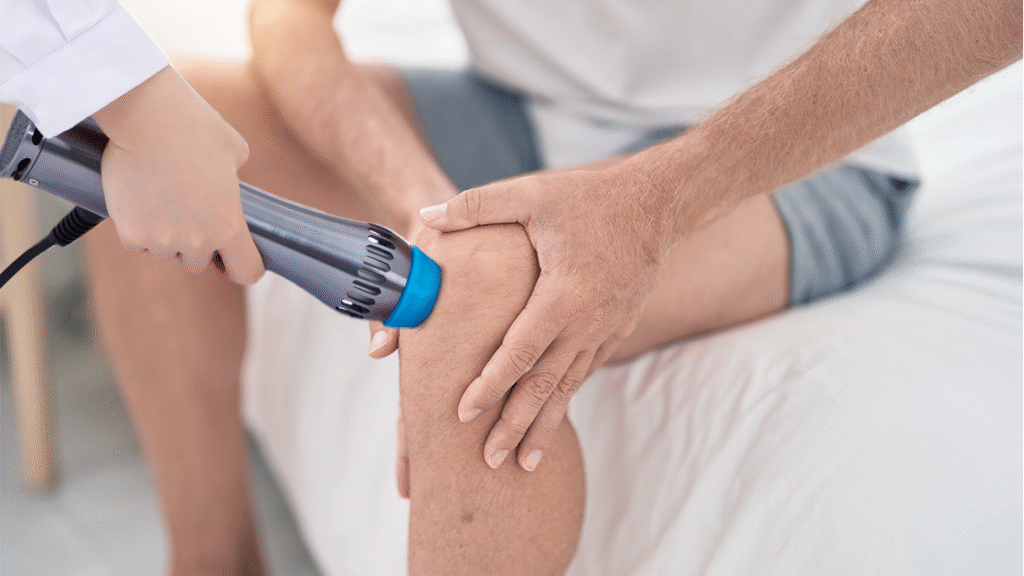
3.1 Mechanism of Action
ESWT generates shockwaves that penetrate deep into tendons, fascia, and muscle tissue. The mechanical energy induces controlled microtrauma, stimulating growth factor release, promoting angiogenesis, and enhancing collagen remodeling. This photomechanical effect accelerates tissue repair and modulates nociceptive signaling, reducing pain intensity and improving function.
3.2 Biophysical Effects on Tendons and Fascia
By increasing local microcirculation, ESWT improves nutrient delivery and metabolic activity in the tendon matrix. Collagen fibers realign along tensile stress lines, enhancing structural integrity and load-bearing capacity. The therapy also modulates inflammatory mediators, decreasing chronic swelling and stiffness, which supports long-term recovery.
3.3 Advantages Over Traditional Physical Therapy
While physical therapy emphasizes strength, flexibility, and gait correction, ESWT accelerates intrinsic tissue healing at the cellular level. Combining ESWT with rehabilitation optimizes outcomes, reduces downtime, and allows runners to return to activity safely and efficiently.
4. Key Benefits of Shockwave Therapy for Runners
4.1 Non-Invasive and Drug-Free
Shockwave therapy does not require incisions, anesthesia, or systemic medication. This non-invasive approach avoids surgical risks and reduces dependency on pharmacological interventions.
4.2 Minimal Downtime and Active Recovery
Athletes can continue low-intensity training during treatment, maintaining cardiovascular conditioning and muscular endurance. ESWT accelerates tissue repair, supporting a progressive return to full activity.
4.3 Targeting the Root Cause
Unlike analgesic therapies, ESWT addresses structural and biochemical tendon pathology, promoting sustainable recovery and reducing recurrence risk.
4.4 Synergy with Physical Therapy
Integrating ESWT with targeted stretching, strengthening, and biomechanical correction enhances overall rehabilitation. Runners gain improved tissue resilience, optimal gait mechanics, and reduced risk of future injuries.
5. Frequently Asked Questions (FAQ)
Is Shockwave Therapy Painful?
Most patients report mild discomfort, described as tapping or tingling. Intensity can be adjusted.
How Long Do Results Last?
Clinical outcomes are generally maintained for several months, especially with ongoing rehabilitation and proper training management.
Can Shockwave Therapy Prevent Future Injuries?
While ESWT improves tissue repair and resilience, long-term prevention also depends on training load management, strength, and flexibility programs.
Can I Continue Running During Therapy?
Yes, but activity modification is advised. Avoid high-impact intervals, reduce mileage, and incorporate cross-training.
Is Shockwave Therapy Safe for Competitive Athletes?
Yes. ESWT is non-invasive, drug-free, and generally permitted under anti-doping regulations.
Conclusion
Shockwave therapy offers runners an effective, non-invasive solution for managing overuse injuries. By promoting tendon and soft tissue repair, improving local circulation, and alleviating pain, ESWT allows athletes to continue training with minimal downtime. When combined with targeted rehabilitation, it accelerates recovery and enhances long-term musculoskeletal health. For runners experiencing chronic or recurrent injuries, consulting a qualified clinician regarding ESWT may provide a path to sustainable, pain-free performance.
References
Chow RT, Johnson MI, Lopes-Martins RA, Bjordal JM. The Efficacy of Low-Level Laser Therapy in Musculoskeletal Pain Management. Pain Res Manag.
https://pubmed.ncbi.nlm.nih.gov/17391052/
Bjordal JM, et al. A systematic review of low level laser therapy in lateral elbow tendinopathy. BMC Musculoskelet Disord.
https://pubmed.ncbi.nlm.nih.gov/12437761/
Hamblin MR. Mechanisms and applications of the anti-inflammatory effects of photobiomodulation. AIMS Biophys.
https://pubmed.ncbi.nlm.nih.gov/31715242/
Rompe JD, et al. Shockwave Therapy for Chronic Achilles Tendinopathy. N Engl J Med.
https://pubmed.ncbi.nlm.nih.gov/23845162/
Gerdesmeyer L, et al. Extracorporeal Shock Wave Therapy for Plantar Fasciitis. J Bone Joint Surg Am.
https://pubmed.ncbi.nlm.nih.gov/17391052/
Furia JP. High-energy shock-wave therapy for chronic patellar tendinopathy. Am J Sports Med.
https://pubmed.ncbi.nlm.nih.gov/21288684/
Lohrer H, et al. Extracorporeal shock wave therapy for chronic gluteal tendinopathy. Br J Sports Med.