

Introduction
Show jumping places considerable stress on a horse’s fetlock joints during takeoff, landing, and rapid changes in direction. Repeated loading can contribute to joint inflammation, ligament injuries, and other orthopedic problems that affect movement and performance. Shockwave therapy is one treatment option veterinarians may consider for selected musculoskeletal conditions. When combined with an accurate diagnosis and a structured rehabilitation plan, it may help support recovery in appropriate cases. This article explores fetlock-related problems in show jumping horses, the potential role of shockwave therapy, and how professional equipment such as the SWAVE-200 can be considered in equine orthopedic care.
1. Understanding Fetlock Joint Problems in Show Jumping Horses
1.1 Why the Fetlock Joint Matters
The fetlock is a key structure in the horse’s lower limb, helping absorb and distribute forces during movement. In show jumping, the joint experiences repeated loading as the horse pushes off, clears obstacles, and lands. These demands make fetlock health especially important for maintaining soundness and athletic performance. When pain or structural damage develops, a horse may show reduced stride length, uneven landings, or reluctance to perform at its usual level.
1.2 Common Conditions Affecting the Fetlock
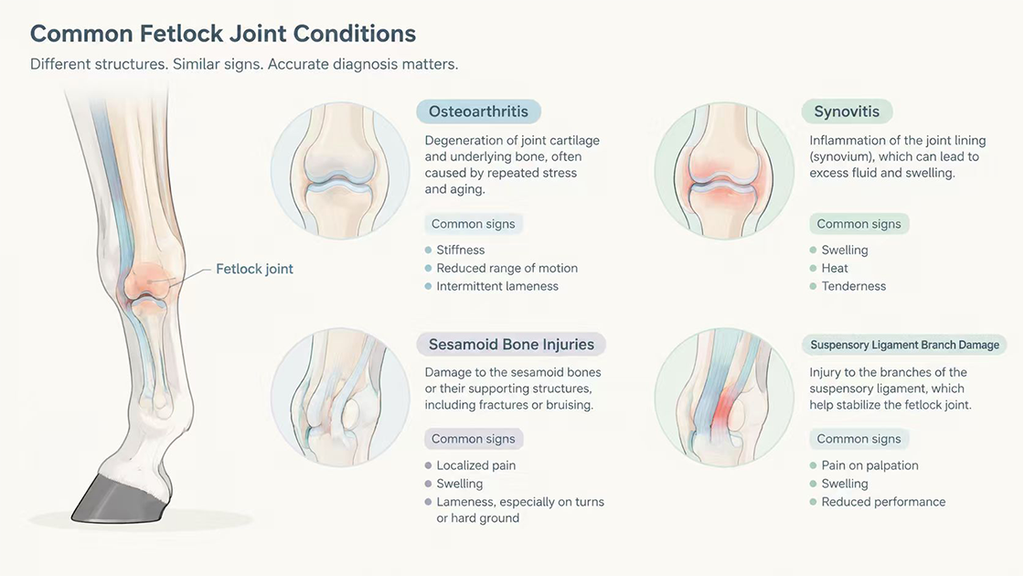
Fetlock-related problems may include osteoarthritis, synovitis, sesamoid bone injuries, and damage to the branches of the suspensory ligament. Symptoms can include swelling, heat, tenderness, or lameness, although some injuries initially produce subtle changes. Because different conditions can cause similar signs, a veterinary examination is essential before selecting a treatment. The underlying diagnosis determines whether shockwave therapy may be appropriate or whether another intervention is needed.
2. What Is Shockwave Therapy for Horses?
2.1 Understanding Extracorporeal Shockwave Therapy
Extracorporeal shockwave therapy (ESWT) delivers acoustic pressure waves to selected tissues through a treatment applicator. In veterinary medicine, it has been investigated for various musculoskeletal conditions involving tendons, ligaments, bones, and joints. Researchers have explored its effects on local tissue responses and pain perception, but the evidence differs among conditions. For this reason, treatment protocols should be based on the horse’s diagnosis and current veterinary guidance rather than a general assumption that shockwave therapy benefits every orthopedic injury.
2.2 Its Potential Role in Fetlock Rehabilitation
For selected soft-tissue or orthopedic conditions around the fetlock, a veterinarian may consider shockwave therapy as an adjunct to conventional treatment. Its potential role depends on the injured structure, the severity of the problem, and the available clinical evidence. Shockwave therapy should not be viewed as a universal solution for joint disease or serious structural damage. It also does not replace rest, appropriate medication, or surgery when these are clinically indicated.
3. Assessing a Horse Before Treatment
3.1 Establish an Accurate Diagnosis
A proper assessment helps identify the source of pain and determine whether shockwave therapy is suitable. Veterinarians may evaluate the horse at different gaits, examine the affected limb, and use diagnostic imaging when needed. Radiographs can help identify bone changes or fractures, while ultrasonography may be useful for assessing accessible soft-tissue structures, including parts of the suspensory ligament. These findings guide treatment selection and help avoid using an adjunctive therapy when a different approach is required.
3.2 Consider Injury Severity and Competition Demands
The horse’s training schedule should not take priority over injury management. A mild soft-tissue problem and a significant joint or bone injury may require very different rehabilitation strategies. Veterinarians should consider the duration of symptoms, previous injuries, imaging findings, and the horse’s response to initial care. For competitive show jumpers, planning recovery around the actual healing process helps reduce the risk of returning to demanding exercise too soon.
4. Choosing Shockwave Equipment for Equine Orthopedic Care
4.1 Review Energy and Frequency Settings
The SWAVE-200 electromagnetic shockwave therapy machine is listed with an energy range of 30–210 mJ, pressure settings of 1–6 BAR, and a frequency range of 1–16 Hz. It also provides continuous and multiple operating modes. These specifications offer clinicians different equipment settings to consider when planning treatment. However, higher energy or frequency does not automatically produce better outcomes. The appropriate parameters depend on the intended treatment target, the device instructions, and the veterinarian’s training and clinical judgment.
4.2 Consider Applicators and Treatment Targets
Applicator selection is another important consideration in equine practice. Fetlock-related pain may originate from the joint, a ligament attachment, or nearby soft tissue, and these structures require careful assessment before treatment. Clinicians should confirm that the selected applicator is suitable for the intended anatomical area and that the device supports the proposed clinical application. Appropriate contact, positioning, and adherence to the manufacturer’s instructions are important parts of responsible equipment use.
4.3 Prioritize Professional Training and Safety
Shockwave equipment should be operated by appropriately trained professionals who understand its indications, limitations, and safety requirements. The treatment plan should account for the horse’s condition and the possibility of temporary changes in pain perception. If a horse appears more comfortable after treatment, this does not necessarily mean that the affected tissue has regained its normal strength. Veterinary monitoring remains essential before increasing exercise intensity or considering a return to competition.
5. Integrating Shockwave Therapy With Rehabilitation
5.1 Manage Rest and Controlled Exercise
Rest and controlled exercise are important components of many equine orthopedic rehabilitation plans. The amount of activity permitted depends on the diagnosis and severity of the injury. Some conditions require strict movement restriction, while others may benefit from carefully supervised exercise as recovery progresses. Shockwave therapy should complement this plan rather than serve as a reason to increase training prematurely. Exercise levels and treatment intervals should be adjusted according to veterinary assessment and the horse’s clinical response.
5.2 Monitor Recovery Beyond Visible Lameness
A reduction in lameness can be encouraging, but it does not confirm complete tissue healing. Follow-up assessments may include gait evaluation, examination for swelling or tenderness, and repeat imaging when indicated. These checks help veterinarians determine whether the horse is tolerating rehabilitation and whether the treatment plan needs adjustment. Monitoring is particularly important when injuries involve ligaments or bone, as recovery may take longer than the initial improvement in comfort suggests.
5.3 Plan a Gradual Return to Jumping
Returning to show jumping should be a progressive process guided by the horse’s recovery and veterinary advice. Depending on the injury, rehabilitation may advance from controlled walking to more demanding flatwork before jumping exercises are reintroduced. The workload should increase only when the horse meets appropriate clinical milestones. If lameness returns, swelling increases, or the horse becomes reluctant to work, training should be reassessed rather than continued in an attempt to maintain the competition schedule.
6. Evidence and Treatment Expectations
6.1 What Research Suggests
ESWT has been investigated for several equine musculoskeletal conditions, including suspensory ligament injuries, tendon disorders, and osteoarthritis. Some findings suggest potential benefits in selected cases, but differences in study design, treatment protocols, and outcome measures make results difficult to generalize. Evidence specifically addressing every type of fetlock joint problem in show jumping horses remains limited. Veterinarians should therefore evaluate the available evidence for the diagnosed condition rather than assuming that findings from another injury apply equally.
6.2 Understand the Limitations
Recovery depends on the type and severity of the injury, the horse’s overall health, and the consistency of rehabilitation. Shockwave therapy cannot guarantee healing or prevent every future injury, and some conditions require additional medical or surgical treatment. Realistic expectations, regular reassessment, and appropriate workload management are essential. The primary goal is to restore comfortable function and protect long-term soundness, not simply to reduce visible lameness before the next competition.
Frequently Asked Questions
Can shockwave therapy treat all fetlock injuries?
No. Suitability depends on the diagnosis, affected tissues, and injury severity.
Can a horse return to jumping immediately after treatment?
Usually, return to jumping requires veterinary assessment and a gradual rehabilitation plan.
How many shockwave sessions are needed?
The number and spacing of sessions depend on the condition and clinical response.
What should veterinarians consider when choosing a shockwave device?
Important factors include energy and frequency settings, applicator suitability, safety instructions, and supported applications.
Can shockwave therapy replace rest and rehabilitation?
No. When appropriate, it should complement a comprehensive veterinary care plan.
Conclusion
Fetlock joint problems can affect a show jumping horse’s comfort, movement, and ability to tolerate competition demands. Shockwave therapy may be considered for selected orthopedic conditions, but its suitability depends on an accurate diagnosis, appropriate treatment parameters, and realistic expectations. Professional systems such as the SWAVE-200 provide adjustable energy and frequency settings for clinical use, while successful rehabilitation still relies on veterinary supervision, controlled exercise, and ongoing assessment. A gradual return to jumping helps prioritize long-term soundness and the horse’s overall welfare.
References
- Merck Veterinary Manual. Disorders of the Fetlock and Pastern in Horses.
https://www.merckvetmanual.com/horse-owners/bone-joint-and-muscle-disorders-in-horses/disorders-of-the-fetlock-and-pastern-in-horses - Asplund, K., et al. Systematic Review of Complementary and Alternative Veterinary Medicine in Sport and Companion Animals: Extracorporeal Shockwave Therapy.
https://pmc.ncbi.nlm.nih.gov/articles/PMC9686741/ - Qiu, Z., et al. Extracorporeal Shock Wave Therapy for Equine Musculoskeletal Disorders: From Biological Mechanisms to Clinical Applications. Frontiers in Veterinary Science, 2025.
https://www.frontiersin.org/journals/veterinary-science/articles/10.3389/fvets.2025.1719123/full - Extracorporeal Shock Wave Therapy in Equine and Canine Practice.
https://pubmed.ncbi.nlm.nih.gov/41791225/ - Shockwave Machines. SWAVE-200 Electromagnetic Shockwave Therapy Machine.
https://www.shockwavemachines.com/swave-200-best