

Introduction
You know that sharp pull in your groin when you go for a hard kick or change direction suddenly. At first, you might brush it off as nothing serious. But then it keeps coming back—every sprint, every cut, every weekend match. Groin pain syndrome is one of the most frustrating injuries for soccer players because it doesn‘t always keep you off the field entirely, but it never lets you play at your best. Rest alone rarely fixes it, and surgery means months away from the game you love. That’s where shockwave therapy comes in. This guide explains why more soccer players are turning to shockwave therapy to treat groin pain syndrome and get back on the pitch faster—without surgery or extended downtime.
1. Why Groin Pain Syndrome Is a Soccer Player‘s Worst Enemy
1.1. More Common Than You Think
Groin pain syndrome isn’t a rare problem—it affects a significant number of players at every level. Across major team sports, soccer players consistently report the highest seasonal groin pain prevalence. Research has found that nearly one in three soccer players experiences groin pain each season, a rate far higher than other sports like basketball or volleyball. Groin injuries account for a notable percentage of all soccer-related injuries, making it one of the most frequently reported conditions in the sport. The demands of the game—sudden accelerations, explosive direction changes, and repetitive kicking—put unique stress on the groin area that few other sports replicate.
1.2. The Hidden Cost of Playing Through Pain
What makes groin pain syndrome especially dangerous is how easy it is to ignore early on. The pain may only appear during certain movements, so you keep playing, thinking it will just go away. But without proper treatment, groin pain tends to become chronic. Players who push through often develop compensatory movement patterns that place abnormal stress on other parts of the body—the lower back, hips, and opposite leg. This can turn a manageable groin issue into a cascade of injuries that takes much longer to resolve. The hidden cost isn‘t just the pain itself—it’s the accumulated time lost and the risk of ending your season early.
1.3. When Rest Isn‘t Enough
Most players try rest first when groin pain starts. But groin pain syndrome is rarely an acute injury that heals on its own with a few days off. The underlying problem often involves chronic tendinopathy of the adductor muscles where they attach to the pubic bone, along with associated weakness in the core and pelvic stabilizers. Taking a week or two off might reduce symptoms temporarily, but once you return to training and match intensity, the pain usually comes back. This frustrating cycle is why groin pain syndrome is sometimes called a “career-ender” by players who never found a solution that actually worked long-term.
2. Why Traditional Treatments Often Fall Short for Soccer Players
2.1. The Limits of Physical Therapy Alone
Physical therapy and structured exercise programs are the foundation of conservative treatment for groin pain. Core stabilization, adductor strengthening, and stretching all play important roles. But for players with chronic or recurrent groin pain, exercise alone may not be enough. Healing takes time, and during that time, you are losing fitness, falling behind teammates, and risking re-injury the moment you ramp up intensity. Adding a complementary treatment that actively stimulates tissue repair can make the difference between a recovery that drags on for months and one that gets you back on the pitch ready to compete.
2.2. The Downsides of Pain Medications
Over-the-counter anti-inflammatory medications offer short-term relief, but they don‘t address the underlying problem. Groin pain syndrome often involves tendinopathy, which is not simply inflammation. Masking the pain with medication while continuing to play can lead to further tissue damage because the warning signals your body sends are being suppressed. Long-term reliance on pain relievers also comes with risks, including gastrointestinal issues and other side effects. For soccer players who need to stay sharp on the field and healthy off it, a drug-free approach that treats the cause makes more sense.
2.3. Surgery Means Extended Time Away
Surgical options for groin pain syndrome exist, but they come with significant trade-offs. Recovery from surgery typically requires months away from the field, and there’s no guarantee of full return to pre-injury performance. For professional players, the lost playing time and risk of complications can make surgery a last resort. Even for amateur players, taking months off for surgery and rehabilitation disrupts training, fitness, and the simple joy of playing the game. A non-invasive option that doesn‘t require going under the knife is far more appealing for most soccer players.
3. How Shockwave Therapy Targets Groin Pain at Its Source
3.1. What Shockwave Therapy Actually Does
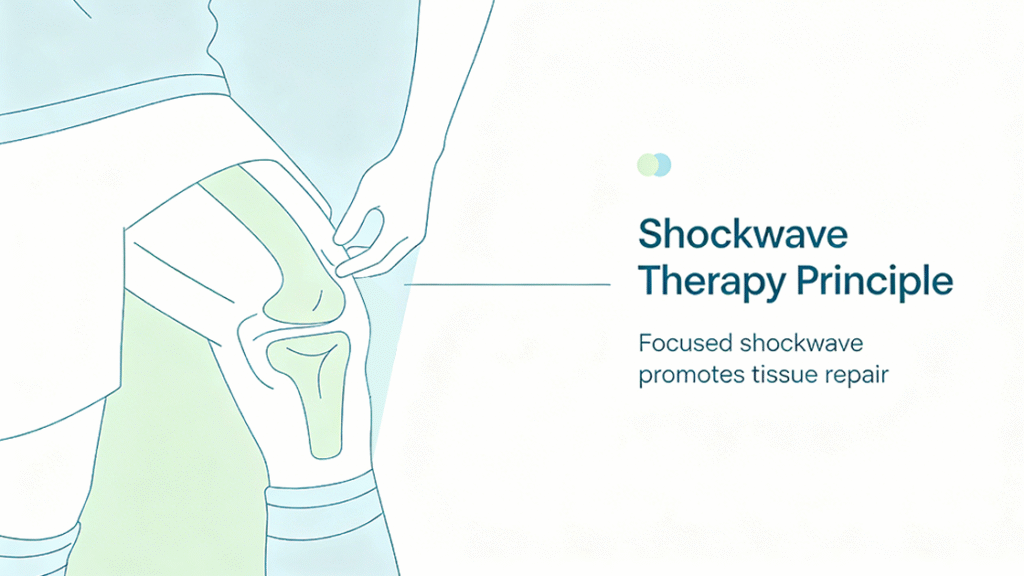
Shockwave therapy uses acoustic waves—high-energy sound waves—that are directed into the injured tissue. These waves carry energy to the painful spots deep in the groin, where the adductor tendons attach to the pubic bone. The mechanical stimulation triggers a biological response: increased blood flow, reduced pain signaling, and activation of the body’s own repair mechanisms. Unlike treatments that only address symptoms, shockwave therapy works to resolve the chronic tissue changes that keep groin pain coming back.
3.2. Reaching Deep Where the Problem Lives
Groin pain syndrome involves structures deep beneath the surface. The adductor muscles and their tendinous attachments sit in a challenging anatomical location, which makes them difficult to reach with superficial treatments like massage or topical creams. Shockwave energy, however, can penetrate to the necessary depth. Focused shockwave therapy, in particular, delivers energy precisely to deep, localized targets. This means the treatment reaches the exact area where chronic tendinopathy and tissue dysfunction are occurring, rather than just addressing surface-level discomfort.
3.3. Evidence That Shockwave Therapy Works for Soccer Players
Clinical research supports the use of shockwave therapy for groin pain syndrome in soccer players. One prospective study involving adult soccer players with confirmed groin pain found that combining focused shockwave therapy with structured rehabilitation was associated with meaningful improvements in both pain and function. Players who received shockwave therapy showed faster pain relief and were able to return to football significantly earlier than those who did not. No adverse events were reported in these studies, underscoring the safety of this approach when delivered appropriately. While shockwave therapy works best as part of a comprehensive rehabilitation plan, the evidence clearly shows it accelerates recovery.
3.4. Addressing Both Pain and Function
Shockwave therapy doesn‘t just temporarily numb the area—it promotes actual tissue healing. The acoustic waves stimulate the body to clear out degenerative tissue and lay down new, healthier collagen. Over the course of treatment, players typically experience not only less pain but also improved strength and range of motion. This is what makes shockwave therapy different from simply resting or taking painkillers. Instead of just waiting for the pain to go away, you are actively supporting your body’s ability to repair the underlying damage.
4. What Soccer Players Can Expect from Shockwave Therapy
4.1. A Quick, Non-Invasive Experience
Shockwave therapy is performed in a clinical setting, typically by a physical therapist, sports medicine physician, or chiropractor. You will lie down while the provider applies a gel to the affected area and uses a handheld applicator to deliver shockwaves to the groin. Each session lasts only a short time. Most players describe the sensation as a series of quick pulses or taps, not sharp pain. There are no needles, no incisions, and no anesthesia required. After the session, you can go about your day normally.
4.2. Typical Treatment Timeline
A full course of shockwave therapy for groin pain syndrome usually involves multiple sessions spaced out over several weeks. Most players receive treatment once or twice per week. The exact number depends on the severity of your condition and how you respond to the initial sessions. Some players notice improvement after just a few treatments, while others require a longer series. The key is consistency. Completing the full course of treatment as recommended gives the tissue adequate time to respond and repair.
4.3. Minimal Downtime Between Sessions
One of the biggest advantages of shockwave therapy for soccer players is the lack of extended downtime. You can often continue with modified training while undergoing treatment. Your provider may advise avoiding certain high-intensity activities immediately after a session, but you are not sidelined for weeks at a time. This means you can stay engaged with your team, maintain fitness, and work on other aspects of your game while your groin heals. For players in the middle of a season, this is a game-changer.
4.4. Integrating Shockwave with Your Rehab Program
Shockwave therapy is most effective when combined with a structured rehabilitation program. Your provider will likely recommend specific exercises to strengthen the adductors, stabilize the core, and improve hip mobility. The shockwave sessions jumpstart the healing process, while the exercises build the long-term resilience needed to prevent recurrence. This integrated approach addresses both the immediate pain and the underlying weaknesses that made you vulnerable to groin pain in the first place. Players who commit to the full plan typically see the best and longest-lasting results.
FAQ
How many shockwave therapy sessions will I need for groin pain syndrome?
Most soccer players need a series of sessions over several weeks. Your provider will tailor the number based on your specific condition and response.
Is shockwave therapy painful?
Most players describe a tapping or pulsing sensation. There is no sharp pain, and no anesthesia is required.
Can I keep training while receiving shockwave therapy?
Yes, you can usually continue modified training. Your provider will advise on any temporary activity restrictions.
How soon will I feel relief after starting shockwave therapy?
Some players notice improvement after just a few sessions, while others require the full course of treatment before feeling significant change.
Conclusion
Groin pain syndrome doesn’t have to keep you off the pitch or ruin your season. Shockwave therapy offers a non-invasive, drug-free way to target chronic groin pain at its source—deep in the adductor tendons where the problem actually lives. By combining shockwave sessions with a smart rehabilitation program, you can accelerate healing, reduce pain, and get back to playing the game you love faster than you thought possible. Surgery isn’t required. Months on the sidelines aren‘t necessary. What you need is a solution that works with your body’s own repair systems. Shockwave therapy delivers exactly that. Get back on the pitch. Play without the ache. And stay there.
References
Shockwave Machines – Indications for Shockwave Therapy:
https://www.shockwavemachines.com/indications
Santilli G, et al. Integrating Focused Shockwave Therapy into Rehabilitation for Groin Pain Syndrome: A Prospective Study in Soccer Players. Life. 2026;16(3):509.
https://pubmed.ncbi.nlm.nih.gov/41901027/
Schöberl M, et al. Non-surgical treatment of pubic overload and groin pain in amateur football players: a prospective double-blinded randomised controlled study. 2017.
https://pubmed.ncbi.nlm.nih.gov/28093636/
Academia. Extracorporeal Shockwave Therapy Augments Holmich Protocol in Chronic Adductor-Related Groin Pain: A Case Study.
https://www.academia.edu/144561182/
JCDR. Groin Pain in Football Players: A Systematic Review. 2025;19(9):180.
UniSa IRIS. Seasonal Groin Pain Prevalence in Team Sport Athletes.