

Introduction
Tennis is a sport that requires repeated swinging motions, quick changes in direction, and precise coordination between the upper and lower body. While playing tennis helps improve physical fitness and athletic ability, repetitive movements can also place continuous stress on muscles, tendons, and joints. Many tennis players experience discomfort in areas such as the shoulder, wrist, forearm, and elbow due to repeated loading and insufficient recovery between training sessions. Shockwave Therapy (Extracorporeal Shockwave Therapy, ESWT) has gained attention in sports rehabilitation because it uses acoustic wave energy to stimulate targeted tissues and support the body’s natural recovery process. When combined with proper training, rehabilitation exercises, and movement adjustments, Shockwave Therapy may help tennis players manage discomfort and maintain better mobility during their active lifestyles.
1. Understanding Overuse Injuries in Tennis Players
Tennis involves thousands of repeated movements during training and matches. Every serve, forehand, and backhand requires coordinated activity between muscles, tendons, and joints. When these tissues experience repeated stress over time without enough recovery, players may develop discomfort that affects their performance and daily activities.
1.1 Common Shoulder and Wrist Problems in Tennis
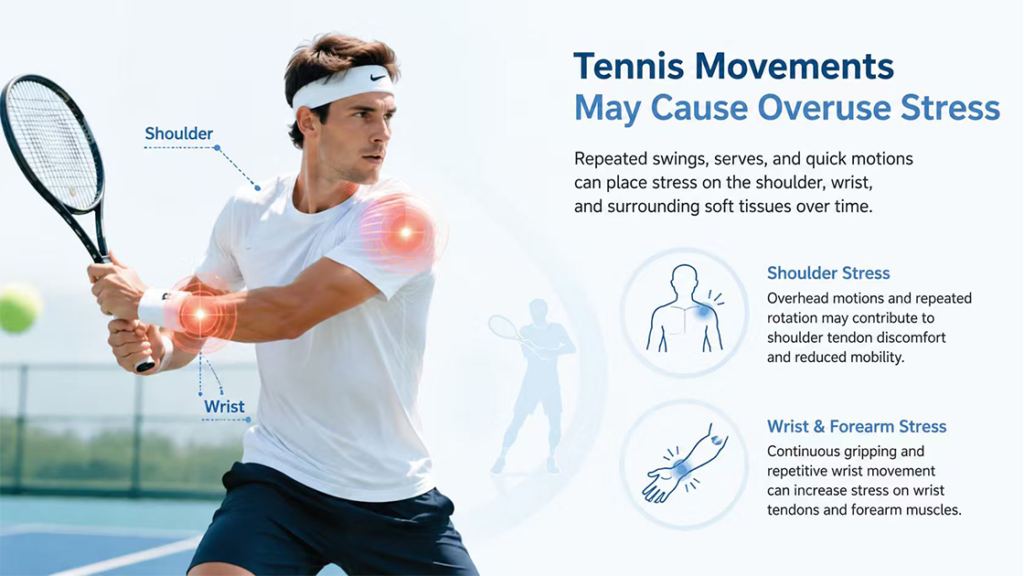
Although tennis elbow is one of the most recognized tennis-related conditions, shoulder and wrist problems are also common among players. The shoulder plays an important role in serving and overhead strokes, while the wrist controls racket movement and absorbs impact during ball contact.
Repeated shoulder rotation may contribute to shoulder tendon discomfort, stiffness, and reduced movement comfort. At the same time, continuous gripping and wrist movement can increase stress around the forearm and wrist tendons. These issues are especially common among players who practice frequently or increase training intensity without allowing enough recovery time.
1.2 Why Repetitive Tennis Movements Affect Soft Tissues
Tennis requires repeated mechanical loading on specific body structures. During a match, players continuously perform similar movements, including racket swings, rapid acceleration, and sudden stops. These actions require the muscles and tendons to repeatedly produce and absorb force.
From a sports biomechanics perspective, soft tissues need adequate recovery time to adapt to physical demands. When training volume increases too quickly, players may experience temporary soreness, stiffness, or reduced flexibility. Understanding these movement patterns can help players choose more appropriate recovery strategies.
1.3 The Importance of Recovery for Tennis Performance
Recovery plays an important role in maintaining long-term tennis participation. A balanced approach that combines proper warm-up routines, strength training, flexibility exercises, and recovery periods can help support healthier movement patterns.
For players who continue experiencing sports-related discomfort, Shockwave Therapy may serve as a supportive option within a comprehensive rehabilitation plan. It works alongside other approaches rather than replacing proper exercise and professional guidance.
2. How Shockwave Therapy Supports Tennis Injury Recovery
Shockwave Therapy uses controlled acoustic waves to deliver mechanical energy into targeted tissue areas. This technology has become increasingly recognized in sports rehabilitation because it may support tissue response, circulation, and recovery processes.
2.1 The Science Behind Shockwave Therapy
Shockwave Therapy works by applying focused or radial acoustic waves to specific areas of the body. These mechanical waves interact with tissues and may encourage biological responses that support recovery.
The treatment process may help promote local circulation, stimulate cellular activity, and create a supportive environment for tissue repair. Unlike approaches that only focus on short-term comfort, Shockwave Therapy aims to work with the body’s natural recovery mechanisms.
2.2 Supporting Shoulder Recovery in Tennis Players
The shoulder experiences significant demands during tennis, especially during serves, overhead shots, and powerful swings. These movements require repeated rotation and stability, which may place stress on the muscles and tendons around the shoulder joint.
Shockwave Therapy may support shoulder recovery by improving the local tissue environment and helping reduce discomfort associated with physical stress. When combined with targeted exercises that improve shoulder strength and flexibility, it can become part of a complete recovery strategy.
2.3 Supporting Wrist and Forearm Comfort
The wrist and forearm are essential for controlling racket direction and generating accurate shots. Continuous gripping, repeated swings, and impact forces can contribute to wrist tendon discomfort and forearm fatigue.
Shockwave Therapy may provide supportive care by delivering mechanical stimulation to affected areas and helping improve tissue conditions. This approach can complement stretching, strengthening exercises, and technique adjustments.
3. Shockwave Therapy for Common Tennis-Related Conditions
Different tennis movements affect different areas of the body. Understanding how Shockwave Therapy may support specific concerns allows players to explore suitable recovery options based on their individual needs.
3.1 Supporting Rotator Cuff Tendon Discomfort
The rotator cuff consists of muscles and tendons that help stabilize and control shoulder movement. Because tennis involves frequent overhead motions and powerful swings, these structures may experience repeated stress.
Players with shoulder tendon discomfort may notice stiffness, reduced range of motion, or difficulty performing certain movements. Shockwave Therapy may help support the recovery environment around the shoulder while working together with rehabilitation exercises designed to improve mobility and strength.
3.2 Supporting Wrist Tendon Issues from Repetitive Motion
Wrist movement is a key part of tennis technique. Players rely on wrist control during serves, backhands, and racket adjustments. Over time, repetitive movements may contribute to discomfort and reduced grip comfort.
Shockwave Therapy may support wrist recovery by providing targeted mechanical stimulation and encouraging a healthier tissue response. Combining therapy with proper training adjustments may help players maintain better movement quality.
3.3 Managing Muscle Tightness During Tennis Training
Frequent tennis training can lead to muscle tension, especially in the forearm, shoulder, and upper back areas. Muscle tightness may affect flexibility and change normal movement patterns.
Shockwave Therapy may help support muscle recovery by improving tissue circulation and promoting relaxation in stressed areas. It can be combined with mobility exercises and recovery techniques to support overall performance.
4. Benefits of Shockwave Therapy in Tennis Rehabilitation
Modern sports rehabilitation focuses on helping athletes maintain activity while managing physical stress. Shockwave Therapy provides a non-invasive approach that can complement traditional recovery methods for tennis players.
4.1 A Non-Invasive Approach for Active Players
Many tennis players prefer recovery options that allow them to continue daily activities without invasive procedures. It can be integrated into rehabilitation programs designed for both recreational players and competitive athletes.
By supporting tissue recovery and helping manage discomfort, it may provide an additional option for players looking to maintain their active routines.
4.2 Supporting Mobility and Athletic Performance
Movement quality is essential in tennis. Shoulder stiffness, wrist discomfort, or muscle tension may influence swing mechanics and overall confidence during play.
It may help support comfortable movement by improving the condition of stressed tissues and complementing exercises that focus on flexibility, strength, and coordination.
4.3 Combining Shockwave Therapy with Training Strategies
It works most effectively as part of a complete recovery plan. Proper tennis technique, conditioning exercises, flexibility training, and sufficient recovery time all contribute to maintaining physical health.
By combining these approaches, players can better manage physical demands and support long-term participation in tennis.
5. Choosing Shockwave Therapy for Tennis Recovery
As more people participate in tennis at different skill levels, interest in effective recovery solutions continues to grow. Understanding available rehabilitation technologies allows players to make informed choices about managing sports-related discomfort.
5.1 Who May Consider Shockwave Therapy?
Shockwave Therapy may be considered by tennis players who experience ongoing discomfort related to repetitive movement, soft tissue stress, or reduced mobility.
It may be suitable for recreational players, competitive athletes, and individuals returning to tennis after periods of reduced activity. A healthcare professional can provide guidance on whether Shockwave Therapy fits an individual recovery plan.
5.2 Maintaining Long-Term Tennis Health
Long-term tennis performance depends on consistent attention to movement quality, conditioning, and recovery habits. Players can support their physical condition through proper technique, balanced training, and injury prevention strategies.
Shockwave Therapy can serve as a supportive tool alongside these practices, helping tennis players maintain mobility and continue enjoying the sport.
FAQ
What is Shockwave Therapy for tennis injuries?
Shockwave Therapy uses acoustic waves to support tissue recovery and help manage discomfort related to sports-related soft tissue stress.
Can Shockwave Therapy help tennis shoulder problems?
It may support recovery from shoulder discomfort by improving tissue stimulation and complementing rehabilitation exercises.
Is Shockwave Therapy only for professional tennis players?
No. Recreational players and active individuals may also consider it as part of a recovery plan.
How does Shockwave Therapy work?
It delivers controlled acoustic waves into targeted areas to support circulation, tissue response, and recovery processes.
Can Shockwave Therapy replace exercise therapy?
No. It works best when combined with proper rehabilitation exercises and professional guidance.
Conclusion
Tennis requires repeated movements that place continuous demands on the shoulders, wrists, and surrounding soft tissues. Over time, these repetitive actions may contribute to discomfort that affects movement and participation in the sport. Shockwave Therapy provides a non-invasive supportive approach that may help tennis players manage soft tissue stress, improve comfort, and support recovery when combined with proper rehabilitation strategies. By integrating advanced recovery methods with effective training habits and injury prevention techniques, tennis players can better maintain mobility and continue enjoying the sport.
References
Extracorporeal Shock Wave Therapy in Musculoskeletal Disorders: A Review of Current Evidence
https://pubmed.ncbi.nlm.nih.gov/30807945
Extracorporeal Shockwave Therapy in the Treatment of Tendinopathies
https://pubmed.ncbi.nlm.nih.gov/30302157
The Role of Shockwave Therapy in Sports Medicine and Rehabilitation
https://pubmed.ncbi.nlm.nih.gov/32244838
Clinical Applications of Extracorporeal Shockwave Therapy in Tendon Disorders
https://www.ncbi.nlm.nih.gov/pmc/articles/PMC6352673
Current Concepts in the Management of Tennis-Related Musculoskeletal Injuries